
How to Adjust Product Plans for Market Shifts
How to Adjust Product Plans for Market Shifts
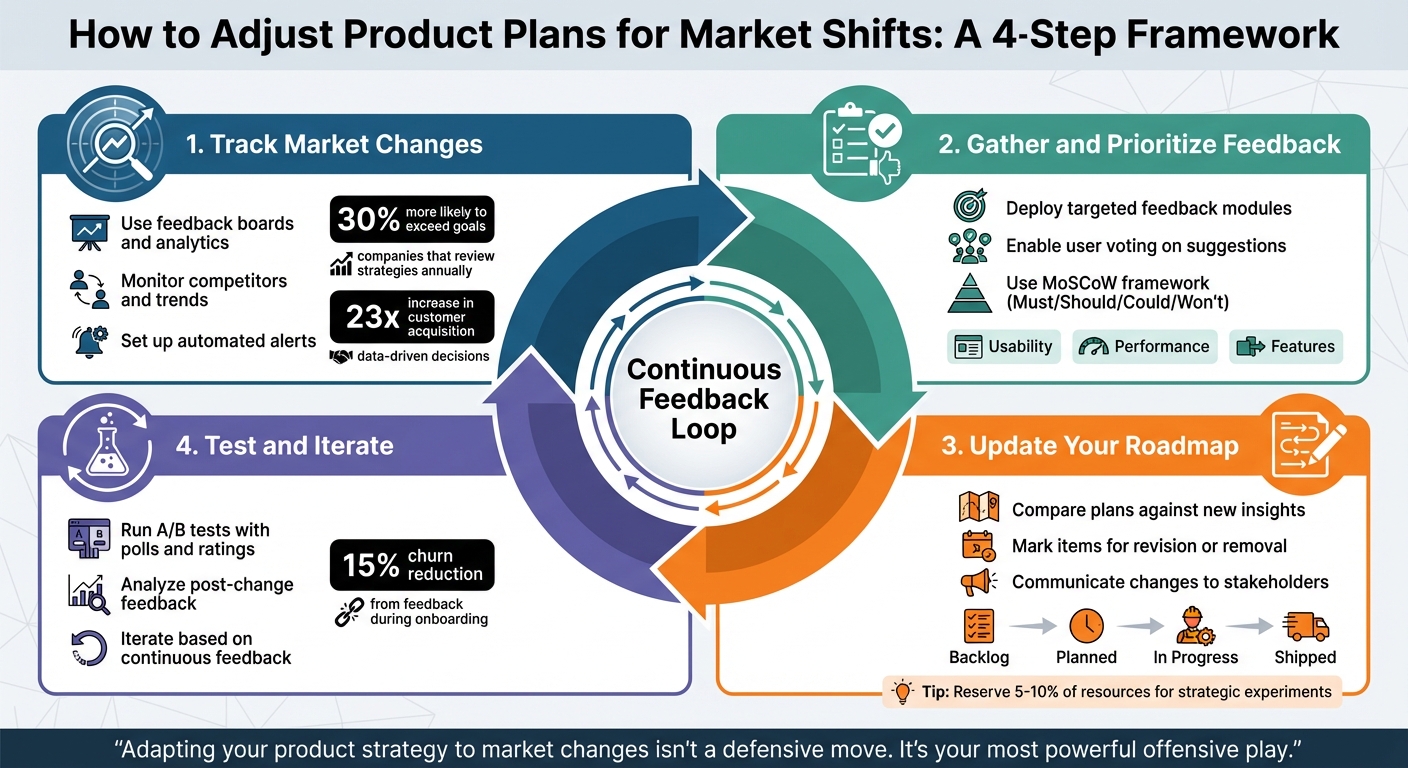
When markets shift, your product plans must evolve to stay relevant. This article outlines a four-step process to help businesses respond effectively to changing customer needs, emerging technologies, and competitive pressures. Here's the approach:
- Track Market Changes: Use tools like feedback boards, analytics, and alerts to identify trends early.
- Gather and Prioritize Feedback: Collect user input through targeted surveys and voting systems to understand what matters most.
- Update Your Roadmap: Reassess priorities, revise outdated plans, and communicate changes clearly to stakeholders.
- Test and Iterate: Validate updates with small-scale tests, analyze feedback, and refine your strategy continuously.
Product Strategy: How to Predict Market Shifts & Align Customer Problems with Tech Waves
Step 1: Identify and Monitor Market Changes
Adjusting your product plans starts with having a system in place to spot early market shifts. Companies that review and adapt their strategies annually are 30% more likely to exceed their goals [3]. The key to staying ahead often lies in monitoring the right signals.
Don't limit yourself to internal metrics. Keep an eye on competitors, broader market trends, and customer feedback. Why? Because decisions driven by data can increase customer acquisition and retention rates by 23 times [3].
To make this happen, you need tools that can capture direct user insights.
Use Feedback Boards and Modules
Tools like Modu's modules are designed to continuously gather user feedback. For example, the Suggestions module allows users to submit and vote on ideas, helping you identify emerging needs. When multiple users highlight the same pain points or request similar features, it’s a clear sign that market expectations are shifting.
Rating modules are another useful tool. They can help you track satisfaction trends over time. A steady decline in NPS scores or satisfaction ratings might signal that your product is no longer meeting user needs. Meanwhile, text modules capture open-ended responses, giving you valuable context about user concerns. As product expert Lance puts it:
"All of the answers to what you should build next are outside of this building" [4].
Track Trends with Analytics
Analytics turn raw feedback into actionable insights. Modu’s AI clustering, for instance, automatically groups similar themes, so you don’t have to sift through every comment manually. This makes it easier to spot trends gaining momentum.
You can also set up automated alerts with tools like Google Alerts to track industry developments and competitor activity [2]. Combine these external insights with your internal feedback to validate trends. For instance, if both industry news and your suggestion board show a spike in mentions of "AI features", it’s a strong indicator of a market shift worth exploring.
These insights help guide updates to your product roadmap. Instead of focusing on lagging indicators like revenue drops, prioritize leading signals such as feature adoption rates and emerging customer requests [5].
Step 2: Collect and Prioritize User Feedback
Once you've identified market shifts, the next step is to gather user feedback in a structured way. By organizing this input into themes like usability, performance, and feature requests, you can turn raw insights into actionable steps. Here's how to effectively collect feedback, rank its importance, and align it with your product roadmap.
Use Targeted Feedback Modules
Strategically place feedback modules where users are most likely to engage. Text-based modules work well for capturing open-ended responses about issues like bugs, feature suggestions, or survey questions. Since these submissions are only visible to admins, users may feel more at ease sharing candid feedback without worrying about public visibility.
For broader idea-sharing, suggestion modules let users submit ideas and vote on others' submissions. This creates a transparent system where the most popular requests naturally rise to the top. For maximum effectiveness, combine private text modules and public suggestion boards at key touchpoints, such as dashboards or documentation pages when users reach 70% scroll depth.
Rank Feedback with User Voting
Voting is a simple yet powerful way to prioritize feedback. By allowing users to upvote suggestions, you can quickly identify what matters most to them. This approach ensures you're addressing real user priorities rather than relying on internal assumptions.
When ranking feedback, consider both its potential impact and feasibility. Pay attention to how often a request appears, how it might improve the user experience, and any technical limitations. Frameworks like MoSCoW can help you categorize feedback into "Must have", "Should have", "Could have", and "Won't have", keeping your team focused on changes that deliver the most value, especially during times of market uncertainty.
Organize Feedback with Roadmap Tools
Once you've gathered and prioritized feedback, the next step is to visualize your plan using a product roadmap. Tools like Modu's roadmap feature can help you organize feedback into four clear categories: Backlog (ideas under review), Planned (confirmed for future development), In Progress (currently being worked on), and Shipped (completed and released). This transparency builds trust with your users.
Roadmap tools also allow you to include details like titles, descriptions, and optional ETA labels (e.g., "Q1 2026" or "Coming Soon") for each item. You can manually add items or sync them directly from approved suggestions. By showing users how their feedback shapes your product updates, you close the loop and maintain their engagement while staying aligned with market needs.
Step 3: Review and Update Your Product Roadmap
Once you've gathered and prioritized feedback, the next step is to reassess your roadmap to align it with the latest market conditions. This involves taking a hard look at what's still relevant, what needs tweaking, and what should be scrapped altogether. The aim is to keep your product plans in sync with both user needs and business goals.
Compare Current Plans Against New Insights
Begin by revisiting each item on your roadmap to see if recent trends or data challenge your earlier assumptions. Using the MoSCoW method, re-prioritize features based on their urgency and importance in the current market. Tools like an Impact/Urgency Matrix can help you visualize which tasks should take precedence, especially during periods of uncertainty.
Top-performing teams often reserve 5–10% of their engineering resources for strategic experiments. These small-scale tests help validate new ideas before committing to significant roadmap changes. Conducting "pre-mortems" - where you ask, "If this initiative fails, why did it happen?" - can also help identify potential pitfalls early on, saving time and resources later.
Pay close attention to internal metrics like sales performance, churn rates, and lead generation. If these indicators are trending downward despite positive user feedback, it might be a sign that some roadmap items need to be re-evaluated or removed entirely.
Once you've identified priority shifts, update your roadmap accordingly by marking items for revision or removal.
Mark Items for Revision or Removal
When you spot misalignments between your roadmap and current market realities, tools like Jira, Trello, or Linear can simplify the updating process. Use these platforms to tie revisions directly to specific customer feedback or market signals, ensuring your engineering team understands the "why" behind each change.
Modu's roadmap module makes it easy to reorganize tasks visually. Move features from "Planned" to "Backlog" if they no longer address pressing needs, or remove them outright if they conflict with your updated strategy. For features that remain relevant but require changes, update their descriptions and timelines (e.g., "Q2 2026" or "Under Review") to reflect the new direction. This kind of clear, visual organization helps your team stay on the same page as priorities evolve.
Communicate Changes to Stakeholders
Transparency is key when rolling out roadmap updates. Modu's changelog feature allows you to share updates with both your team and your users. Use this tool to write straightforward update notes that explain the reasoning behind changes, whether they're driven by customer needs or competitive shifts.
Establish a regular rhythm for communicating updates. Bi-weekly meetings can be a good way to discuss roadmap changes internally, while email, Slack, and the public changelog ensure everyone stays informed. Present these updates as strategic adjustments rather than missteps - frame them as opportunities to learn and grow in response to new data.
Before sharing updates externally, make sure your leadership team is aligned on the messaging. This prevents any mixed signals that could undermine confidence. Once internal alignment is achieved, loop in your sales, support, and customer success teams so they can manage user expectations effectively and maintain trust.
Step 4: Test Changes and Collect Ongoing Feedback
Now that your updated roadmap is ready, it's time to put it to the test. This step is all about validating changes through targeted experiments and gathering feedback to keep your product aligned with user needs. Think of it as turning your static plan into a dynamic, ever-evolving strategy.
Run A/B Tests with Polls and Ratings
Before diving into a full-scale rollout, start small. Test major updates with a limited group of users to minimize risk and gather early insights. Use tools like multiple-choice polls to figure out which messaging or features strike the right chord. Simple rating modules - like a 1-5 scale - are perfect for capturing immediate user impressions. For example, one SaaS company managed to cut churn by 15% by adding feedback forms during onboarding and after key feature trials [6].
Start with a pilot group, around 10% of your user base, to see how the changes perform. If the feedback and metrics (like engagement or satisfaction scores) look promising, you can confidently roll out the updates to a broader audience.
Analyze Post-Change Feedback
Once the changes are live, it’s time to dig into the results. Use tools like Modu's analytics to track user ratings and spot trends in sentiment. Pair this quantitative data with qualitative insights from open-ended feedback forms or text submissions. Support tickets can also provide valuable clues about whether the updates addressed user pain points.
To make sense of the data, group feedback into themes - like usability issues, performance concerns, or feature requests. Prioritize these themes based on how frequently they come up and their potential impact. Keep an eye on your Net Promoter Score (NPS) to see how the changes affect customer loyalty. This blend of data gives you a clear direction for future improvements.
Iterate Based on Continuous Feedback
The work doesn’t stop after the first round of feedback. Build a regular review process into your workflow to keep refining your product. Schedule routine team meetings to analyze feedback trends and turn them into actionable design sprints or roadmap updates. Tools like Modu's suggestion boards can help by letting users vote on ideas, giving you a real-time sense of what matters most to them.
For deeper insights, use targeted surveys to explore specific issues highlighted in your analytics. Combining voting results with detailed user responses gives you a well-rounded understanding of what’s working and where there’s room for improvement.
Flexibility is key - your product strategy should adapt as user needs evolve [1]. And don’t forget to close the feedback loop. Let your users know how their input has influenced changes. This transparency builds trust and keeps them engaged in shaping your product’s future.
Conclusion
Now that we’ve gone through the key steps, it’s time to put them into action. Adjusting product plans to meet market shifts isn’t something you do once and forget - it’s an ongoing process. The four steps we discussed - monitoring market trends, gathering and prioritizing user feedback, updating your roadmap, and testing changes - create a practical system for staying ahead. Together, they form a continuous feedback loop that keeps your product aligned with what users and the market demand.
As Basis puts it, "Adapting your product strategy to market changes isn't a defensive move. It's your most powerful offensive play." [5] Companies that succeed are the ones that continuously adapt, using real user data to guide their decisions.
Tools like Modu make this process easier by centralizing feedback from various sources. Instead of struggling with spreadsheets, scattered user comments, or endless support tickets, you can turn that feedback into clear, actionable insights that shape your product decisions.
Remember, a static roadmap won’t cut it. The companies that excel aren’t necessarily those with flawless initial plans - they’re the ones that learn and adjust faster. By incorporating feedback into your workflow and using tools to keep it organized, you can identify changes early and act before they turn into major challenges.
Start small - try one feedback module and build a habit of iterating based on insights. Let your users know how their input influenced changes to strengthen their trust and engagement. By listening, analyzing, and acting quickly, you position your product to thrive in a constantly shifting market.
FAQs
Which market signals should I watch first?
Focus on how quickly customers are adopting your product, how engaged they are with it, and any noticeable changes in their behavior - these metrics can give you a clear picture of your product’s fit in the market and where adjustments might be needed. Keep an eye on external influences too, such as changing user expectations or new technologies shaking up the industry. If you notice growth or engagement starting to plateau, especially alongside broader market changes, it might be time to rethink your product strategy.
How do I prioritize feedback when users disagree?
When users disagree, it’s essential to focus on feedback that aligns with your overall strategy. Start by spotting patterns - like low adoption rates or declining engagement - that might indicate bigger issues. Dig into the feedback to uncover recurring themes or major pain points that stand out. A structured approach can help here: try categorizing feedback based on its impact and feasibility. This way, you can prioritize suggestions that not only address key challenges but also push your goals forward while staying in tune with market changes.
How often should I change my product roadmap?
The timing for updating your product roadmap hinges on market dynamics and what your customers are asking for. It’s a good idea to review it every few months or whenever major changes arise. This allows you to stay adaptable and keep the roadmap relevant. Whether it’s responding to user feedback, new tech developments, or market shifts, making adjustments ensures your product stays in tune with both current needs and upcoming opportunities.