
AI in Feedback Analysis for Product Iteration
AI in Feedback Analysis for Product Iteration
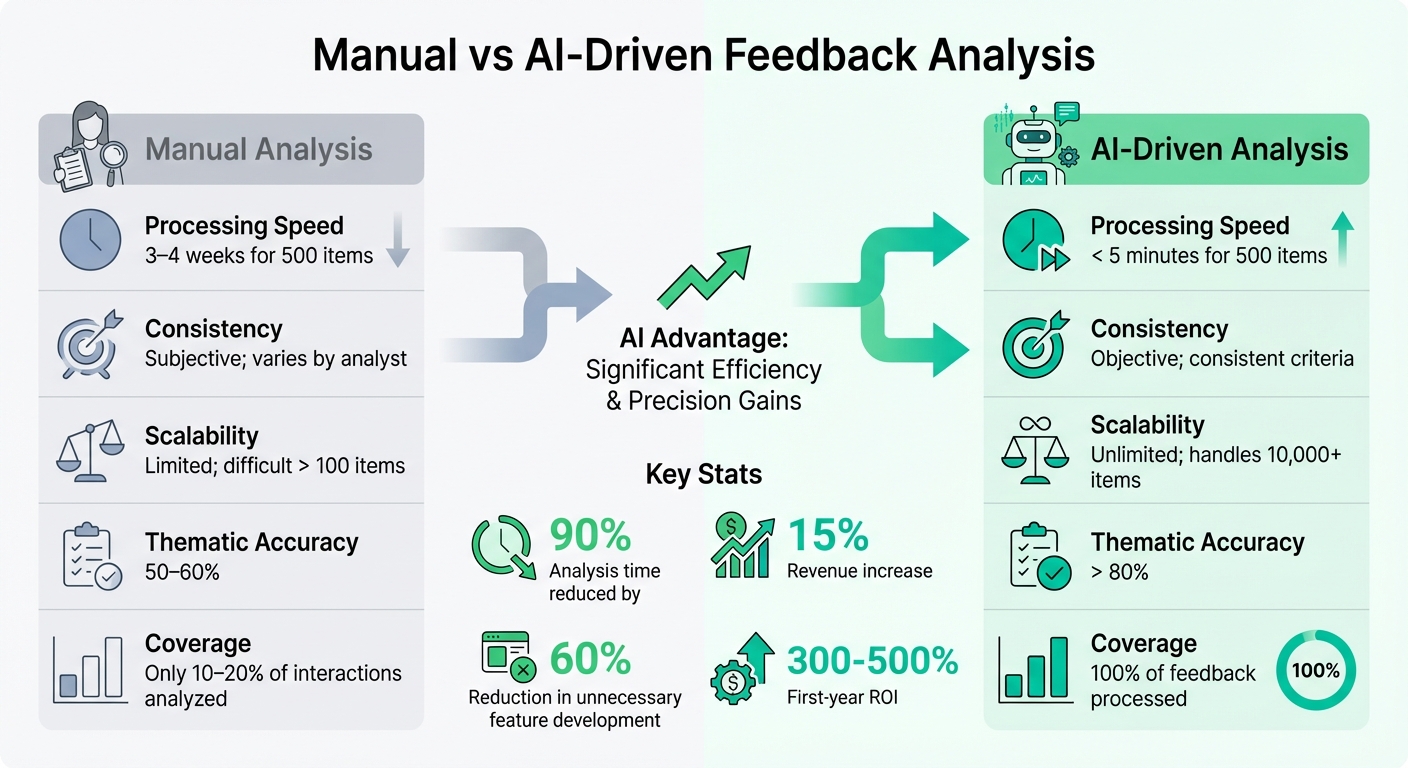
AI is transforming how companies analyze feedback, making the process faster, more accurate, and scalable. Instead of manually sifting through thousands of user comments, AI tools can process data from multiple channels, identify trends, and deliver actionable insights in minutes. Here's why this matters:
- Manual feedback analysis is slow and incomplete: Teams often analyze only 10–20% of interactions, missing critical insights.
- AI covers 100% of feedback: It processes data from sources like app reviews, emails, and social media, tagging multiple themes in a single comment.
- Faster decisions: AI reduces analysis time by up to 90%, enabling quicker product updates.
For example, companies using AI have seen a 15% revenue boost and reduced unnecessary feature development by 60%. Tools like sentiment analysis and clustering ensure feedback is organized and actionable, while human oversight ensures accuracy. To get started, centralize your data, choose AI tools that integrate with your systems, and balance automation with human judgment.
Analyze product feedback at scale: AI demo
How AI Improves Feedback Collection and Analysis
Collecting Data from Multiple Channels
AI simplifies feedback collection by automatically gathering data from various sources such as Zendesk, app reviews, social media, CRM systems, Slack, and email [1][2]. This eliminates the need for manual data entry and ensures real-time monitoring. For example, AI can instantly flag anomalies, like a 280% spike in checkout errors, as they happen [1].
Unlike manual reviews, which often cover only a fraction of interactions, AI processes nearly 100% of customer feedback [3]. It also excels at multi-intent tagging, breaking down a single comment into multiple themes. If a user compliments your design but criticizes the checkout process, AI captures both sentiments [5]. This comprehensive data collection sets the stage for more advanced analysis.
Natural Language Processing and Sentiment Analysis
Natural Language Processing (NLP) helps AI interpret unstructured text by analyzing its context, tone, and intent. Sentiment analysis takes this further, categorizing feedback as positive, negative, or neutral. Modern AI even assigns sentiment scores to specific themes [5].
This level of detail is crucial. Traditional sentiment analysis often averages conflicting opinions, like enjoying a mobile app's design but disliking its pricing, into a neutral score - masking critical insights. By training AI models with seed tags tailored to product areas like "Mobile UX" or "Pricing Confusion", businesses can ensure the analysis aligns with their needs [5].
AI Clustering for Organized Insights
AI doesn’t just analyze feedback - it organizes it. Using unsupervised machine learning techniques like LDA or NMF, AI groups similar comments into actionable themes, such as "Performance Issues" or "Feature Requests." It can also identify patterns, such as frequent mentions of "pricing confusion" alongside "support delays" [5].
| Feature | Manual Analysis | AI‑Driven Analysis |
|---|---|---|
| Processing Speed | 3–4 weeks for 500 items | < 5 minutes for 500 items |
| Consistency | Subjective; varies by analyst | Objective; consistent criteria |
| Scalability | Limited; difficult > 100 items | Unlimited; handles 10,000+ items |
| Thematic Accuracy | 50–60% | > 80% |
This streamlined approach not only organizes feedback but also highlights the insights that matter most for your product roadmap. For example, Modu’s Growth plan integrates AI clustering to automatically group feedback from various channels into actionable themes. These insights can then be seamlessly incorporated into your product development process, ensuring every piece of feedback contributes to meaningful improvements.
Real Applications and Results
Measured Impact on Product Iteration
AI-powered feedback analysis has proven to be a game-changer for businesses. Companies leveraging these tools have reported a 15% increase in revenue while reducing wasted efforts on unnecessary feature development by 60% - all thanks to better alignment with user needs[1][3]. On average, organizations implementing AI feedback tools see a first-year ROI ranging from 300% to 500%[4].
Operational improvements are also striking. For instance, Cynet achieved a 14-point boost in customer satisfaction scores and cut ticket volumes by 47% through AI-driven workflow automation[3]. Additionally, conversational AI surveys are outperforming traditional static surveys, delivering 40% higher response rates[3].
Speed is another standout benefit. Teams have slashed analysis time by an impressive 90%, enabling product managers to resolve issues and prioritize features in just hours - compared to the 3–4 weeks required for manual analysis[1][4]. These results highlight how AI drives both operational efficiency and financial gains.
Examples from Different Industries
AI's influence on feedback analysis spans across industries, showcasing its adaptability and effectiveness.
In enterprise software, SAP SE conducted a UX measurement project between January 2022 and November 2023, analyzing 8,757 user comments across 40 products. Using an SBERT-based classification model, they improved feedback categorization accuracy by 24.58%, achieving an F1 score of 0.82 for handling complex issues like "Licensing"[5].
In transportation, Greyhound implemented AI to consolidate feedback from diverse sources, including post-ride surveys, station reports, and driver evaluations. For example, if multiple passengers at a station flagged cleanliness concerns, managers received same-day alerts, allowing for immediate action. This system processes feedback from various touchpoints, uncovering patterns that might go unnoticed with manual reviews.
In the B2B SaaS sector, Fivetran offers another compelling example. Under the guidance of Director of Product Management Shiva Mogili in January 2026, the company deployed an AI system that integrates data from Zendesk, Jira, and Salesforce. This system generates automated "T-shirt sizing" estimates and feasibility reports for feature requests within one hour of submission. This rapid turnaround empowers product teams to make informed decisions in hours instead of weeks, speeding up product iteration cycles.
These examples demonstrate how AI tools can extract actionable insights, improve efficiency, and enable faster, smarter decision-making across industries.
How to Add AI to Your Feedback System
Preparing and Organizing Your Data
Before introducing AI into your feedback system, it’s essential to get your data in order. 73% of product managers face major delays due to manual feedback analysis [1], and fragmented data only makes the process harder.
Start by centralizing all your feedback. Pull data from sources like support tickets (Zendesk, Intercom), app store reviews, social media mentions, CRM notes (Salesforce, HubSpot), and survey responses into one unified repository. Each piece of feedback should be structured as a row, with columns for metadata like the date, platform, user plan, product version, and region. This context helps AI uncover patterns and trends more effectively [5].
Next, define your goals. Are you looking to figure out why activation rates are dropping? Or maybe you want to pinpoint the most-requested features? Clear questions like these help guide how AI tags and filters your data [5]. Don’t forget to anonymize sensitive details - mask or remove personally identifiable information before processing [5].
You can also give your AI a head start by applying "seed tags" for known issues, like "Pricing Confusion." This helps improve categorization accuracy right from the beginning [5].
Selecting the Right AI Tools
Once your data is organized, the next step is choosing the right AI tools. Focus on tools that integrate seamlessly with your current systems - like Jira, Slack, or Salesforce - rather than just going for the cheapest option. Switching between systems can hurt productivity [4]. Look for features like multi-channel data ingestion, real-time analysis, sentiment detection, and impact scoring based on customer value [4].
Be cautious of tools that need extensive manual training or charge per "AI credit", as these costs can add up quickly [1].
"Real-time feedback analysis is the new competitive advantage. Companies that can adapt to customer signals within days rather than quarters will dominate their markets."
Combining AI with Human Judgment
Even with AI in place, human oversight is essential to ensure the insights are accurate and actionable. While AI tools can achieve 90–95% accuracy in theme detection and sentiment analysis [4], they still need human input for more nuanced decisions.
Set confidence thresholds to automatically flag uncertain feedback (e.g., below 70% confidence) for manual review [5]. Regularly review misclassifications - monthly check-ins work well - to refine the AI’s performance and build trust in the system [5].
When sharing AI-generated insights with stakeholders, pair trends with real user quotes. This gives the data context and makes it easier to gain buy-in [5]. A phased rollout can also help: start with one feedback source, run AI analysis alongside your current manual process, compare the results, and then expand from there [1].
Tools like Modu can simplify this process. They combine AI-driven clustering with manual review options, letting AI organize feedback into themes while your team decides which insights should take priority. This balance ensures that AI insights directly drive product decisions, blending powerful automation with human expertise for faster, smarter outcomes.
Ethics in AI Feedback Analysis
Ethical considerations play a critical role in AI feedback analysis, complementing its operational advantages. Addressing issues like bias and privacy is essential to maintain trust and fairness.
Reducing Bias in AI Models
AI systems can unintentionally amplify biases by as much as 40% if their training data lacks diversity [6]. Regular calibration reviews are a practical way to spot and address biased patterns. For example, if an AI system consistently labels feedback from free-tier users as "low priority" while marking enterprise-level requests as "urgent", it could signal algorithmic bias. Validating these trends through direct customer conversations helps ensure the patterns genuinely reflect user needs.
Another red flag is when AI systems fail to explain their reasoning. If feedback is categorized as a "feature request" or "bug report" without clear justification, the system lacks the transparency needed to build trust [1]. To counter this, opt for tools that provide clear, understandable explanations for their categorization processes.
Addressing bias is only part of the equation - protecting user data is equally important.
Protecting Data Privacy and Security
Before processing user feedback, it's essential to remove all personally identifiable information (PII). This includes masking details like names, email addresses, and phone numbers to protect user identities [5]. Ensuring compliance with regulations such as GDPR minimizes legal risks and fosters trust [7][9].
Incorporating governance early in the process is another key step. For instance, implementing human-in-the-loop checkpoints allows team members to review AI-generated insights before they influence product decisions [8][10].
| AI Method | Function | Ethical/Trust Benefit |
|---|---|---|
| PII Masking | Removes sensitive data | Protects user privacy and security [5] |
| Transparent Rationale | Explains tag logic | Builds reviewer and user trust in AI results [5] |
Transparency is the cornerstone of trust. When users see that their feedback is handled fairly and securely - and that their data is safeguarded - they are more likely to share openly. This openness ensures that feedback continues to drive meaningful improvements in products.
Conclusion
AI-powered feedback analysis has reshaped the way teams refine their products. Instead of spending weeks manually sifting through support tickets, surveys, or feature requests, teams can now process thousands of inputs in just hours. This approach uncovers patterns, tracks sentiment changes, and pinpoints emerging priorities - insights that often stay buried in disconnected data sources.
The impact is hard to ignore. Many product managers report that manual workflows significantly slow decision-making. Companies like Motel Rocks and Catapult have shown how AI can deliver tangible results, such as cutting support ticket volume and first reply times by up to 50%.
The next step? Integration. You don’t need to overhaul your entire workflow to see results. Start small - focus on a single high-volume channel like support tickets, app reviews, or community feedback. Measure the impact over two weeks. Once you’ve demonstrated ROI, expand to other channels. Tools like Modu simplify this process by centralizing feedback from various sources (e.g., ratings, polls, or text responses) and using AI to group insights automatically.
It’s also crucial to implement these tools ethically. Masking personal information, maintaining transparency in categorization, and including human oversight are key to preserving user trust. When people see their feedback handled responsibly and securely, they’re more likely to keep sharing the insights that lead to meaningful product improvements.
FAQs
What feedback should I analyze first with AI?
To make the most of customer feedback, start by zeroing in on the insights that highlight urgent needs, major pain points, or highly requested features. This is where AI truly shines - it can sift through massive amounts of data, such as support tickets or reviews, to uncover recurring themes, sentiment trends, and patterns. By concentrating on feedback that appears frequently or carries a strong negative tone, teams can identify the most pressing issues. Tackling these areas not only boosts customer satisfaction but also helps refine and improve the product more effectively.
How do I know the AI insights are accurate?
AI insights achieve precision by utilizing methods such as Natural Language Processing (NLP), sentiment analysis, and clustering. These techniques allow AI to quickly detect patterns and themes in feedback. However, to ensure the results are meaningful, it's crucial to combine AI-driven insights with human review. This approach helps capture subtle context and nuances that AI alone might miss.
The effectiveness of these insights also hinges on the variety and quality of input data, as well as the proper setup of the AI system. Regular validation processes are essential to maintain both the accuracy of the insights and confidence in the outcomes.
How can I use AI without risking user privacy?
To leverage AI for feedback analysis while safeguarding user privacy, it's crucial to implement strict data protection practices. Start by anonymizing feedback data - this means stripping away or encrypting any personally identifiable information (PII). Ensure compliance with privacy regulations such as GDPR or CCPA, which set standards for handling user data responsibly. Always obtain clear, explicit consent from users before collecting or analyzing their feedback.
In addition, establish well-defined data governance policies to guide how data is handled, stored, and processed. AI tools can then work with anonymized data, applying methods like sentiment analysis to extract meaningful insights. By prioritizing these privacy measures, you can balance gaining actionable feedback insights with maintaining the trust and confidence of your users.