
Common Gamification Mistakes in Feedback Systems
Common Gamification Mistakes in Feedback Systems
Gamification can make feedback systems more engaging, but 80% of gamification projects fail due to poor implementation. The biggest mistakes? Overcomplicating mechanics, prioritizing quantity over quality, ignoring diverse user motivations, and using gamification to mask poorly designed tools.
Key Insights:
- Reward Quality, Not Quantity: Incentivizing detailed, valuable feedback prevents "completion farming."
- Keep It Simple: Overly complex systems confuse users and reduce engagement.
- Cater to Different Motivations: Not all users thrive on competition - some value collaboration or purpose.
- Fix the Basics First: Gamification won't save a clunky interface.
- Avoid Overusing Leaderboards: Public rankings can demotivate lower-ranked users.
- Monitor and Update Regularly: Stale systems lose users over time.
Gamification works best when it's clear, user-friendly, and aligned with feedback goals. Tools like Modu simplify the process by focusing on actionable insights and user experience.
Mistake 1: Focusing on Rewards Instead of Feedback Quality
The Problem of Misaligned Goals
Introducing points, badges, or prizes into a feedback system can unintentionally shift users' motivations. Instead of contributing feedback to genuinely improve your product, users may start participating just to rack up rewards. This shift, known as "motivation crowding out," turns the focus from the importance of feedback to what users can gain from it [7][3].
The result? "Completion farming." Users flood the system with low-effort, repetitive submissions just to earn rewards. Instead of detailed bug reports or thoughtful feature suggestions, you get one-word responses or duplicate entries. This reflects Goodhart's Law: when a measure (like the volume of feedback) becomes the goal, it stops accurately reflecting quality [7][1].
"Gamifying feedback can incentivize and promote the wrong behavior, making employee feedback more about points and prizes than providing actual value to the company." - Lattice [3]
While high participation rates might look impressive on paper, they can be misleading. A surge in low-quality feedback can overshadow the meaningful insights your team needs. Overloading your platform with gamification features can also create unnecessary clutter, making it harder for users to focus on providing thoughtful input [10].
To avoid these pitfalls, your gamification strategy needs to align with clear, quality-focused feedback goals.
Solution: Connect Rewards to Feedback Objectives
To prevent the system from rewarding quantity over quality, tie incentives to actions that genuinely add value. For example, encourage users to submit detailed feature requests with real-world use cases or vote on suggestions that align with your product roadmap [1]. If you're using a platform like Modu’s Suggestions module, you could recognize users whose ideas receive the most "Helpful" votes from the community, rather than simply rewarding the number of submissions.
Set limits on rewards. Daily or weekly caps on points can discourage obsessive behavior and reduce the temptation to game the system [1]. Additionally, track how often users actively request feedback from others, as this can be a better indicator of a healthy feedback culture than simply counting submissions [3].
And most importantly: fix your feedback tool before gamifying it. As behavioral scientist Jason Hreha wisely states:
"If you're adding games to make something tolerable, first ask why it's intolerable. Fix that first." [7]
Make sure your feedback interface is easy to use and frustration-free before layering on any gamification elements. Otherwise, points and badges might feel condescending rather than motivating [7]. When incentives are aligned with thoughtful feedback, you’ll receive insights that truly drive better decisions. Misaligned rewards, on the other hand, only undermine the system.
Mistake 2: Making Gamification Too Complicated
How Complexity Frustrates Users
Trying to pack too many mechanics into a gamification system can leave users feeling overwhelmed. Instead of focusing on sharing their feedback, they get stuck trying to figure out confusing rules. This mental overload turns what should be a quick, simple interaction into a frustrating experience [7]. Unsurprisingly, statistics reveal that overly complex gamification efforts often fail to achieve their goals.
In fact, over 80% of gamified initiatives have historically fallen short, mainly due to poor design and unclear objectives [5]. Systems that reward every tiny action dilute their purpose. Users either lose interest entirely or mindlessly click through tasks just to finish [7].
Take gamified survey platforms as an example. Research shows that participants using gamified interfaces completed surveys faster but provided shorter, less thoughtful responses compared to those using traditional setups [9]. While speed increased, the quality of feedback dropped. Instead of enhancing the process, the gamification distracted from its real purpose.
There's also the "Novelty Decay Curve" to consider. User engagement typically starts high in the first week, dips noticeably by week four, and often plummets to near-zero by week twelve [7]. Complex systems only speed up this decline, as users quickly realize that understanding the mechanics takes more effort than it's worth.
"The biggest mistake is thinking that gamification alone will solve long-term issues within a service. If the root issue is not understood then gamification will often only add a novelty boost in activity."
– Andrzej Marczewski, Gamification Authority [5]
Solution: Keep Gamification Simple
The key is simplicity - focus on rewarding just two or three behaviors that directly align with your feedback goals [5]. For instance, a straightforward 1–5 rating scale is far more effective than a complex system with tiers, multipliers, or endless badges. In suggestion modules, basic upvoting allows users to highlight important ideas without wading through complicated rules.
A great example is Modu's Rating module. It uses a clean 1–5 scale (with numbers or emojis), allowing users to rate quickly and move on. The results are easy to understand, showing an average score and distribution - no need for intricate calculations. Similarly, Modu's Suggestions module keeps it simple: users submit ideas, others vote, and the best suggestions rise to the top based on vote count alone.
The bottom line? Gamification should make giving feedback easier, not more difficult. If your feedback interface is already clunky or confusing, fix that first [7]. A simple, intuitive tool will always outperform a needlessly complicated one, no matter how many badges or points you throw at it. The goal isn't to turn feedback into a game - it’s to make it effortless.
5 Common Gamification Mistakes you should avoid, with Amy Jo Kim #shorts

Mistake 3: Ignoring Different User Motivations
Understanding Different User Types
People engage with feedback systems for all kinds of reasons. Some are motivated by competition and love climbing leaderboards, while others just want to share their thoughts without feeling pressured. Treating everyone the same? That’s a recipe for disengagement.
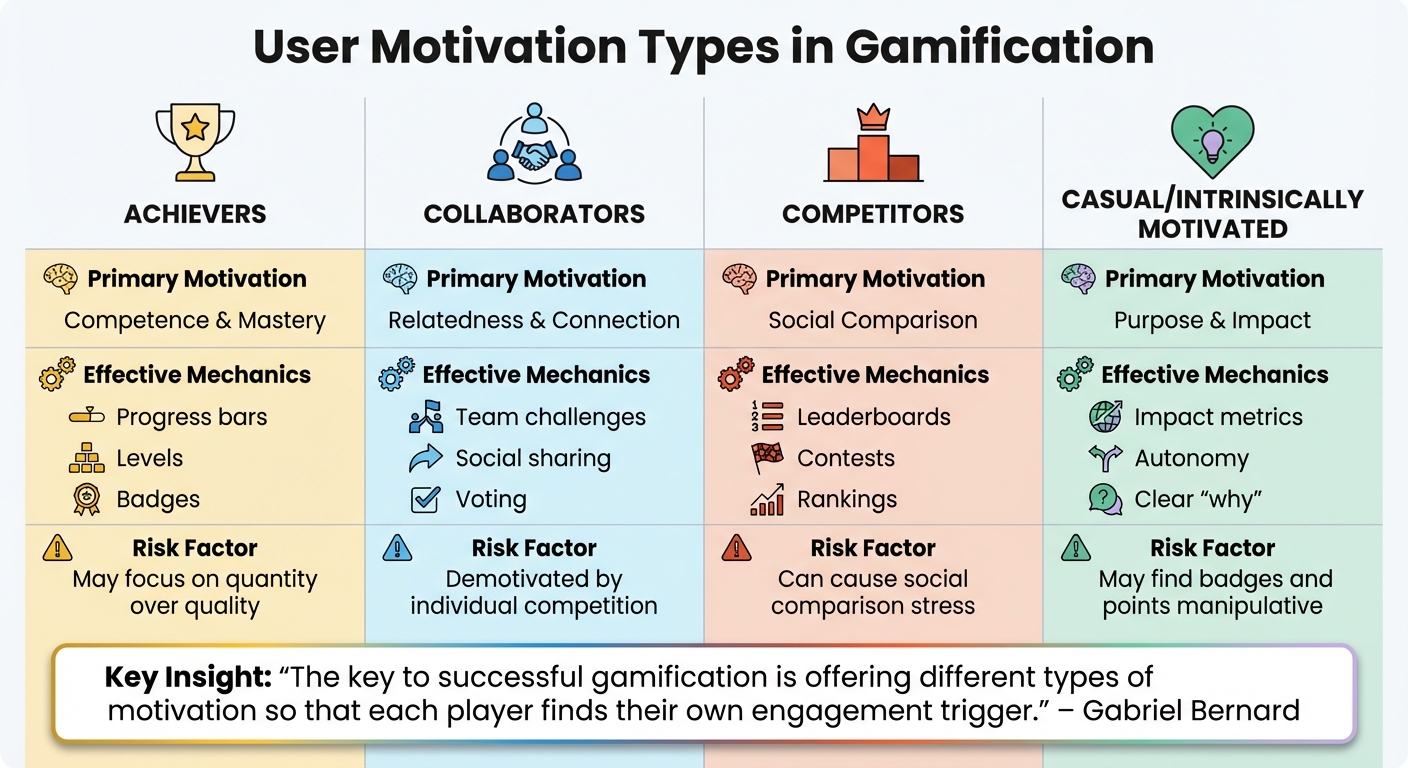
Most gamification systems lean heavily toward Achievers (who enjoy earning points and badges) and Competitors (who thrive on leaderboards). But there’s a whole group of users being overlooked: Collaborators (who value social interaction) and those who are casually or intrinsically motivated (who care about purpose and impact) [7]. Focusing only on a narrow slice of users leaves a big audience untapped.
Take public leaderboards as an example. While they can inspire some, they often backfire. If someone sees they’re ranked way down at 100th place with no realistic chance to catch up, they might just stop participating altogether [8]. This is known as the "Leaderboard Loser Effect." Meanwhile, users who are already passionate about giving feedback - like loyal customers or volunteers - might find badges or points downright patronizing. In fact, a 2025 study of 57 Swedish volunteers found that digital badges didn’t significantly boost engagement or improve the quality of feedback [9]. For these users, flashy rewards often miss the point entirely.
| User Type | Primary Motivation | Effective Mechanics | Risk Factor |
|---|---|---|---|
| Achievers | Competence & Mastery | Progress bars, levels, badges | May focus on quantity over quality |
| Collaborators | Relatedness & Connection | Team challenges, social sharing, voting | Demotivated by individual competition |
| Competitors | Social Comparison | Leaderboards, contests, rankings | Can cause social comparison stress |
| Casual/Intrinsically Motivated | Purpose & Impact | Impact metrics, autonomy, clear "why" | May find badges and points manipulative |
Acknowledging these different motivations is critical to keeping feedback meaningful and actionable. A one-size-fits-all approach just doesn’t cut it, and it’s clear that tailoring your strategy can make a world of difference.
Solution: Customize Gamification for Different Users
Here’s how to bridge the gap: instead of relying on leaderboards alone, offer diverse ways for users to engage. For Achievers, use tools like progress trackers that show how their feedback directly contributes to product improvements. For Collaborators, introduce features like collaborative voting, where users can support and elevate each other’s ideas.
For example, Modu’s Suggestions module allows users to vote on ideas collaboratively, while the Roadmap module shows how their contributions drive actual product changes - no badges or points required.
Competitors, on the other hand, thrive on time-limited leaderboards (like daily or weekly resets) that give everyone a fair shot at success. You can also introduce team-based competitions, such as department matchups, to encourage collaboration and reduce the sting of losing as an individual [8].
For users who are casually or intrinsically motivated, skip the gimmicks entirely. Instead, focus on showing them the real-world impact of their feedback.
"The key to successful gamification is offering different types of motivation so that each player finds their own engagement trigger."
– Gabriel Bernard [2]
Mistake 4: Adding Gamification to Poorly Designed Tools
The Impact of Poor Feedback Interfaces
Gamification isn’t a cure-all for an ineffective feedback tool. It's a design strategy, not a fix for deeper issues. If you add points, badges, and leaderboards to a clunky or confusing interface, you’re not addressing the root problem - you're making it worse.
When feedback tools are hard to use - whether they’re slow, unclear, or overly complex - gamification can lead to cognitive overload. This happens when the effort required to navigate the tool outweighs any motivation the gamification provides [2]. Instead of boosting engagement, users may feel frustrated and disengaged.
Flawed interfaces also encourage users to cut corners. For example, they might click randomly or give low-effort responses just to get through the process. This results in a pile of meaningless data that obscures the genuine insights you’re looking for.
"DON'T try to fix a broken product or service with gamification."
– Dr. Michael Wu, PhD [1]
A study conducted in September 2025 by researchers Kim Siebeneicher, Edit Söderqvist, and George Palamas revealed this dynamic clearly. They tested a custom survey platform with 57 Swedish volunteers. Half of the participants used a gamified version with achievement badges, while the other half used a plain version. Although the gamified group completed surveys faster, their responses were shorter and showed little engagement with the gamification elements. The study concluded that for users already motivated, surface-level gamification could actually reduce the quality of feedback [9].
This research highlights the importance of fixing the core usability of your tools before layering gamification on top.
Solution: Fix Feedback Tools Before Adding Gamification
To make gamification work, your feedback tool needs to be intuitive and user-friendly. If users struggle to understand how to interact with it, no amount of game mechanics will improve their experience.
Start by simplifying your interface. Use clear, direct language in your questions, and ensure the response options are specific and easy to interpret. For instance, instead of vague choices like "Somewhat agree" or "Moderately satisfied", offer precise options that are easier to evaluate.
"If the core experience doesn't already support progress, clarity, and feedback, no amount of points will save it."
– Steven Judge, Founder of GameLayer [6]
Tools like Modu's Single Choice and Multiple Choice modules prioritize simplicity. They focus on helping users share their thoughts without unnecessary distractions. Features like clear options, straightforward voting mechanisms, and clean layouts ensure that users can provide meaningful feedback without any friction.
Once your feedback tool is polished and easy to use, you can think about adding gamification. But keep in mind: gamification only amplifies what's already there [6]. A strong foundation will make game mechanics a powerful enhancement. A weak one? It’ll just draw attention to the flaws.
| Red Flag | What It Means | Fix It First |
|---|---|---|
| Confusing Navigation | Users can’t figure out how to submit feedback | Simplify the user journey and reduce steps |
| Vague Questions | Poll options are unclear or overlapping | Rewrite questions with specific, distinct choices |
| Slow Load Times | Interface lags or freezes | Optimize performance before adding features |
| No Clear Purpose | Users don’t understand why their feedback matters | Communicate impact (e.g., show how feedback shapes roadmaps) |
Mistake 5: Overusing Competitive Leaderboards
The Risk of Demotivation in Competitive Systems
Leaderboards might seem like a natural fit for feedback systems - they're visible and tap into our competitive instincts. But here's the catch: most users shy away from public competition, especially when they feel outmatched or see little chance of success.
When people find themselves stuck in lower ranks, it can trigger what behavioral scientist Jason Hreha calls "social comparison stress" [7]. Instead of feeling inspired to improve, they often feel discouraged and might even disengage completely. This is particularly common in systems where a handful of power users dominate the top spots.
Leaderboards can also encourage the wrong behavior. For example, users might start gaming the system by flooding it with low-quality feedback just to rack up points and climb the rankings [7].
"Social comparison stress - Leaderboards often demotivate lower-ranked users."
– Jason Hreha, Behavioral Scientist [7]
Interestingly, the users who thrive on leaderboards - those who enjoy the competitive aspect - are usually in the minority. Most people are motivated by other factors, like connecting with a community, exploring ideas, or genuinely contributing to a product they care about. Overemphasizing public rankings risks alienating this majority.
Research backs this up. Systems that rely heavily on gamification elements like points, badges, and leaderboards often see user retention rates drop below baseline after 30 days [7]. Shifting the focus from public competition to personal progress can help maintain engagement.
Solution: Balance Competition with Personal Goals
To avoid demotivating users, it's important to strike a balance between competition and personal achievement. If you choose to include leaderboards, don't make them the centerpiece of your gamification strategy. Instead, focus on individual growth and meaningful contributions.
Here are a few ways to do that:
- Private Progress Tracking: Use tools like progress bars or level-up systems that let users monitor their own achievements without the stress of public rankings.
- Team-Based Goals: Shift the focus from individual competition to group efforts. For instance, track how much feedback a team or department submits collectively, encouraging collaboration rather than rivalry.
- Quality Over Quantity: Reward users for helpful, actionable feedback rather than sheer volume. Recognize contributions that your team or other users find valuable.
| Leaderboard Problem | Better Alternative |
|---|---|
| Public rankings demotivate lower-ranked users | Use private progress tracking to highlight individual growth |
| Rewards volume over quality | Recognize helpful feedback through peer or team validation |
| Focuses on individual competition | Encourage team-based goals and collaborative challenges |
| Encourages "completion farming" | Tie rewards to impactful feedback (e.g., ideas implemented in your roadmap) |
Platforms like Modu are great examples of this balanced approach. Their Suggestions module allows users to submit and vote on ideas without the pressure of a public leaderboard, while the Roadmap module shows how user feedback directly shapes product decisions.
If you do stick with leaderboards, consider adding time-bound resets - like daily, weekly, or monthly rankings. This ensures that everyone has a fair shot at climbing the ranks and prevents power users from dominating indefinitely [8]. It keeps the competition fresh and gives newcomers a reason to stay engaged.
Ultimately, gamification should make participating in feedback systems enjoyable, not stressful. By focusing on personal progress and rewarding meaningful contributions, you'll create an environment where users feel valued and are more likely to stay involved over the long run.
Mistake 6: Not Monitoring or Updating Gamification
The Need for Regular Evaluation
Once you've nailed the design and customization of your gamification system, the next step is to ensure it stays effective. That means keeping an eye on how it's performing and making adjustments when necessary.
Gamification isn't a "set it and forget it" strategy. What excites users today might bore them tomorrow. Without regular updates, the very system you worked hard to create can become dull, predictable, or even counterproductive.
Steven Judge explains the risks of neglecting regular updates:
"Engagement logic changes constantly. Rules change. Rewards need tuning. Progression needs balancing. User behaviour shifts. When this logic is hardcoded into apps, every change becomes expensive. Teams stop iterating. Engagement systems stagnate" [6].
Ignoring these shifts can lead to serious problems: declining engagement, users finding ways to exploit the system, or a drop in the quality of feedback. As noted earlier, static mechanics often lead to what’s called a "novelty cliff" - the initial excitement fades, and users disengage.
The numbers back this up. Roughly 80% of gamified initiatives fail to meet their goals, largely because teams either don’t set clear objectives or fail to monitor their system’s performance [5]. Without tracking data - like how users interact with changelog updates, vote on suggestions, or complete feedback modules - you’re essentially operating in the dark.
Solution: Use Analytics to Improve Gamification
To keep your gamification system engaging, treat it as a work in progress. Use analytics to figure out what’s working, what’s not, and how to adapt.
Start by identifying where users lose interest. Analytics tools can help you spot the exact moments where engagement drops off and uncover the reasons behind it. Maybe the process is too complicated, the rewards feel repetitive, or users are overwhelmed with options [11].
Platforms like Modu offer built-in analytics to track engagement trends and differentiate between high-value and low-quality feedback. By integrating with tools like Slack or Jira, you can act on this data in real time - for instance, notifying your team when a suggestion with lots of votes needs attention.
Prioritize quality over quantity. Ensure that feedback is meaningful rather than just a way for users to rack up points. Regularly updating your mechanics is just as important. As Sam Liberty points out:
"If you are really determined to find out why people are not enjoying your product, you need to find people who deleted the app" [11].
Reach out to disengaged users to understand why they stopped participating.
Lastly, plan for the inevitable. Over time, every system needs a refresh. Schedule quarterly reviews to tweak your gamification mechanics, introduce fresh challenges, or phase out elements that no longer resonate. Experiment with A/B testing to see what works best - maybe your audience responds better to progress bars than leaderboards, or team goals might outperform individual rewards [4]. The goal is to keep your system evolving so it always feels fresh and engaging.
Conclusion
When done right, gamification can completely reshape how feedback systems function. The key to success lies in four main principles: clear goals, simplicity, personalization, and continuous improvement.
To make gamification work, tie it directly to your feedback objectives instead of just tossing in points and badges for show. Keep the mechanics straightforward so users instantly understand what they’re working toward - without feeling overwhelmed. Remember, not everyone is motivated the same way. Some users thrive on competition, while others value collaboration or personal growth. Designing systems that cater to these different motivations is essential to avoid the common pitfalls discussed earlier.
Think of gamification as a living, evolving strategy rather than a one-time solution. As gamification expert Andrzej Marczewski wisely states:
"Gamification should be a strategy, not an afterthought or add-on" [8].
This means keeping a close eye on analytics, spotting where engagement drops, and refreshing the mechanics before they lose their appeal.
Tools like Modu’s integrated analytics make this process easier by offering real-time tracking of user activity across suggestion boards, polls, and roadmaps. With seamless integrations into platforms like Slack, Jira, and Linear, you can fine-tune your approach based on actual data. The numbers speak for themselves: 95% of employees enjoy gamified systems, and engagement can soar by up to 60% when implemented effectively [8]. However, 80% of gamification efforts fail due to poor design and unclear objectives [5]. In the end, gamification should be seen as an ongoing commitment to meeting user needs - not a quick patch for product flaws.
FAQs
How do I measure feedback quality, not just volume?
To gauge the quality of feedback, focus on its depth, relevance, and usefulness rather than simply tallying the number of responses. High-quality feedback often includes detailed, specific insights or actionable suggestions that can be implemented effectively.
Using qualitative methods, such as organizing feedback into themes, can help identify patterns and priorities. Additionally, analytics tools - like tracking the amount of time users spend engaging with your content - offer valuable context. Ultimately, thoughtful and well-aligned feedback is far more impactful than a large volume of surface-level responses, as it provides a clearer path for meaningful improvements and better addresses user needs.
When should I add gamification to a feedback tool?
If you're looking to increase engagement and inspire users to actively participate, gamification can be a powerful addition to your feedback tool. Adding elements like points, badges, or leaderboards can create a sense of achievement and friendly competition, motivating users to contribute more.
However, it's important to ensure these features align with clear objectives. The goal should be to encourage meaningful and consistent feedback, not just surface-level participation. Overcomplicating the design or relying too heavily on rewards like points can actually discourage users if it feels forced or irrelevant.
Instead, think of gamification as one piece of a larger system. A well-structured feedback tool combines gamified elements with a focus on valuable input, ensuring users feel both rewarded and heard. Keep it simple, purposeful, and tied to your overall goals for the best results.
What should I use instead of a public leaderboard?
Instead of leaning on public leaderboards, prioritize providing constructive feedback, acknowledgment, or progress tracking that aligns with user objectives and nurtures internal motivation. This strategy steers clear of the downsides of competitive ranking systems while promoting a more engaging and uplifting experience for users.