
5 Tools for Competitor Benchmarking in SaaS
5 Tools for Competitor Benchmarking in SaaS
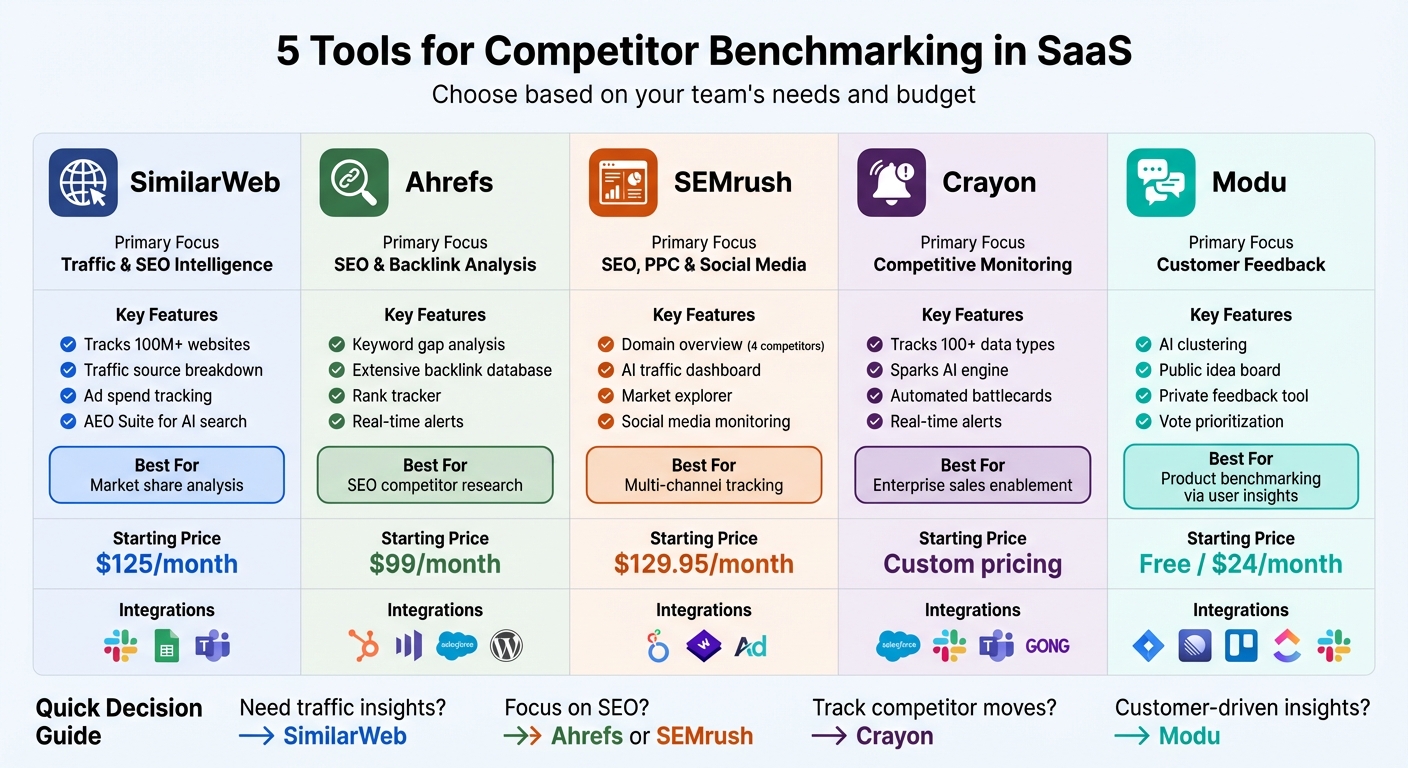
In SaaS, staying ahead means knowing what your competitors are doing. Benchmarking tools simplify this by offering insights into traffic, SEO, pricing, and customer feedback. Here are five standout tools to help you analyze competitors effectively:
- SimilarWeb: Tracks traffic sources, SEO performance, and ad spend. Great for understanding market share and audience engagement. Starts at $125/month.
- Ahrefs: Focuses on SEO, with tools for backlink analysis and keyword gaps. Excellent for identifying content opportunities. Plans start at $99/month.
- SEMrush: Combines SEO, PPC, and social media insights. Ideal for multi-channel performance tracking. Pricing begins at $129.95/month.
- Crayon: Monitors competitor updates like pricing, messaging, and product launches. Tailored for enterprise teams with custom pricing.
- Modu: Gathers customer feedback to refine your product. Offers free and affordable paid plans, starting at $24/month.
Each tool serves a different purpose, from traffic analysis to feedback-driven insights. Choose based on your needs and budget. Below is a quick comparison:
| Tool | Focus | Key Features | Starting Price |
|---|---|---|---|
| SimilarWeb | Traffic & SEO | Tracks traffic sources, ad spend | $125/month |
| Ahrefs | SEO & Backlink Analysis | Keyword gaps, backlink strategies | $99/month |
| SEMrush | SEO, PPC & Social Media | Multi-channel insights | $129.95/month |
| Crayon | Competitive Monitoring | Tracks pricing, messaging, updates | Custom pricing |
| Modu | Customer Feedback | Feedback clustering, task integration | Free/$24/month |
Pick the tool that aligns with your goals to make smarter, faster decisions.
How To Do Competitor Analysis In Semrush 2026 (Step-by-Step)
1. SimilarWeb
SimilarWeb helps SaaS teams gain a deeper understanding of competitors' traffic, marketing strategies, and SEO performance. By tracking over 100 million websites and 4 million apps with 10 years of historical data, it supports teams in identifying trends and making informed strategic decisions [8]. Let’s break down how SimilarWeb provides actionable insights into traffic and SEO.
Traffic and SEO Insights
SimilarWeb reveals where competitors draw their visitors from and evaluates audience engagement. Metrics like total visits, bounce rates, visit duration, and pages per visit help gauge market share and audience quality [8]. Traffic sources are categorized into Direct, Search (both Organic and Paid), Social, Referral, Display Ads, and Email [8].
For SEO, it highlights keyword gaps, tracks rankings across SERP features and AI Overviews, and monitors backlink profiles. Its AEO Suite (Answer Engine Optimization) goes further by tracking brand visibility in generative AI search results and measuring referral traffic from large language models - an essential feature as AI-driven search continues to evolve [8]. A notable example: Group M in Poland used these tools to achieve a 60% year-over-year increase in organic traffic [8].
Competitor Analysis and Strategy
The platform also tracks competitor conversion rates [8]. For paid search, it provides ad spend estimates, CPC data, and insights into ad creatives, helping teams identify high-performing keywords and safeguard brand terms. For instance, MandM Direct used SimilarWeb’s benchmarking to increase new customer acquisitions by 8% year-over-year [8].
Seamless Integration with SaaS Workflows
SimilarWeb’s Data-as-a-Service API allows businesses to integrate digital insights directly into tools like BI platforms, CRMs, and custom dashboards [8]. This makes it easy to automate reporting and streamline outreach efforts using up-to-date data.
Pricing and Access
SimilarWeb offers a free tier for basic traffic lookups. Starter plans start at $125 per month, designed for smaller teams [3] [4]. Advanced and Enterprise plans come with custom pricing, tailored to the level of data access and historical depth required [4] [8]. Recognized by G2 as a leader in Enterprise Competitive Intelligence and SEO Tools, users appreciate its user-friendly interface. However, data estimates for smaller sites may sometimes lack accuracy [1] [4].
2. Ahrefs

Ahrefs is a popular tool among SEO professionals, especially for competitor research, backlink analysis, and evaluating organic content performance. SaaS teams often rely on it to dissect competitor strategies and identify gaps in their own keyword coverage. This is essential for benchmarking against competitors. With the platform's Site Explorer, users gain detailed insights into competitor content, such as which pages drive the most traffic, the keywords they rank for, and the backlinks they've secured [6]. This data helps prioritize SEO strategies based on what’s already working for others.
Traffic and SEO Insights
Ahrefs' Keyword Gap Analysis tool is excellent for spotting opportunities. It highlights keywords that competitors rank for but your site doesn’t, helping you identify areas where you can improve [6]. The platform also boasts an extensive backlink database, making it easier to analyze competitor link-building strategies by pinpointing their referring domains [6]. On top of that, the Rank Tracker feature lets you monitor your site’s keyword rankings alongside competitors, giving you a clear picture of how your search engine performance stacks up over time [6].
"Ahrefs is the go-to for SEO competitor analysis. Its huge database and detailed backlink metrics are unmatched." - SpyFu [6]
Competitor Updates and Intelligence
With Ahrefs Alerts, you can stay on top of your competitors' activities without constantly checking dashboards. These alerts notify you in real time when competitors earn valuable backlinks, rank for new keywords, or publish new content [6]. This feature allows teams to react quickly and adjust their strategies as needed. Plus, these alerts integrate seamlessly with other tools, enhancing workflow efficiency.
Integrations with SaaS Workflows
Ahrefs supports integration with major platforms like HubSpot, Marketo, and Salesforce, making it easier to incorporate competitive insights into existing CRM and lead-tracking processes [9]. It also works with Google Data Studio for creating custom dashboards to visualize benchmarks [9]. For content and technical workflows, integrations with WordPress and Google Search Console allow users to compare their site’s performance with competitors directly from their management interfaces [9].
Pricing and Scalability
Ahrefs offers flexible pricing to suit different needs. The Lite Plan starts at $99 per month, catering to independent users and basic SEO tracking [1]. The Standard Plan, at $129 per month, provides deeper insights and access to historical data [9]. Growth-focused teams often opt for plans starting around $300 per month [1], while Enterprise Plans with custom pricing are available for larger organizations [9]. While Ahrefs is widely praised for its expansive backlink database, some users mention that it has a learning curve for beginners and that its reporting features may not match the depth of specialized business intelligence tools [9].
3. SEMrush
SEMrush brings together SEO, PPC, social media, and market research into a single platform, making it a go-to tool for SaaS teams looking to measure performance across channels and stay ahead of competitors [6]. With features like the Domain Overview, you can analyze up to four competitor URLs at once, gaining insights into Authority Scores, organic and paid traffic, keyword data, and backlink profiles [3]. Here's how SEMrush simplifies competitor benchmarking.
Traffic and SEO Insights
SEMrush offers powerful tools to uncover opportunities. The Keyword Gap tool highlights keywords your site is missing, giving you a clear roadmap for content creation [3][4]. Meanwhile, the Backlink Gap tool identifies domains linking to competitors but not to you, opening doors for link-building efforts [3][4]. For those tracking trends in AI-driven traffic, the AI Traffic Dashboard monitors visits from platforms like ChatGPT, Gemini, Perplexity, and Claude [10]. Additionally, the Market Explorer places competitors into a "Growth Quadrant" based on audience size and growth rate, classifying them as Niche Players, Game Changers, Established Players, or Leaders. These insights help SaaS teams pinpoint opportunities and refine their strategies.
Competitor Updates and Intelligence
Staying updated on competitors is easier with tools like EyeOn and Semrush Copilot, which automatically track changes in competitor content, keywords, and backlinks, allowing quick adjustments to your strategy [10][3]. The Advertising Research tool dives into historical Google Ads data, showing which keywords competitors consistently bid on - an indicator of profitable terms [4][6]. For social media, Semrush Social monitors competitor growth and engagement across platforms like Facebook, X, Instagram, and Pinterest, helping you track their audience dynamics [3].
Integrations with SaaS Workflows
SEMrush supports seamless integration into SaaS workflows. For example, its partnership with Wappalyzer via the Client Manager tool helps identify the technology stacks your competitors use [10]. It also connects with Looker Studio for advanced reporting and features a centralized Projects page for ongoing campaign monitoring [3][2]. The Semrush App Center expands functionality with third-party tools like AdClarity for advertising insights, making it easy to customize the platform to your team's needs [3][10].
Pricing and Scalability
SEMrush offers tiered pricing to suit different business sizes. Plans include the Pro Plan at $129.95/month, Guru at $249.95/month, and Business at $499.95/month [4]. Additional tools like the Traffic & Market Toolkit can be added for $289/month, while Semrush Social costs $20/month [3]. A free account provides 10 daily credits for basic competitor research [5]. While SEMrush is widely recognized for its comprehensive capabilities, new users may find the interface overwhelming, and accessing full market intelligence often requires higher-tier subscriptions or add-ons [4].
4. Crayon
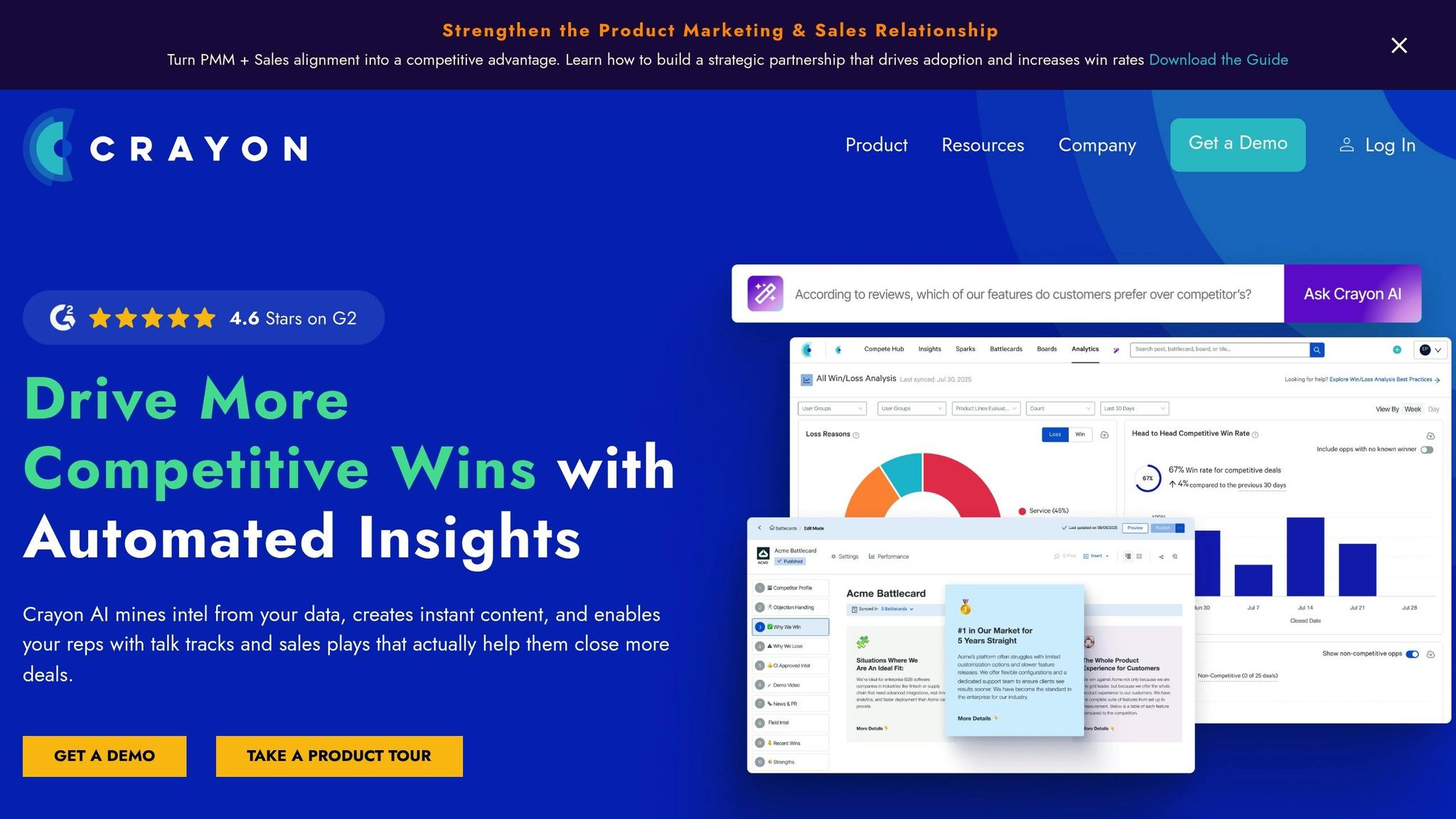
Crayon stands out as a competitor monitoring tool tailored specifically for enterprise-scale SaaS teams. Unlike platforms that focus solely on SEO or traffic metrics, Crayon provides a broader scope of competitive intelligence, capturing both concrete data and subtle market trends.
Designed for mid-market and enterprise SaaS organizations, Crayon transforms raw observations into actionable insights. It tracks over 100 types of data from across the web - everything from website updates and product launches to messaging changes and customer reviews. Using AI, Crayon filters through the noise to deliver only the most relevant information, making it ideal for teams managing multiple competitors and large-scale go-to-market strategies [4][2].
Competitor Updates and Intelligence
Crayon’s Sparks AI engine dives deep into your competitors’ digital activities, compiling insights into tools like SWOT analyses, sales talk tracks, and automated battlecards [7]. Alerts for pricing changes, feature rollouts, and messaging updates are sent directly to Slack or your CRM [4]. Beyond the obvious, Crayon captures less tangible shifts - like changes in executive leadership, customer sentiment in reviews, or adjustments to landing page calls-to-action - areas often overlooked by traditional tools [2][7]. By integrating with CRMs, the platform also supports win/loss analysis, helping teams understand what’s driving competitive successes and setbacks [2].
These insights are designed to plug directly into your existing sales and marketing processes, making them more actionable and effective.
Integrations with SaaS Workflows
Crayon integrates with popular tools like Salesforce, Slack, Microsoft Teams, and Gong. Its dynamic battlecards automatically update, giving sales teams real-time insights during critical conversations [4][7][2]. To avoid information overload, users can prioritize monitoring their top two or three competitors and set alerts for key changes, such as pricing adjustments [4]. Additionally, insights from feature launches can guide product development and refine marketing campaigns almost instantly [2].
Pricing and Scalability
Crayon operates on a custom quote-based pricing model, tailored specifically for enterprise needs. This makes it less suitable for early-stage startups [4][2]. The platform is built for high-performing teams that need to manage and update hundreds of competitive battlecards at once [7]. To maximize its potential, Crayon requires a dedicated competitive intelligence or product marketing lead to oversee its adoption and ensure it integrates seamlessly into existing processes [2].
5. Modu

Modu stands out by focusing on customer feedback to benchmark your product, instead of just monitoring competitors externally. As a feedback management platform, it provides SaaS teams with a structured way to collect and analyze user input. This helps uncover insights that position your product in the competitive landscape, all while keeping the user experience at the center.
Feedback Insights and Intelligence
One of Modu's standout features is its AI clustering, which groups similar feedback submissions automatically. This makes it easier to spot trends and identify what users care about most. The platform offers two key tools for gathering input:
- Suggestions Module: A public idea board where users can submit and vote on feature requests. This crowd-sourced approach helps prioritize your product roadmap based on actual demand.
- Text Module: A private feedback tool for gathering detailed responses to specific questions. For example, you can ask why users prefer your product, what features they feel are missing, or what might make them stay loyal. Since responses are visible only to admins, users are more likely to provide honest and thorough feedback.
Together, these tools provide a mix of open community-driven input and candid, internal insights.
Integrations with SaaS Workflows
Modu integrates seamlessly with popular project management tools like Jira, Linear, Trello, and ClickUp, turning high-priority feedback into actionable tasks. Its Slack integration sends alerts for new suggestions or when votes hit key milestones, keeping teams informed in real time. Additionally, the Google Sheets integration enables live CSV exports for ongoing trend analysis. These integrations ensure that feedback isn't just collected - it actively shapes your competitive strategy.
Pricing and Scalability
Modu offers flexible pricing, making it accessible for teams of all sizes:
- Free ($0/month): Includes 1 board, 3 modules, and basic customization.
- Start ($24/month): Offers 3 boards, 15 modules, integrations, and support for up to 3 team members.
- Growth ($59/month): Unlocks unlimited boards and modules, AI clustering, SSO, password-protected boards, and custom domains. It supports 10 team members, with additional seats available at $5/month.
The Growth plan is particularly useful for SaaS companies managing feedback across multiple customer tiers or product lines. Whether you're just starting out or scaling up, Modu's pricing adapts to your needs, ensuring feedback-driven decisions grow alongside your business.
Tool Comparison
When it comes to competitor analysis, each tool brings its own strengths, tailored to meet different SaaS business needs. SimilarWeb stands out for delivering a comprehensive view of a competitor's digital footprint. It tracks traffic sources across direct, referral, social, and display channels, giving businesses a bird's-eye view of their rivals' online presence. Plus, it integrates seamlessly with tools like Slack, Google Sheets, and Microsoft Teams, making it easier to automate updates and monitor traffic trends. However, its pricing structure might be a hurdle for smaller teams.
For SEO and PPC benchmarking, Ahrefs and SEMrush are the go-to platforms. Ahrefs shines in conducting detailed SEO audits, offering in-depth backlink analysis and keyword insights. SEMrush, on the other hand, provides similar search-focused features but places a strong emphasis on keyword and PPC data, making it a favorite for search marketing professionals.
Crayon takes a different approach by focusing on competitive enablement. It automates the tracking of competitor website changes and pricing updates to help sales teams stay ahead. Its integrations with Salesforce, Slack, Microsoft Teams, and Gong allow real-time alerts and battlecards to be delivered directly into CRM and communication platforms, ensuring quick responses to competitors' moves.
Lastly, Modu sets itself apart by leveraging customer feedback to benchmark performance. It transforms user insights into actionable tasks through integrations with Jira, Linear, Trello, ClickUp, Slack, and Google Sheets. With pricing options that include a free plan and a premium plan starting at $59 per month, Modu is a flexible choice for startups and growing SaaS companies looking to scale without breaking the bank.
Here’s a quick comparison of the tools:
| Tool | Primary Focus | Key Integrations | Starting Price |
|---|---|---|---|
| SimilarWeb | Traffic intelligence & channel mix | Slack, Google Sheets, Microsoft Teams | Custom pricing (enterprise-focused) |
| Ahrefs | SEO audits & backlink analysis | Limited native integrations | $129/month |
| SEMrush | SEO & PPC benchmarking | Limited native integrations | $139.95/month |
| Crayon | Competitive enablement & sales | Salesforce, Slack, Microsoft Teams, Gong | Custom pricing |
| Modu | Customer feedback & product insights | Jira, Linear, Trello, ClickUp, Slack, Google Sheets | $0/month (Free plan) |
Conclusion
Selecting the right benchmarking tool can make a huge difference for SaaS teams looking to make smarter, quicker decisions. The key is aligning the tool's features with your team's needs, budget, and structure to get the most out of your investment.
SimilarWeb is ideal for detailed traffic and market share analysis. On the other hand, Ahrefs shines in backlink analysis, while SEMrush provides an all-in-one solution covering search, content, and paid advertising. For competitive insights, Crayon offers real-time updates on pricing changes and messaging shifts, integrating seamlessly with your CRM to deliver actionable battlecards. Meanwhile, Modu focuses on customer-driven benchmarking, helping you align your product with user needs rather than just keeping up with competitors. With integrations like Jira, Linear, Trello, and Slack, it turns customer feedback into actionable tasks without the hassle of manual input.
Each tool serves a specific purpose, from analyzing traffic to gathering customer insights, enabling you to craft a well-rounded competitive strategy. Start with the tool that fits your current priorities, and expand your toolkit as your business evolves.
FAQs
Which tool should I start with for competitor benchmarking?
Start by using a tool like CompetiTracker, which offers automated, real-time tracking of your competitors' features, pricing, and messaging. It provides instant alerts and up-to-the-minute data, ensuring you're always informed and ready to act swiftly.
How accurate are competitor traffic and ad spend estimates?
Competitor traffic and ad spend estimates are rough approximations. These figures are based on available data, predictive modeling, and estimations, meaning their accuracy can vary. Treat them as a general guide rather than precise numbers.
How do I turn customer feedback into benchmarking insights with Modu?
Modu offers feedback tools that make it easy to collect structured input like feature requests, ratings, and open-ended responses. You can gather this feedback through embeddable widgets, links, or popups, seamlessly integrating it into your user experience.
With Modu’s analytics, you can dive into trends by comparing feedback across different segments or time periods. This allows you to spot patterns, monitor progress, and measure how your product stacks up against customer expectations. By transforming raw feedback into clear, actionable insights, Modu helps you prioritize improvements that matter most to your users.