
Customer Feedback vs. Product Vision: Finding Balance
Customer Feedback vs. Product Vision: Finding Balance
Balancing customer feedback with a product vision is critical for creating a product that resonates with users while maintaining a clear identity. Here's the challenge: focus too much on feedback, and you risk building a cluttered, incoherent product. Ignore it, and you might miss real user needs. The solution? Use your vision as a guide to filter feedback and prioritize effectively.
Key takeaways from the article:
- Customer Feedback: Highlights user needs and provides insights through surveys, tickets, and forums. However, it often focuses on incremental changes, not transformative ideas.
- Product Vision: Serves as a long-term guide, ensuring the product stays focused and aligned with its purpose.
- Pitfalls of Overemphasis:
- Too much feedback reliance leads to feature overload and diluted identity.
- Ignoring feedback risks irrelevance and missed opportunities.
- Balancing Strategy:
- Evaluate feedback based on alignment with vision, user reach, and business impact.
- Use structured feedback loops to collect, analyze, and act on insights.
- Tools like Modu help centralize feedback, identify trends, and maintain transparency.
Product VISION vs customer REQUESTS | What's more important?
What Customer Feedback and Product Vision Mean
Before diving into how these two elements work together, it's essential to understand what they represent and their roles in product development.
What is Customer Feedback?
Customer feedback is the direct input users share about their experiences with your product. It comes through various channels - surveys, interviews, support tickets, chats, and forums - and typically includes feature requests, bug reports, usability concerns, and ideas for improvement.
This feedback serves as the backbone of ongoing product refinement. It highlights issues you might have missed, reveals new possibilities, and confirms whether you're addressing real user needs. For instance, the Aha! product team evaluates 20 to 30 customer requests weekly, ensuring each one is reviewed within 24 hours [10]. Feedback is inherently reactive, helping you address current challenges [3].
On the flip side, product vision takes a more forward-looking approach.
What is Product Vision?
Product vision is your long-term roadmap. It's the guiding principle that shapes every decision, defining who your product serves, the problem it solves, the unique approach you'll take, and why it matters. Syed Balkhi, Founder at WPBeginner and CEO at Awesome Motive Inc, explains it well:
"Your product vision is your North Star. It's the reason you began your entrepreneurial journey and kept going against all odds."
Unlike feedback, which is rooted in the present, product vision is future-focused. It acts as a unifying blueprint, ensuring your team stays aligned even when faced with competing demands. As Seema Lakhani, Head of Core Products at Wattpad, points out:
"The vision doesn't tell us what to build... It focuses on higher level impact."
A strong product vision keeps your product from becoming a patchwork of features. Without it, there's a risk of creating something uninspired - a product that blends in rather than stands out [11].
What Happens When You Focus Too Much on One Side
Overcommitting to either extreme - whether it’s catering to every customer request or ignoring feedback altogether - can spell trouble for your product. Striking a balance is key, as leaning too far in one direction can derail your product's success.
Problems with Following Only Customer Feedback
Building a product based solely on customer requests often leads to what’s known as a "Frankenstein product" - an overloaded, disjointed mess of features that confuses users and dilutes your product’s core identity [8]. This scattershot approach can erode focus, making it harder for users to understand what your product is really about.
Take Basecamp’s 10% rule as an example: they only consider implementing features when at least 10% of their user base requests them [4]. Why? Because most feedback comes from a small but loud group - often power users or early adopters - whose needs don’t reflect the broader audience [9]. Syed Balkhi, CEO of Awesome Motive, highlights this pitfall:
"A product might be able to do many things, but do all of them poorly, compromising your ability to offer an enhanced user experience." [1]
Another issue is that customer feedback tends to focus on incremental improvements rather than transformative ideas. As Henry Ford famously said, "If I had asked people what they wanted, they would have said faster horses" [3]. Over-prioritizing these requests can lead to technical debt and stifle larger, strategic innovations [6].
But ignoring feedback entirely isn’t the solution either.
Problems with Ignoring Customer Feedback
Disregarding customer feedback can make your product irrelevant. Product Manager Yasintha Jayaratne warns, "Only serving existing customers can make your product obsolete" [3]. Without input from users, teams risk developing tunnel vision, missing out on valuable insights about real-world use cases and potential opportunities [1].
Ignoring critical issues like usability problems or bugs can also erode trust and damage your reputation. Over time, this drives users away and can hurt your bottom line [7][12]. A product built in isolation - based on assumptions rather than actual feedback - might sound great in theory but often fails to solve real market problems.
Balancing customer feedback with a clear product vision is the only way to avoid these pitfalls.
How to Balance Feedback and Vision
Balancing customer feedback with your product vision means finding a way to filter valuable input without losing sight of your product's core identity. The trick? Use your vision as a framework for making decisions.
How to Prioritize Feedback by Impact and Alignment
Syed Balkhi, CEO of Awesome Motive, suggests running all feedback through a "vision filter" [1]. Before acting on a request, ask yourself three key questions: Who is this feedback from? How does it align with the vision? Are there other ways to solve the problem?
Often, customers propose solutions instead of identifying the root issue. By asking targeted questions like, "When did this happen, and why was it a problem?", you can uncover the real pain points. This allows you to develop solutions that benefit a broader audience.
Not all feedback is created equal. Focus on input from your core user personas rather than isolated requests. Some teams even follow a "10% rule", meaning they only consider features if at least 10% of their user base requests them. This prevents the loudest voices from derailing your focus.
Look for recurring themes across multiple channels. If the same issues pop up in support tickets, sales calls, and surveys, it's likely a genuine market need. Evaluate feedback based on its potential to impact business outcomes, such as retention, conversion rates, or revenue growth. Seema Lakhani, Head of Core Products at Wattpad, explains it well:
"The best way to achieve business objectives is to solve real user problems and build a product that is valuable, usable and feasible" [4].
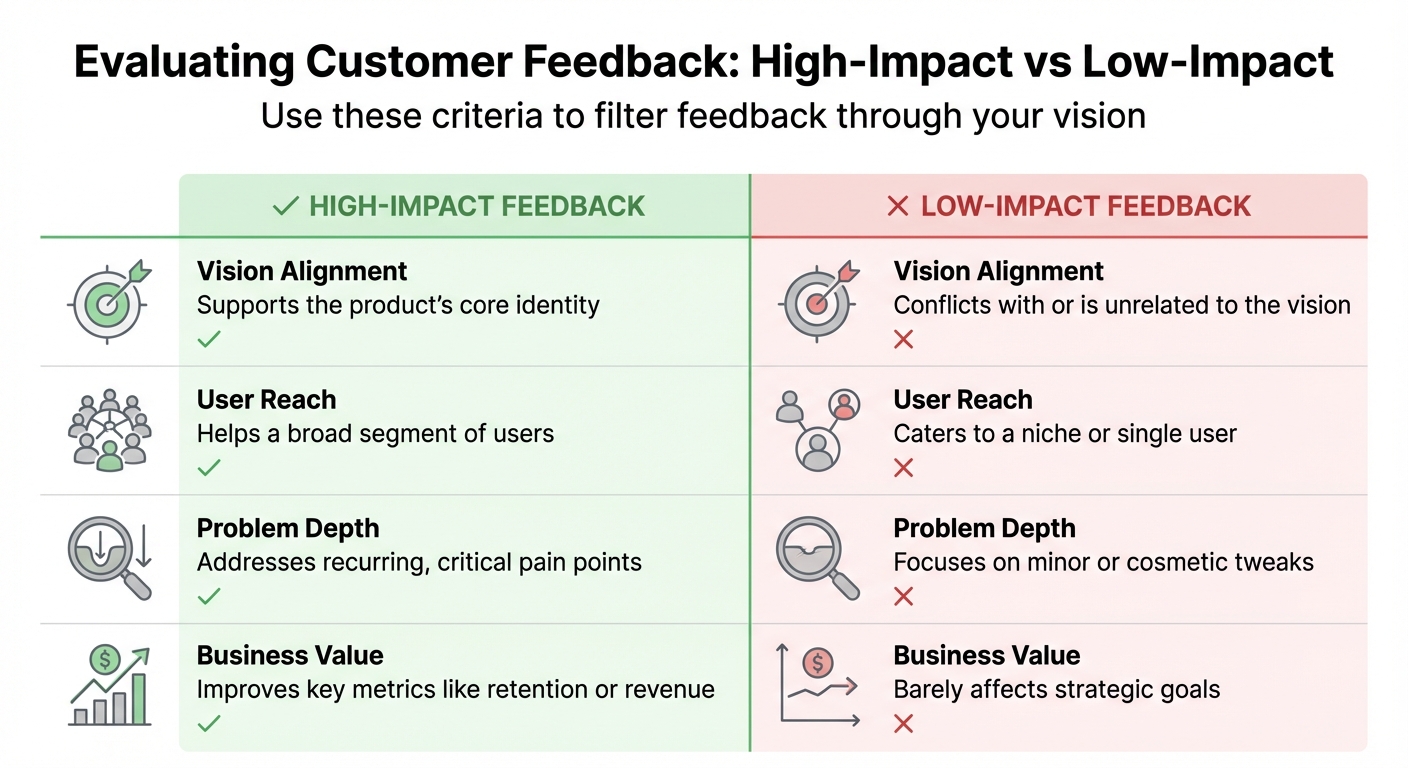
Here’s a quick comparison of high-impact versus low-impact feedback:
| Criteria | High-Impact Feedback | Low-Impact Feedback |
|---|---|---|
| Vision Alignment | Supports the product's core identity | Conflicts with or is unrelated to the vision |
| User Reach | Helps a broad segment of users | Caters to a niche or single user |
| Problem Depth | Addresses recurring, critical pain points | Focuses on minor or cosmetic tweaks |
| Business Value | Improves key metrics like retention or revenue | Barely affects strategic goals |
When feedback doesn't align with your vision, even if it’s from a paying customer, it’s okay to say "no" or "not yet." For instance, if your product is positioned as an alternative to traditional email services, adding conventional email features could dilute its unique value. Being transparent about these decisions builds trust, even when the answer isn’t what users want to hear.
This filtering process lays the groundwork for a solid feedback loop.
Setting Up Feedback Loops with Modu

Once you've prioritized feedback, the next step is creating a structured feedback loop. This ensures valuable insights are captured and acted upon without losing focus. A typical feedback loop involves four stages: Collect, Analyze, Take Action, and Follow Up [13].
Modu simplifies this process by centralizing feedback collection and analysis. Instead of juggling multiple tools, you can use Modu's dedicated boards to gather input from various channels. For example:
- Suggestions modules for community-driven ideas
- Text modules for private bug reports
- Rating modules for satisfaction scores
The Suggestions module is particularly effective for balancing feedback and vision. Users can submit ideas and vote on them, which naturally highlights common needs - like the 10% rule mentioned earlier.
Modu’s AI clustering groups similar feedback into themes, saving you time and identifying recurring challenges that may require changes to your roadmap.
When it’s time to act, Modu’s Roadmap module helps you communicate decisions transparently. Approved suggestions can be added directly to your roadmap, moving through stages like Backlog, Planned, In Progress, and Shipped. This gives users clear visibility into your product’s development.
Following up is crucial. Research shows that only 35% of companies consistently update customers on what happens to their feedback [14]. Modu’s integrations with tools like Slack, Jira, and Linear allow you to automatically notify users when their suggestions move to "Shipped."
For inspiration, consider Aha!'s approach. As of November 2025, their product team had implemented nearly 3,000 customer ideas using a structured feedback loop. Led by CEO Brian de Haaff, they review 20–30 new requests weekly, ranking them based on a "product value score" to prioritize ideas that align with strategic goals [13][10].
You can adopt a similar strategy using Modu’s analytics dashboard, which tracks vote counts, submission trends, and user engagement across all modules. This data helps you make informed decisions about which feedback needs immediate attention and which can wait.
Using Modu Modules to Balance Feedback and Vision
Modu's modules are designed to help you strike the right balance between listening to your community and staying true to your long-term goals. They build on the feedback loop strategy to create a structured approach that aligns user input with your vision.
Using Suggestions and Roadmaps for Community Input
The Suggestions module is a powerful way to gather user ideas and identify trends. By allowing users to upvote suggestions, it shifts the focus from reacting to individual requests to spotting broader patterns. This ensures you’re addressing validated needs rather than isolated opinions.
As Sarah McCasland, Product Manager at ModusCreate, explains:
"Customers usually know what the problem is to solve, but not how to execute the best solution" [4].
The Roadmap module takes this a step further by organizing suggestions based on your long-term objectives. Items are categorized as Planned, In Progress, or Shipped, keeping users informed. If a popular suggestion doesn’t align with your vision, you can mark it as "Not Planned" or "Future Consideration." This transparency sets clear expectations and avoids the pitfall of becoming a "feature factory", where features are added without considering their strategic importance.
Seema Lakhani, Head of Core Products at Wattpad, emphasizes the importance of focusing on outcomes:
"The roadmap itself is about the key outcomes we need to achieve to reach the vision, not specific ideas for the product and when they will be shipped" [4].
By separating the "idea" stage (Suggestions) from the "opportunity" stage (Roadmap), you stay in control of your product's direction while still valuing community input. This approach ensures a thoughtful balance between user needs and your overarching goals. Next, we’ll explore how other modules complement this process by providing quantitative and detailed feedback.
Comparing Modu Module Types for Feedback
Each module in Modu serves a distinct role in balancing user feedback with your vision. Suggestions modules are excellent for capturing a wide range of user priorities but require strategic filtering to align with your goals. Roadmaps focus on aligning with your vision by clearly communicating progress and future plans, though they primarily serve as informational tools.
Rating modules provide quick, measurable insights like NPS scores or satisfaction ratings, helping you gauge whether your strategic decisions resonate with users. Meanwhile, Text modules allow for open-ended feedback, offering rich qualitative insights. Modu’s AI clustering can even group these responses into themes, such as "Mobile experience", achieving cohesion scores as high as 92% [15].
| Module Type | Primary Use | Vision Alignment | Feedback Capture |
|---|---|---|---|
| Suggestions | Crowdsourcing and upvoting ideas | Medium (Filtered by status labels) | High (Community priorities) |
| Roadmap | Transparency and progress tracking | Very High (Defines future direction) | Low (Informational/Status updates) |
| Rating | Sentiment and NPS tracking | High (Measures impact of vision) | High (Quantitative satisfaction) |
| Text | Qualitative, free-form feedback | Medium (Identifies new themes) | Very High (AI-grouped insights) |
The key to success lies in combining these modules effectively. Use Suggestions to identify what users want, Text modules to understand the reasons behind their requests, Rating modules to validate whether your changes meet user expectations, and Roadmaps to communicate how these ideas align with your strategy. Together, these tools allow you to respect user input while staying firmly on course toward your vision.
How to Measure Success in Balancing Feedback and Vision
Key Metrics to Track
To strike the right balance between customer feedback and your product vision, it's essential to measure both user satisfaction and strategic progress. Start by looking at feature adoption rates - when users request a feature but barely use it after launch, it could mean the root problem wasn’t fully addressed [6][3]. Quick responses to feedback also matter, as they build trust and show users you’re listening.
Metrics like Net Promoter Score (NPS) and Customer Satisfaction (CSAT) can reveal whether your decisions align with user expectations [6]. Pair these with roadmap progress tracking to ensure you're not just reacting to requests but also moving toward your long-term goals. A roadmap alignment score - measuring how many implemented features match your strategic priorities - can help you stay on course [2][5].
Tools like Modu's Rating modules simplify capturing NPS and satisfaction scores directly from users. Meanwhile, integrated analytics monitor engagement across your platform. For open-ended feedback, text modules can pinpoint recurring themes, helping you identify patterns that either support or challenge your vision. Together, these metrics provide a clear picture of whether you're staying aligned with both user satisfaction and your broader strategy.
By tracking these numbers, you can spot when adjustments are needed to maintain harmony between vision and feedback.
Adjusting the Balance Over Time
Using these metrics, you can continuously monitor trends and fine-tune your approach. The right balance evolves as your product matures and market dynamics shift. Regularly reviewing your data can help you catch early warning signs. For instance, low adoption rates for requested features might mean you're addressing feedback too literally without solving the real issue [3]. On the flip side, rising technical debt or product clutter could indicate an overemphasis on narrow user requests [3]. Negative reviews or higher churn rates may signal unmet user needs [6].
Modu's analytics make it easier to track these trends over time. You can analyze which suggestions get the most votes, compare them against your roadmap, and adjust your prioritization process. For example, while 70% of organizations incorporate customer feedback into their roadmaps [14], only 35% consistently follow up with updates [14]. By using tools like Roadmap and Changelog modules to maintain transparency, you can stand out and build stronger connections with your users.
Conclusion
From our discussion on feedback and vision, one thing becomes clear: balancing these two is not a single decision but an ongoing process that shapes your product's success. Your vision acts as your guiding star, setting the course, while customer feedback provides the practical insights needed to adjust and refine that journey. Neither can thrive in isolation.
As Syed Balkhi puts it:
"Your product vision should inspire you but must also be specific enough to guide your decisions" [1].
The key lies in filtering feedback through the lens of your vision. This approach ensures that every suggestion enhances the product’s core value rather than detracting from it. It’s about digging deeper to understand the real needs behind requests, weighing their impact and feasibility, and balancing immediate user demands with long-term goals.
Tools like Modu make this balancing act more manageable. By centralizing feedback, using AI to identify trends, and enabling users to prioritize suggestions collectively, Modu simplifies the process. Its Roadmap and Changelog features also help maintain transparency by showing how feedback aligns with your vision and what’s actively being developed. This openness fosters trust and keeps users engaged.
FAQs
How do I decide which feedback to ignore?
To determine which feedback to set aside, consider how well it aligns with your product's overall vision. Focus on feedback that supports your strategic goals and improves the user experience. By disregarding suggestions that clash with your vision or compromise the core purpose of your product, you can avoid scope creep and stay on track. It's essential to strike a balance between listening to users and staying committed to your long-term goals to ensure a clear and focused development process.
What metrics show I’m balancing vision and feedback well?
Key metrics to keep an eye on include the customer satisfaction score (CSAT), which shows how well users respond to changes based on their feedback, and the Net Promoter Score (NPS), which gauges user loyalty and how likely they are to recommend your product. It's also crucial to measure progress against your product roadmap to ensure you're staying aligned with your overall vision. On top of that, analyzing feedback trends can help confirm that user suggestions are driving meaningful improvements without steering you away from your strategic objectives.
How can Modu help me identify the real problem behind a request?
Modu digs into the root of customer requests by using feedback tools like suggestion modules, where users can share ideas and cast votes. This process shines a light on shared pain points or unmet needs. Additionally, private text feedback offers a closer look at underlying issues when analyzed as a whole. By leveraging AI-driven analytics and trend detection, Modu spots recurring patterns, enabling teams to focus on addressing broader challenges rather than isolated requests - leading to more impactful product decisions.