
Customizing Feedback for B2B vs. B2C Audiences
Customizing Feedback for B2B vs. B2C Audiences
When it comes to gathering customer feedback, the approach must match the audience. B2B (business-to-business) and B2C (business-to-consumer) feedback programs differ significantly due to their unique customer behaviors, decision-making processes, and expectations. Here's what you need to know:
- B2B Feedback: Focused on long-term relationships, often involving multiple stakeholders. Feedback is detailed, tied to measurable outcomes, and requires personalized follow-ups. Methods include win-loss analysis, customer advisory boards, and AI-driven interviews.
- B2C Feedback: Transactional and emotion-driven, with customers expecting fast responses. Feedback is often anonymous, collected through surveys, in-app tools, and social media. Incentives like discounts or loyalty points help boost participation.
Key Differences:
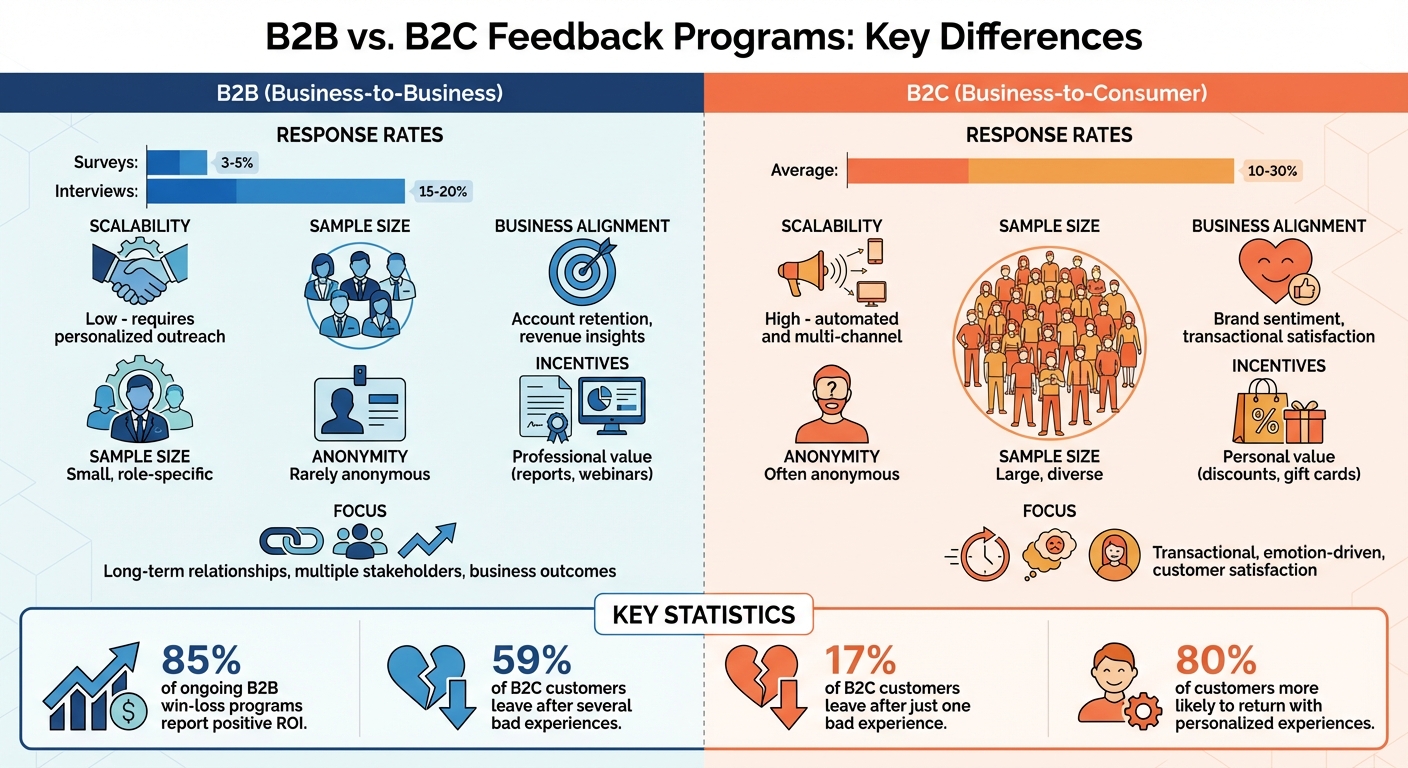
- Response Rates: B2B surveys see 3–5%, while B2C averages 10–30%.
- Scalability: B2C feedback is easier to scale with automation, while B2B requires more manual effort.
- Focus: B2B feedback prioritizes business outcomes and retention, while B2C focuses on customer satisfaction and loyalty.
The right strategy depends on understanding your audience's mindset and tailoring tools and methods accordingly.
1. B2B Feedback Programs
Audience Mindset
When it comes to B2B feedback programs, the challenge is notably different from B2C. You're not just dealing with one decision-maker; you're addressing a buying committee. This group often includes executives focused on ROI, IT teams prioritizing security, finance departments analyzing costs, and daily users interacting with your product regularly [2]. Each group has its own priorities and perspectives, making the feedback landscape more complex.
Unlike B2C customers who might quickly abandon a product when dissatisfied, B2B users often stick around due to professional obligations. This can lead to hidden frustrations simmering beneath the surface, only to come to light during critical moments like contract renewals. Because these relationships are long-term and high-stakes, B2B customers expect their feedback to result in real, measurable changes - not just surface-level acknowledgment [4].
Feedback Collection Methods
Traditional surveys often fail to hit the mark in B2B settings, with response rates hovering between 3% and 5% [3]. To truly understand your customers, you need methods tailored to the complexities of B2B relationships.
Win-Loss Analysis: This approach helps uncover why deals are won or lost, going beyond unreliable CRM data. For instance, in 2026, Tom Kahl, CRO of Hello Heart, discovered through a third-party win-loss interview by Clozd that a deal marked as "lost" was actually a "not now" scenario. Acting on this insight, the team reconnected with the lead and turned it into a $500,000 opportunity [3].
"Winning deals is our sport, and this is our video review." - Ravi Kumaraswami, President of Worldwide Field Operations, Riskified [3]
Customer Advisory Boards (CABs): These small, focused groups allow for in-depth discussions with specific customer segments, such as by industry or company size. CABs are particularly effective for gathering qualitative insights and fostering collaboration [5].
Flex AI Interviews: This modern approach uses AI to conduct asynchronous interviews, dynamically adjusting questions based on customer responses. For example, if a buyer mentions concerns about pricing, the AI can dig deeper into that issue instead of sticking to a rigid script. This method bridges the gap between static surveys and resource-heavy live interviews [3].
Proxy Feedback: Customer-facing teams like sales and customer success often hear candid feedback during onboarding or troubleshooting. These insights, which might not appear in formal surveys, can be invaluable for shaping your product roadmap [5].
These methods allow for a more nuanced and actionable understanding of B2B customer needs.
Customization Strategies
B2B feedback programs often require a different level of personalization. Unlike B2C surveys, where anonymity can encourage honesty, B2B feedback is more effective when linked to specific accounts. This allows for personalized follow-ups, a practice known as "closing the loop", which is critical for building trust in long-term partnerships [7].
To encourage participation, use personalized invitations from account managers and offer incentives that align with business goals, such as access to exclusive reports or early previews of new features [2] [4]. Since B2B respondents are more likely to abandon lengthy surveys, prioritize your most important questions at the start [5]. Including an "Other" option in multiple-choice questions can also uncover unexpected pain points [5].
Recommended Tools
For companies looking to build effective B2B feedback programs, platforms like Modu offer tailored solutions:
- Suggestions Module: A feature request board where stakeholders can submit and vote on ideas, making it easier to engage an entire buying committee.
- Text Module: Provides private forms for gathering detailed, open-ended feedback from enterprise clients.
- Roadmap Module: Displays customer-driven development plans, organized by status categories like In Progress, Planned, Backlog, and Shipped.
Modu also integrates seamlessly with tools like Slack, Jira, and Linear, ensuring feedback flows directly into your existing workflows. With password protection and SSO authentication, it meets the security needs of enterprise clients while keeping everything organized and accessible.
2. B2C Feedback Programs
Audience Mindset
When it comes to B2C feedback, emotions often take center stage. Customers in this space tend to focus on their personal experiences rather than business metrics [2]. The nature of B2C relationships is transactional and short-lived, often centering around a single purchase or delivery [4]. Unlike B2B customers, who may stick with frustrating software out of necessity, B2C consumers are quick to walk away. In fact, 59% of customers will stop engaging with a company after several bad experiences, and 17% will leave after just one [6].
"While B2C consumers will simply stop using products they don't like, unhappy B2B customers often continue using products they are unsatisfied with because they need them to do their job." - UserVoice [5]
Privacy expectations also differ. B2C customers often prefer anonymity when sharing feedback, while B2B respondents are usually comfortable being identified due to established professional relationships [4]. This means B2C programs need to act fast to capture insights before customers vanish. These distinct mindsets demand tailored methods, which are explored next.
Feedback Collection Methods
To collect meaningful B2C feedback, you need to meet customers where they already are. Multi-channel surveys on websites, apps, email, and social media help capture preferences in real time [8]. Timing is crucial - asking for feedback right after a purchase or delivery ensures the experience is still fresh and emotionally impactful [2].
Tools like in-app feedback widgets and AI chatbots allow customers to share their thoughts spontaneously without disrupting their tasks. These tools work best when activated 10–30 seconds after a page loads, avoiding interruptions during the initial experience [5].
Behavioral analytics tools, such as heatmaps and session recordings, can reveal what users do versus what they say [8]. Social listening on platforms like Instagram or X (formerly Twitter) can also uncover trends and sentiments that formal surveys might miss [8].
To combat survey fatigue, many brands now use gamification techniques - offering loyalty points, progress bars, or rewards to keep participants engaged. Monetary incentives like discounts or gift cards can even double the likelihood of survey completion [2].
Once feedback is gathered, the focus shifts to designing surveys and incentives that respect the consumer's limited attention span.
Customization Strategies
B2C feedback programs thrive when they value the consumer’s time. Surveys should be brief - ideally under 15 minutes - and in-app widgets should stick to 1–3 focused questions [2][6]. Visual appeal also matters. Surveys that include images or interactive elements tend to hold attention better [2].
Including an "Other" option is a smart way to capture unexpected insights, especially from mobile users [5]. Speaking of mobile, all feedback tools should be simple and optimized for mobile devices [8]. Rewards like discounts, gift cards, or loyalty points resonate better with B2C customers than professional perks [2].
Although individual follow-ups are rare due to the high volume of responses and anonymity, closing the loop publicly can foster trust. Sharing updates based on feedback - through social media, newsletters, or product announcements - shows customers their input matters. This approach can boost loyalty, with 80% of customers more likely to return to companies that offer personalized experiences [6][7].
These strategies lay a solid foundation for using the right tools to enhance feedback collection.
Recommended Tools
To bring these strategies to life, Modu offers a range of tools designed with consumers in mind:
- Single/Multiple Choice Modules: Quick polls that let customers share preferences without lengthy forms - perfect for A/B testing or gauging interest in new features.
- Rating Module: A simple 1–5 scale (using numbers or emojis) for capturing satisfaction scores and NPS-like feedback in seconds.
- Text Module: Private forms for open-ended responses, ensuring customer privacy while gathering detailed insights.
- Changelog Module: Share product updates with visuals like cover images and YouTube embeds, allowing customers to react with emojis and see how their feedback shaped changes.
Modu’s popup widgets can be embedded on websites or shared via direct links, making it easy to reach consumers across various touchpoints. With a mobile-friendly design, the platform ensures a smooth experience whether customers are on their phones or desktops. Plus, integrated analytics help uncover trends across thousands of responses, making it easier to act on customer insights.
B2B Vs B2C Marketing | A Detailed Guide
Pros and Cons
Let’s break down the trade-offs between B2B and B2C feedback programs to see how each approach influences feedback collection and its application.
B2B feedback programs prioritize depth and strategic alignment, but they often face challenges with low participation. Typical survey response rates in B2B hover between 3% and 5%, though live interviews can achieve higher rates of 15% to 20% [3]. While every response in B2B carries significant weight due to smaller sample sizes, this also means the data can be skewed by outliers. On the other hand, B2C feedback programs typically see 10% to 30% response rates [2], providing the volume needed to identify trends across a wide range of customer demographics.
Scalability is another area where the two differ. B2C feedback tools can easily gather input from millions of consumers through automated surveys, social media, or in-app widgets, requiring minimal manual effort. In contrast, B2B programs rely on more resource-intensive methods like personalized invitations, follow-up interviews, or customer advisory boards. While this limits how many accounts can be engaged, the insights gained are often directly tied to revenue. Notably, 85% of ongoing B2B win-loss programs report a positive ROI [3].
When it comes to business alignment, B2B feedback is tightly connected to account retention and product development. Since unhappy B2B customers often stick with products they dislike out of necessity [5], collecting feedback proactively can help prevent churn before it reaches a breaking point. B2C feedback, meanwhile, excels at capturing broader market sentiment and emotional responses that shape brand loyalty. However, anonymity in B2C feedback makes it difficult to follow up with individual customers or link their input to lifetime value [4].
B2B’s key strength lies in decision-making accuracy. Internal CRM data about lost deals is wrong 85% of the time, and competitor insights are incorrect 65% of the time [3]. Direct feedback from buyers cuts through this noise, offering actionable insights that directly influence revenue and strategy.
Here’s a quick summary of the differences:
| Factor | B2B Feedback Programs | B2C Feedback Programs |
|---|---|---|
| Response Rates | 3–5% (surveys), 15–20% (interviews) [3] | 10–30% average [2] |
| Scalability | Low; requires personalized outreach [3] | High; automated and multi-channel [2] |
| Sample Size | Small, role-specific [2] | Large, diverse [2] |
| Business Alignment | Account retention, revenue insights [3] | Brand sentiment, transactional satisfaction [2][4] |
| Data Quality | Deep, strategic, tied to CRM [3] | High volume, emotionally driven [2] |
| Anonymity | Rarely anonymous [4] | Often anonymous [4] |
| Incentives | Professional value (reports, webinars) [2] | Personal value (discounts, gift cards) [2] |
Conclusion
B2B and B2C feedback programs require different strategies to deliver meaningful insights. B2B programs focus on quality over quantity, targeting key stakeholders through personalized outreach, CRM integration, and relationship-focused follow-ups. While sample sizes may be smaller, the insights gained are often tied directly to revenue and long-term strategy. B2C programs, on the other hand, thrive on scale, using automated surveys, social media, and anonymous feedback channels to capture broad consumer sentiment and market trends.
The secret to success is aligning your feedback strategy with your audience's decision-making process. This highlights why feedback tools need to be as varied as the audiences they serve.
Closing the loop is especially critical in B2B settings. As Matthew Chatterton, Research Director at Ipsos UK, explains:
"Hearing customers in their own words is particularly powerful in B2B organisations" [1]
A unified platform can simplify managing these different approaches. Modu offers the tools to handle both effectively. Use Text modules for private, account-specific B2B surveys or Suggestions modules to create public B2C idea boards that gather thousands of votes. Rating modules are ideal for NPS-style B2B relationship evaluations, while Single Choice polls can quickly capture B2C consumer preferences. Integrations with tools like Slack, Jira, and Linear help B2B teams close the loop efficiently, while popup widgets and anonymous feedback options make it easy to collect large-scale B2C responses.
FAQs
How do I choose between B2B interviews, CABs, and surveys?
When deciding how to gather feedback or insights, think about your goals and who you're trying to reach.
- B2B interviews are perfect for digging deep into qualitative insights. These one-on-one conversations with decision-makers give you a detailed understanding of their needs and challenges.
- CABs (Customer Advisory Boards) work well for strategic input. They involve collaborative discussions with key clients, helping you gain high-level feedback and shape your long-term strategies.
- Surveys are best for collecting broad, quantitative data. They’re ideal for spotting trends, measuring satisfaction, and gathering input at scale.
Each method serves a different purpose: interviews for in-depth knowledge, CABs for strategic collaboration, and surveys for large-scale analysis. Match your approach to your objectives to get the best results.
What’s the best way to “close the loop” in B2B vs. B2C?
Closing the loop works differently for B2B and B2C audiences.
For B2B, the focus is on building long-term relationships through personalized interactions. This often means using direct communication and actionable feedback to create a sense of partnership and trust over time.
On the other hand, B2C takes a broader approach. Scalable methods like surveys and automated responses help manage large volumes of feedback efficiently. The goal here is to build trust and loyalty by showing responsiveness on a larger scale.
While both aim to address customer needs, B2B prioritizes deeper connections, whereas B2C emphasizes speed and wide-reaching engagement.
Which Modu modules fit B2B feedback vs. B2C feedback?
Modu modules are versatile and can be adjusted to suit both B2B and B2C feedback needs.
- For B2B: Modules like Suggestions, Ratings, and Text are excellent for gathering ideas, measuring satisfaction scores, and collecting private feedback. These tools cater to professional settings where detailed and thoughtful input is often required.
- For B2C: Single/Multiple Choice and Ratings modules shine for quick surveys and gathering broad feedback. Additionally, Suggestions can be a great way to involve larger consumer groups by crowdsourcing ideas and fostering engagement.
The key is to select modules that align with your audience's preferences and your specific feedback objectives.