
Stakeholder Alignment Checklist for Feature Prioritization
Stakeholder Alignment Checklist for Feature Prioritization
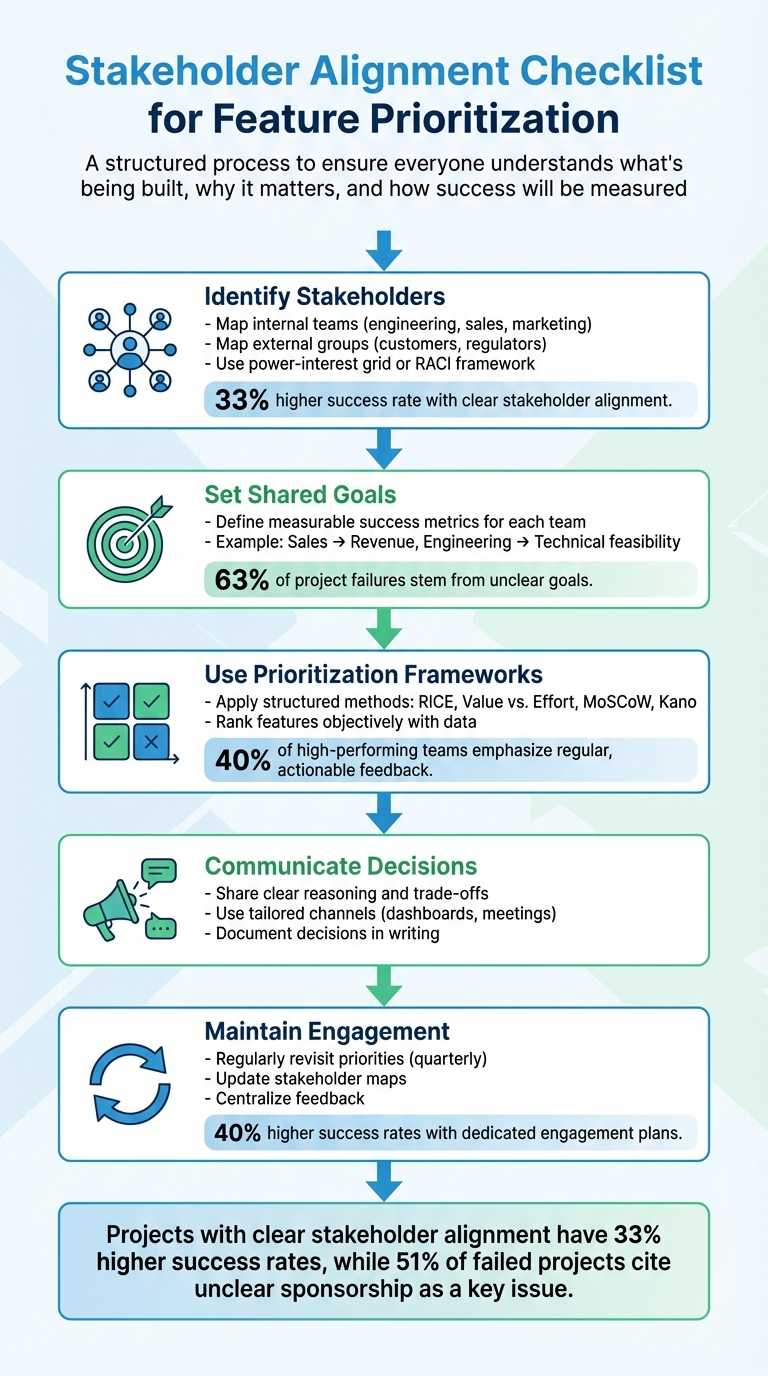
Feature prioritization often fails when stakeholders are not aligned. Miscommunication leads to confusion, wasted resources, and unmet expectations. To avoid this, you need a structured process that ensures everyone understands what’s being built, why it matters, and how success will be measured.
Here’s a quick guide to align stakeholders effectively:
- Identify Stakeholders: Map out internal teams (e.g., engineering, sales, marketing) and external groups (e.g., customers, regulators). Use tools like a power-interest grid or RACI framework to clarify roles.
- Set Shared Goals: Define measurable success metrics for each team (e.g., sales focuses on revenue, engineering on technical feasibility).
- Use Prioritization Frameworks: Apply structured methods like RICE or Value vs. Effort to rank features objectively.
- Communicate Decisions: Share clear reasoning, trade-offs, and updates through tailored channels (e.g., dashboards, meetings).
- Maintain Engagement: Regularly revisit priorities, update stakeholder maps, and centralize feedback to adapt to changes.
This approach reduces surprises, builds trust, and ensures resources are focused on the most impactful features. By following this checklist, you can streamline decision-making and keep everyone aligned throughout the process.
Using Your Roadmap to Drive Stakeholder Alignment | Featured Product Makers, Bruce McCarthy
Identify Key Stakeholders and Their Roles
When mapping out stakeholders, it’s not just about titles - it’s about impact. For example, a customer support rep dealing with user complaints about missing features might offer more practical insights than a senior executive who’s less involved in day-to-day product interactions.
Your stakeholder network often extends beyond your immediate team. Internally, this typically includes product managers, engineering leads, UX/design teams, sales, marketing, customer success, finance, legal, security consultants, and executives. Externally, you’re looking at end-users, customers, regulators, investors, suppliers, service vendors, and integration partners [6]. Why is this important? Projects with clear alignment among stakeholders have a 33% higher success rate, while 51% of failed projects cite unclear sponsorship as a key issue [6]. By identifying and mapping these players upfront, you ensure every voice is heard before moving forward.
Create a Stakeholder Map
A power-interest grid can help you organize stakeholders based on their influence and level of interest. This 2x2 matrix divides people into four categories:
- High Influence/High Interest: Engage with them daily - they’re critical to success.
- High Influence/Low Interest: Keep them satisfied with concise updates.
- Low Influence/High Interest: Keep them informed with regular updates.
- Low Influence/Low Interest: Monitor them with occasional check-ins [6].
Tailoring your communication to fit these categories can boost cross-functional efficiency by 21% [6].
To avoid confusion about roles, use the RACI framework. Assign stakeholders specific responsibilities:
- Responsible: The person doing the work.
- Accountable: The decision-maker.
- Consulted: Those who provide input.
- Informed: Those who need updates [6].
Document Stakeholder Information
Keep detailed records of each stakeholder’s role, goals, communication preferences, and how they influence feature prioritization [6]. For instance:
- Engineering teams focus on technical feasibility and managing technical debt.
- Sales teams prioritize revenue and deal velocity.
- Marketing teams emphasize clear value propositions.
- Support teams aim to lower ticket volumes.
To objectively rank stakeholder importance, use weighted scoring. Surveys can help team leads rate stakeholders on a 1–5 scale based on factors like funding authority, expertise, compliance needs, and the scope of their influence [6]. Companies using automated stakeholder mapping have seen a 23% drop in missed requirements during launches [6].
Validate the Stakeholder List
To ensure no one is overlooked, ask stakeholders to recommend others who might be impacted or hold veto power. This "snowball" approach can uncover hidden influencers [6]. Cross-functional workshops with representatives from engineering, sales, and support are another way to minimize blind spots [6]. Explicitly identify which stakeholders will help move the project forward and which might pose obstacles [6].
Revisit your stakeholder list quarterly or after major milestones to reflect any changes in influence or interest [6]. Pay attention to feedback - if stakeholders frequently report feeling left out of decisions, it’s a sign your process needs adjustment [1]. Consider this: 82% of unmet expectations in digital tools stem from misidentifying end-user groups [6]. Keeping your stakeholder mapping process dynamic is key to avoiding these pitfalls.
Align Stakeholders Around Feature Goals
Once you've mapped your stakeholders, the next step is aligning feature priorities with their key concerns. This doesn’t mean everyone has to agree on every decision - it’s about making sure everyone understands why a decision was made. That distinction is crucial: 63% of project failures stem from unclear goals and communication gaps [6].
Start by defining the strategic vision before diving into specific features. Different teams naturally focus on different priorities - sales cares about revenue, developers worry about technical debt, and support teams want to reduce ticket volume. To make progress, you need a shared framework to evaluate features objectively.
Define Success Criteria for Stakeholders
Building on your stakeholder mapping, the next step is to define measurable success metrics that align with each team’s objectives.
Every group sees success through a different lens. For example:
- Executive leadership tracks ROI and market share.
- Sales teams focus on new customer acquisition and recurring revenue.
- Engineering teams prioritize velocity and managing technical debt.
- Support teams aim to reduce ticket volume and improve satisfaction.
- Marketing teams look at conversion rates and brand awareness.
- End users care about task efficiency and ease of use.
By documenting these metrics upfront, you can avoid endless debates later. A shared scoring rubric helps here - define what "High Impact" means with concrete examples, like achieving a >10% lift in a specific KPI. This ensures everyone evaluates features using the same criteria.
Document Feature Value Statements
Every feature should have a concise, clear explanation of the problem it solves and the benefit it delivers. Think of it as an elevator pitch - keep it to 150–160 characters and tie it directly to a strategic initiative. This approach makes the feature's purpose crystal clear. If you can’t summarize a feature in one or two sentences, it probably needs more refinement.
It’s also important to distinguish outcomes from activities. For example, "Secure budget approval" is an outcome, but "Facilitate stakeholder workshops" is just an activity. When you tie features to measurable business results instead of just tasks, it’s easier for everyone to see how the feature fits into the bigger picture. Linking features to strategic goals like this fosters alignment and broader buy-in.
Identify and Address Misalignments
Even with clear success criteria and value statements, conflicts between stakeholder groups are bound to happen. The key is addressing them early, not letting them fester.
When disagreements arise, let data be the neutral decider. Metrics like NPS, adoption rates, or potential revenue can help settle disputes. For example, if sales champions a feature that engineering finds too complex, real customer data - like the number of users requesting the feature or its potential revenue impact - can provide clarity.
To manage trade-offs effectively, consider hosting "Buy-a-Feature" workshops. Assign a cost to each feature based on effort, then give stakeholders a limited budget to “buy” the ones they value most. This exercise highlights what truly matters when resources are tight. For particularly thorny issues, you could run facilitated trade-studies where you weigh pros, cons, and risks, scoring features against key criteria. Doing this in a live session ensures everyone understands the reasoning behind decisions, fostering transparency and trust.
Select and Use a Prioritization Framework
Once stakeholder goals are aligned, the next step is to objectively assess and compare feature options. A structured prioritization framework helps transform subjective opinions into measurable scores, making decisions easier to justify while maintaining stakeholder trust. The framework you choose should align with your team's size, product complexity, and the data you have available.
Evaluate Framework Options
Different frameworks suit different needs:
- RICE (Reach, Impact, Confidence, Effort): Ideal when you have quantitative data and need objective comparisons.
- Value vs. Effort: A simple 2x2 matrix that quickly visualizes trade-offs between business impact and development complexity.
- MoSCoW (Must have, Should have, Could have, Won't have): Perfect for time-boxed releases where scope needs to be clearly defined.
- Kano Model: Focuses on user satisfaction by categorizing features as basic needs, performance improvements, or "delighters."
The framework you select should reflect your team’s priorities and stakeholder diversity. For example, executives focused on ROI might prefer the RICE framework, while non-technical teams may find the Value vs. Effort matrix more intuitive. Importantly, your choice should align with the success metrics established earlier. According to research, 40% of high-performing teams emphasize regular, actionable feedback as key to making informed product decisions, so opt for a framework that encourages data-driven discussions over gut instincts [7].
Collaborate on Framework Application
A prioritization framework only works if stakeholders trust the scoring process. To achieve this, involve cross-functional leads in the application of the framework. For instance:
- Engineering teams can estimate effort and technical complexity.
- Sales and support teams can provide data on impact and reach.
- Product leadership can evaluate how features align with strategic goals.
This collaborative approach ensures a balanced perspective, preventing any one team from dominating the discussion.
Before diving in, create a standardized scoring rubric. Define clear criteria for each score. For example, specify that a "High Impact" score of 5 equates to a ">10% lift in monthly recurring revenue." Without these clear definitions, scores may vary wildly based on personal interpretation. Use past projects with known outcomes to calibrate scores and ensure consistency [7].
For particularly contentious decisions, consider running a "Buy-a-Feature" workshop. In this exercise, assign each feature a cost based on effort and give stakeholders a limited budget to "purchase" their top priorities. This forces realistic trade-offs and helps identify what truly matters when resources are tight [7].
Once everyone agrees on the scoring, document the results to maintain transparency and avoid confusion.
Document and Share Results
Transparency is key. Share prioritization results and their rationale promptly to ensure stakeholders stay informed. No one should hear about decisions through informal channels. Establish a single source of truth, such as a shared wiki, project management tool, or a roadmap platform like Modu’s Roadmap module. These tools can organize features into clear statuses such as Backlog, Planned, In Progress, and Shipped [1].
Save dated snapshots of your prioritization matrix to track how rankings evolve over time. Use visual aids like color-coding or traffic-light indicators (green/yellow/red) to make dense scoring grids easier to scan and highlight top priorities [7]. Instead of just listing features, tell a story that explains the customer problem each feature addresses and why it’s a priority now. This narrative approach helps stakeholders understand not just what you’re building, but why it’s important at this moment [1].
Communicate Decisions and Set Expectations
Once you've gathered input from stakeholders, the next step is to clearly communicate your decisions. This transparency builds trust and reduces friction. When stakeholders understand the reasoning behind prioritization, they’re less likely to feel left out or blindsided. The aim isn’t just to announce what’s been prioritized - it’s to explain the logic, acknowledge trade-offs, and establish realistic expectations.
Present Prioritization Logic
Take the time to walk stakeholders through the decision-making framework you used. For example, if you relied on a scoring model like RICE, share the results: "Feature A scored 85 (Reach: 5,000 users, Impact: 3/5, Confidence: 80%, Effort: 2 weeks), while Feature B scored 42." This level of transparency helps decisions feel grounded in logic rather than politics.
Visual aids can make a big difference here. Tools like heatmaps or 2×2 matrices (impact versus effort) simplify complex trade-offs, making them easier to understand. For non-technical stakeholders, prototypes or diagrams are especially useful for illustrating constraints or challenges.
Be upfront about what didn’t make the cut and why. For instance: "The mobile app redesign was deprioritized because it didn’t align with our Q2 focus on retention. Data shows that UI friction isn’t a top complaint among current users." Acknowledging these kinds of trade-offs not only builds credibility but also helps set realistic expectations about what your team can deliver.
Define Scope and Success Metrics
Clearly outline the project scope, exclusions, and success metrics in a single document. For example, if you’re working on an analytics dashboard, you might specify: "In scope: user-level data exports, 7-day retention tracking. Out of scope: real-time alerts, custom report scheduling. Success metric: 30% of active users adopt the dashboard within 60 days of launch." This level of detail ensures everyone is aligned on what’s being delivered and prevents scope creep.
To avoid confusion over roles, consider using a framework like RACI (Responsible, Accountable, Consulted, Informed). It clarifies who has decision-making authority and who needs to be kept in the loop, reducing unnecessary disputes or misunderstandings.
Select Communication Channels
Once scopes and metrics are defined, choose the right communication channels to share updates. Tailor your approach to each stakeholder group based on their level of influence and interest. For example:
- High-power, high-interest stakeholders (e.g., VPs or key customers) benefit from weekly one-on-ones or live review meetings where they can ask questions directly.
- Low-power, low-interest groups (e.g., peripheral teams) are better served with automated dashboards or monthly newsletters.
Here’s a quick guide to communication strategies:
| Stakeholder Group | Engagement Level | Recommended Channel | Frequency |
|---|---|---|---|
| Executives (CEO/VP) | Keep Satisfied/Manage Closely | Executive Dashboards, 1:1s, 3-bullet summaries | Monthly/Quarterly |
| Engineering Leads | Manage Closely | Sprint planning, 1:1s, Technical docs | Weekly |
| Sales/Marketing | Keep Informed | Async updates, Monthly syncs, Product Narratives | Monthly |
Document every decision in writing, even after verbal discussions. This creates a single source of truth and avoids confusion caused by informal reinterpretations.
"Asana maintains stakeholder alignment by writing 'decision docs' after every major choice. These documents are shared widely across the organization to ensure everyone knows what was decided, why, and what the next steps are, preventing information from living only in 'silos.'" [1]
Platforms like Modu’s Roadmap module can help keep everyone on the same page. Features are organized into clear categories - Backlog, Planned, In Progress, and Shipped - so stakeholders can easily see progress. Combine this with a Changelog module to broadcast releases, ensuring sales, support, and customers stay informed.
Maintain Stakeholder Engagement After Prioritization
Once priorities are set, keeping stakeholders engaged is crucial for staying aligned and adapting to changes. Prioritization isn't a one-and-done process - it requires consistent attention throughout development. Without ongoing communication, priorities can shift, trust may weaken, and past debates can resurface, wasting valuable time and energy.
Establish a Communication Cadence
Tailor your communication approach to match each stakeholder's level of influence and involvement. For core teams like engineering, design, and product, weekly check-ins or brief syncs can help address blockers and fine-tune plans. Functional leads - such as sales or customer success - benefit from monthly updates summarizing progress and upcoming features. Executives often prefer quarterly reviews with a focus on high-level metrics and strategic alignment [2][5][8].
Adopt a "write more, meet less" mindset. Use asynchronous tools like wikis, project hubs, or decision documents for routine updates, reserving meetings for complex discussions or major decisions [1][8]. This approach respects everyone's time while ensuring information continues to flow.
A communication matrix can help you organize who needs what information, how often, and in what format. Here's a quick example:
| Stakeholder Group | Engagement Level | Recommended Cadence | Primary Format |
|---|---|---|---|
| Core Team (Eng/Design) | Collaborate | Weekly | 1:1s / Sprint Planning |
| Functional Leads (Sales/CS) | Consult/Involve | Bi-weekly / Monthly | Async Updates / Monthly Sync |
| Executive Leadership | Inform/Satisfy | Monthly / Quarterly | Executive Dashboard / 1:1 |
| Broader Org / Users | Inform | Monthly / Ad-hoc | Newsletter / Public Roadmap |
One golden rule: stakeholders should never hear about delays or scope changes from someone else. Always flag risks early and propose solutions to maintain trust [8]. This structured communication ensures transparency and keeps everyone aligned.
Centralize Feedback and Updates
Once communication channels are in place, centralizing updates in a single repository streamlines access for everyone. This eliminates confusion and reduces the need for status-check emails, allowing stakeholders to self-serve without disrupting your workflow.
Tools like Modu's Roadmap module can help organize updates by categorizing features into Backlog, Planned, In Progress, and Shipped. Pairing it with Jira or Linear ensures real-time progress tracking. Stakeholders can check the status anytime, while the Changelog module keeps teams and customers informed about completed releases.
To make updates more digestible, use visual indicators like traffic-light badges (green/yellow/red) or progress bars. These make it easy for executives to scan high-level updates, while detailed views can be provided to teams who need them [7]. For example, executives might see a "Now, Next, Later" summary, while engineering teams access a more granular breakdown [4].
Closing the feedback loop is just as important. Notify stakeholders when a feature they requested or supported is completed. This simple gesture turns passive observers into active supporters and reinforces that their input matters.
Adapt to Changing Conditions
Your engagement plan shouldn't be static - it needs to evolve as priorities and stakeholder dynamics shift. Reassess your stakeholder power and interest grids quarterly to ensure your communication strategy stays effective [5][8].
Regularly evaluate your approach at the end of each sprint or quarter. If a meeting format isn't working or resistance is growing, adjust quickly. Projects that include dedicated stakeholder engagement plans are shown to have up to 40% higher success rates [5].
When priorities shift, be transparent about trade-offs. Use a "no to the request, yes to the need" framework to explain delays or changes. For example: "We're moving the mobile redesign to Q3 to prioritize the API integration you requested. This means enterprise features will be delivered two months earlier, but consumer-facing updates will take longer." This level of openness prevents stakeholders from feeling blindsided.
Finally, replace one-off surveys with continuous feedback tools like pulse surveys or embedded feedback forms. Modu's Rating and Text modules make it easy to collect ongoing input without scheduling formal reviews [5]. This kind of real-time listening helps you spot potential issues before they escalate, keeping your stakeholder relationships strong and productive.
Conclusion
Stakeholder alignment isn’t something you can check off after a single meeting - it’s a continuous effort that ensures your product decisions lead to effective execution. The checklist you’ve just reviewed offers a practical system for transforming conflicting priorities into shared goals, helping every team understand not just what you’re building, but why it matters.
Strong alignment can make or break a project, reducing the risk of failed initiatives and highlighting the importance of structured stakeholder management [6]. It’s the difference between delivering impactful features and getting stuck in endless debates. By mapping stakeholders based on their influence, defining success criteria early, and relying on structured decision-making frameworks, you shift from subjective opinions to clear, data-driven choices [3][7].
"Stakeholder management is the single most underestimated skill in product management. You can have perfect strategy... but if you cannot align stakeholders, none of it ships." – Tim Adair, Strategic Executive Leader, IdeaPlan [8]
As you put this checklist into practice, remember that alignment is an ongoing commitment. The real challenge isn’t just the kickoff meeting - it’s what happens months later when shifting priorities or technical hurdles arise. Teams that treat stakeholder maps and roadmaps as evolving tools, revisit them quarterly, and maintain a single source of truth report up to 40% higher project success rates [6]. This proactive approach helps avoid “passive resistance,” where stakeholders agree in meetings but stall progress behind the scenes [5].
FAQs
How can I identify 'hidden' stakeholders?
To find those 'hidden' stakeholders who might not be immediately apparent but are crucial to your project, you can use stakeholder mapping and analysis techniques. Tools like the stakeholder salience theory - which evaluates power, legitimacy, and urgency - can help identify these individuals or groups. Other methods, such as RACI matrices, customer segmentation, and influence/interest grids, provide a structured way to pinpoint less obvious stakeholders who are key to achieving project success.
What metrics should define feature success?
To gauge the success of a feature, it’s crucial to align metrics with both strategic objectives and what users truly need. Some key indicators to consider include:
- User feedback: Pay attention to ratings, suggestions, and other forms of direct input from users. These insights can reveal how a feature is perceived and areas for improvement.
- Engagement data: Track metrics like votes and open-ended responses to understand how users interact with the feature and their overall sentiment.
- Performance indicators: Look at adoption rates, how often the feature is used, and its influence on broader business goals, such as improving retention or boosting customer satisfaction.
The metrics you select should not only highlight progress but also help align stakeholders and offer clear, actionable insights to guide decision-making and prioritization.
Which prioritization framework should we use?
Choosing the right prioritization framework depends on what your project demands. A feature prioritization matrix offers a clear way to evaluate features by assigning scores based on factors like user value, business impact, and development effort. Frameworks such as MoSCoW or the Kano Model provide methods to classify features by their level of importance or how they resonate with users. By blending data-driven insights with feedback from stakeholders, you can make well-rounded decisions that align priorities with overall goals.