
5 Steps for Goal-Driven Roadmap Planning
5 Steps for Goal-Driven Roadmap Planning
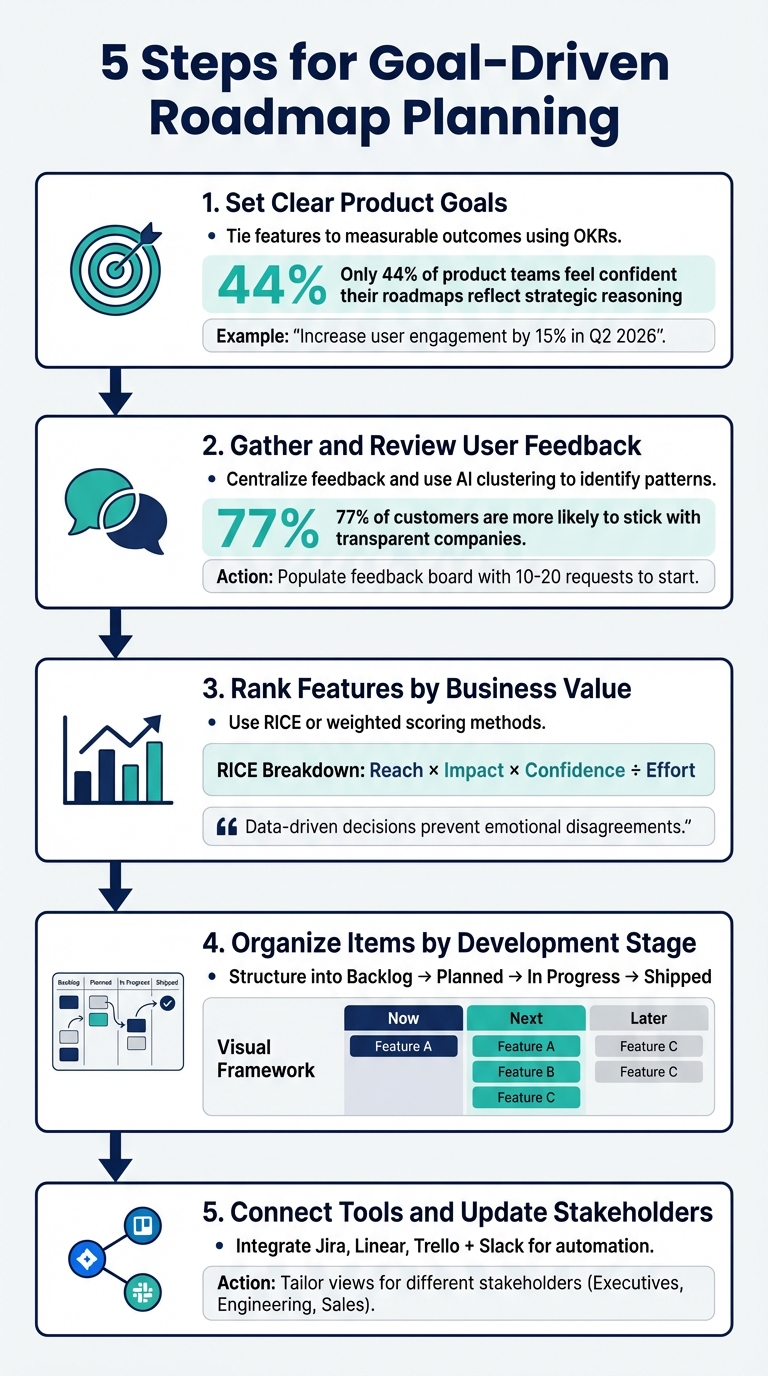
A roadmap without clear goals is ineffective. This guide focuses on aligning product features with business goals to create roadmaps that prioritize impact and clarity. Here’s a quick summary of the five steps:
- Set Clear Product Goals: Tie every feature to measurable business outcomes using frameworks like OKRs. Focus on the "why" before the "what" or "when."
- Gather and Review User Feedback: Centralize feedback, use tools like AI clustering to identify patterns, and align requests with strategic goals.
- Rank Features by Business Value: Use methods like RICE or weighted scoring to prioritize features objectively based on their impact, reach, confidence, and effort.
- Organize Items by Development Stage: Structure your roadmap into stages like Backlog, Planned, In Progress, and Shipped for clarity and alignment.
- Connect Tools and Update Stakeholders: Integrate tools (e.g., Jira, Slack) to automate updates and tailor views for different stakeholders.
1. Set Clear Product Goals
Goal Alignment
Start by ensuring your product strategy aligns seamlessly with your company's broader business objectives. Think of it as a strategic hierarchy where every product goal connects to higher-level goals - from individual features to product lines, divisions, and ultimately, the company’s overall strategy [4]. This approach transforms your roadmap from a simple feature list into a powerful tool that drives measurable outcomes.
It's important to distinguish between goals and the means to achieve them. Goals represent the destination, while initiatives are the steps to get there [4]. Your roadmap should clearly answer the "what" and "when", but only after you've nailed down the "why" [1]. For instance, instead of saying "Build a new dashboard", frame it as a measurable outcome like: "Increase user engagement by 15% in Q2 2026." This shift keeps the focus on the desired impact rather than the mechanics.
Interestingly, only 44% of product teams feel confident that their roadmaps reflect the strategic reasoning behind their work [5]. To bridge this gap, tie every feature or epic directly to a business goal, whether that’s boosting retention, reducing churn, or addressing technical debt [3]. This outcome-driven approach ensures that roadmap discussions revolve around impact rather than just a list of features.
Frameworks like OKRs (Objectives and Key Results) can serve as your team’s guiding star [3]. By clearly defining key metrics, you can make prioritization more objective. Use your roadmapping tools to link each feature to both strategic goals and overarching initiatives, making it easier to see how daily tasks contribute to the bigger picture [4]. Finally, incorporate user feedback and voting into your process to refine and strengthen your strategy.
2. Gather and Review User Feedback
Stakeholder and User Feedback Inclusion
User feedback is the backbone of a solid, data-driven roadmap. But let’s face it - keeping all that input organized can be tricky. Teams often collect feedback from multiple channels, which makes spotting patterns a real challenge. The solution? Use a single feedback portal to bring everything together in one place. This way, no valuable insight gets overlooked.
Once you’ve centralized your feedback, tools like AI clustering can do the heavy lifting. These tools group similar requests into themes - like "Onboarding Issues" or "Performance Complaints" - helping you uncover trends without spending hours combing through entries. Plus, it minimizes duplicate requests, so your priorities don’t get skewed.
To get things rolling, populate your feedback board with 10–20 requests right from the start. This shows users that their input matters and encourages more participation. Categorize feedback by topics like UI, integrations, or mobile, and work with your engineering team to assign a 1–5 complexity score. This makes prioritizing tasks much easier. By centralizing and organizing feedback, you’re not just simplifying your process - you’re also setting the stage to connect user insights with your strategic goals.
Tool Integration and Transparency
Once your feedback is centralized, integrating tools that promote transparency can make a big difference. Why? Because transparency builds trust. In fact, research shows that 77% of customers are more likely to stick with companies that are open about their processes [2]. For example, setting up automatic notifications to let users know when a feature they voted for moves from "Planned" to "Shipped" can turn casual users into loyal advocates. It’s also a great way to reduce repetitive support questions.
Make sure every feedback request ties back to your strategic goals. This keeps your roadmap focused and aligned with your objectives. It also makes it easier to explain why certain popular requests aren’t being developed, which helps maintain trust and transparency with your users.
3. Rank Features by Business Value
Goal Alignment
Focus on strategy, not just what's trending. Start by clarifying your vision and SMART goals - those that are Specific, Measurable, Achievable, Relevant, and Time-bound. Every feature in your roadmap should tie back to these objectives. For example, if your goal is to boost daily active users by 20% by Q3 or cut churn by 15% this quarter, each feature should directly contribute to those targets [2].
Make sure to connect every feature to a strategic goal. This clear alignment allows for more objective evaluations as you move through the prioritization process.
Prioritization Methods
One trusted framework for prioritizing features is RICE. This method scores initiatives based on four factors:
- Reach: How many users will it impact?
- Impact: How much will it improve their experience?
- Confidence: How certain are you about your estimates?
- Effort: How much development time will it take?
The RICE formula generates a single score, helping you balance customer needs with your team's capacity [2].
"If you use a prioritization model, your decisions are data-driven rather than based on gut feeling, preventing objections and emotional disagreements." - Andrei Tiburca, UX Expert, Lucid.co [8]
Another option is weighted scoring, which is simpler but still effective. Assign weights to criteria like business value, cost, and risk based on what matters most to your organization. Multiply each feature's score by these weights to rank them objectively [8]. Collaborative workshops, like "Priority Poker", can also be helpful. These sessions allow subject matter experts to score features together, reducing bias and avoiding dominance by the loudest voice in the room [8].
Tool Integration and Transparency
Once you've scored your features, use tools like Modu's roadmap module to streamline the process. Integrate with platforms like Jira, Linear, or Trello to sync approved suggestions directly into your roadmap. Automate task creation when items transition from "Planned" to "In Progress", ensuring everyone stays on the same page without the hassle of manual updates.
For every strategic goal, define success metrics and attach clear KPIs. For instance, you might track a goal like "Increase trial-to-paid conversion by 12% by June 30, 2026." These metrics make it easier to evaluate whether a feature delivers the intended business value [2]. Over time, this data-driven approach will help you refine and improve your prioritization process.
4. Organize Items by Development Stage
Roadmap Organization
When you structure a roadmap by development stages, it becomes much easier to understand where things stand, what's coming next, and what ideas are still under consideration. The categories - Backlog, Planned, In Progress, and Shipped - are already familiar, so you can use these to neatly organize your work.
For agile teams, the "Now, Next, Later" framework is a practical way to manage priorities. Here's how it works: "Now" covers what's in active development, "Next" focuses on the upcoming cycle, and "Later" holds the long-term backlog. To make things even clearer, teams often use color coding: Navy for "Now/Committed", Teal for "Next/Upcoming", and Light Gray for "Later/Future" [2][6].
| Development Stage | Description | Typical Time Horizon |
|---|---|---|
| Backlog / Under Review | Ideas and feedback being evaluated for strategic relevance. | Later |
| Planned | Features committed to but not yet started. | Next |
| In Progress | Items actively being developed or designed. | Now |
| Shipped / Done | Features that are completed and released to users. | Completed |
This setup not only helps your team stay on track but also makes collaboration with stakeholders much more effective.
Stakeholder and User Feedback Inclusion
Before moving items from the Backlog to Planned, take a moment to validate your assumptions through discovery sessions with stakeholders. This step ensures that the features align with user needs and business goals. Collaboration with engineering leads is equally important - they'll provide insights into technical feasibility and scalability [10].
Bringing in Sales and Marketing teams early is also a smart move. It allows them to prepare their messaging and campaigns around upcoming features [9][10]. Juan Manuel Agudo Carrizo, Head of Product at Product School, offers an interesting perspective:
"Missing deadlines is not necessarily a bad thing... You're calibrating, trying to find the sweet spot. It really comes down to the relationship between the engineering manager or director and the team" [10].
When you combine stakeholder input with well-integrated tools, your roadmap process becomes much smoother.
Tool Integration and Transparency
Using tools like Modu's roadmap module can simplify your workflow. It organizes features into Backlog, Planned, In Progress, and Shipped, giving you and your team instant visibility into progress. Plus, integrations with Jira, Linear, or Trello can automatically create tasks as items move between stages, keeping everyone aligned.
For external roadmaps, it's best to focus on customer benefits and overall progress rather than sticking to rigid deadlines [8][6]. Internal roadmaps, on the other hand, should dive into the details - dependencies, resources, and tactical plans. Transparency is key here: 77% of customers are more likely to trust and do business with companies that are open about their processes [2]. Many teams now label external items with confidence indicators like "committed", "targeted", or "exploring" rather than assigning fixed dates [6]. This approach balances clarity with flexibility.
5. Connect Tools and Update Stakeholders
Tool Integration and Transparency
Bring your team's tools together for seamless collaboration. Use project management platforms like Jira, Linear, or Trello to sync status updates automatically. Pair these with communication tools like Slack or Microsoft Teams to send real-time alerts whenever priorities shift. For example, Modu integrations can notify users instantly when a feature is shipped, reinforcing confidence and keeping everyone informed. This kind of synchronization not only simplifies internal workflows but ensures stakeholders get timely, actionable insights tailored to their roles.
Stakeholder-Specific Views
Automated updates are just the start - customizing information for different stakeholders is where the magic happens. Executives typically need a big-picture view of strategic goals and outcomes, while engineering teams focus on detailed feature statuses and dependencies. Sales teams, on the other hand, benefit from clear timelines and feature benefits, enabling them to communicate effectively with potential customers [4][7]. Tailor these dashboards to match each team's goals and the metrics they care about most.
"Airtable has changed the way I organize and view my information. It gives you the freedom and structure to design a solution that fits your needs, and evolve that solution progressively over time." – Jeremy Ho, Software Engineer at Uber [7].
To keep everyone aligned, establish a regular rhythm for updates. Weekly stand-ups can help surface blockers, monthly reviews of "Now/Next/Later" priorities keep teams focused, and quarterly strategic sessions ensure long-term alignment [2]. When priorities change, document the decisions in a log that explains what shifted, why it happened, and the tradeoffs made. This practice builds transparency and trust, especially during times of change [6].
How to Build a Product Roadmap: 5 Steps From Features to Outcome Roadmap (REAL EXAMPLE)
Conclusion
Goal-driven roadmap planning shifts product development from simply churning out features to becoming a focused, strategic process. When every item on the roadmap connects directly to business goals, resources are allocated to work that delivers measurable results, rather than being spread thin across conflicting priorities. This structured approach replaces subjective debates with clear, objective decision-making, making it easier to confidently turn down requests that don’t align with overarching objectives [8].
Incorporating user feedback ensures your roadmap stays grounded in real-world needs. By actively gathering input through suggestions, ratings, and open-ended responses, you can create a roadmap that balances strategic business goals with genuine user demands. This balance builds trust and transparency with stakeholders, fostering stronger, long-term relationships [2].
"Caring deeply about outcomes rather than personal comfort is fundamental to effective leadership." – Francois Ajenstat, Chief Product Officer, Amplitude [11]
This mindset is at the heart of every successful roadmap. Modu brings these principles to life by streamlining the feedback and planning process. With the Suggestions module, you can collect and prioritize feature requests through community voting, ensuring that only the most impactful ideas move forward. Approved ideas sync directly to the Roadmap module, where stakeholders can monitor progress across statuses like Backlog, Planned, In Progress, and Shipped. Integrate tools like Jira, Linear, or Trello to automatically update your roadmap as tasks advance, and configure Slack notifications to keep everyone informed when priorities change. This cohesive workflow keeps your roadmap current and eliminates the need for manual updates.
FAQs
How do I pick the right KPIs for each roadmap goal?
To choose the best KPIs, tie them directly to your roadmap goals - whether that's boosting satisfaction, driving revenue, or cutting down churn. Focus on metrics that are measurable, actionable, and relevant. For example, use Net Promoter Score (NPS) to gauge satisfaction or retention rates to assess engagement. As your roadmap shifts, revisit and refine your KPIs regularly to keep them aligned with your objectives and to ensure they support smart, data-driven choices.
How can I turn messy user feedback into clear feature themes?
Collecting feedback efficiently is crucial for understanding user needs. Tools like Modu make it easier by centralizing suggestions, ratings, and open-ended responses in one place. Once you've gathered the input, the next step is to analyze it. Look for common requests and recurring patterns, then organize similar ideas into larger, overarching themes. This approach transforms scattered feedback into clear, structured insights that highlight what users care about most.
How often should I update the roadmap and who needs which view?
Updating your roadmap regularly is essential to stay aligned with shifting priorities, progress, and feedback. How often you update it depends on factors like your goals, the pace of project changes, and what your stakeholders need.
For internal teams, detailed, real-time updates can be incredibly useful to keep everyone on the same page. On the other hand, external audiences often prefer a simplified, high-level overview, such as a "Now, Next, Later" format.
Frequent updates not only help ensure everyone is aligned but also build trust and keep your audience engaged, whether they're part of your team or external users.