
How AI Enhances Feedback Analysis
How AI Enhances Feedback Analysis
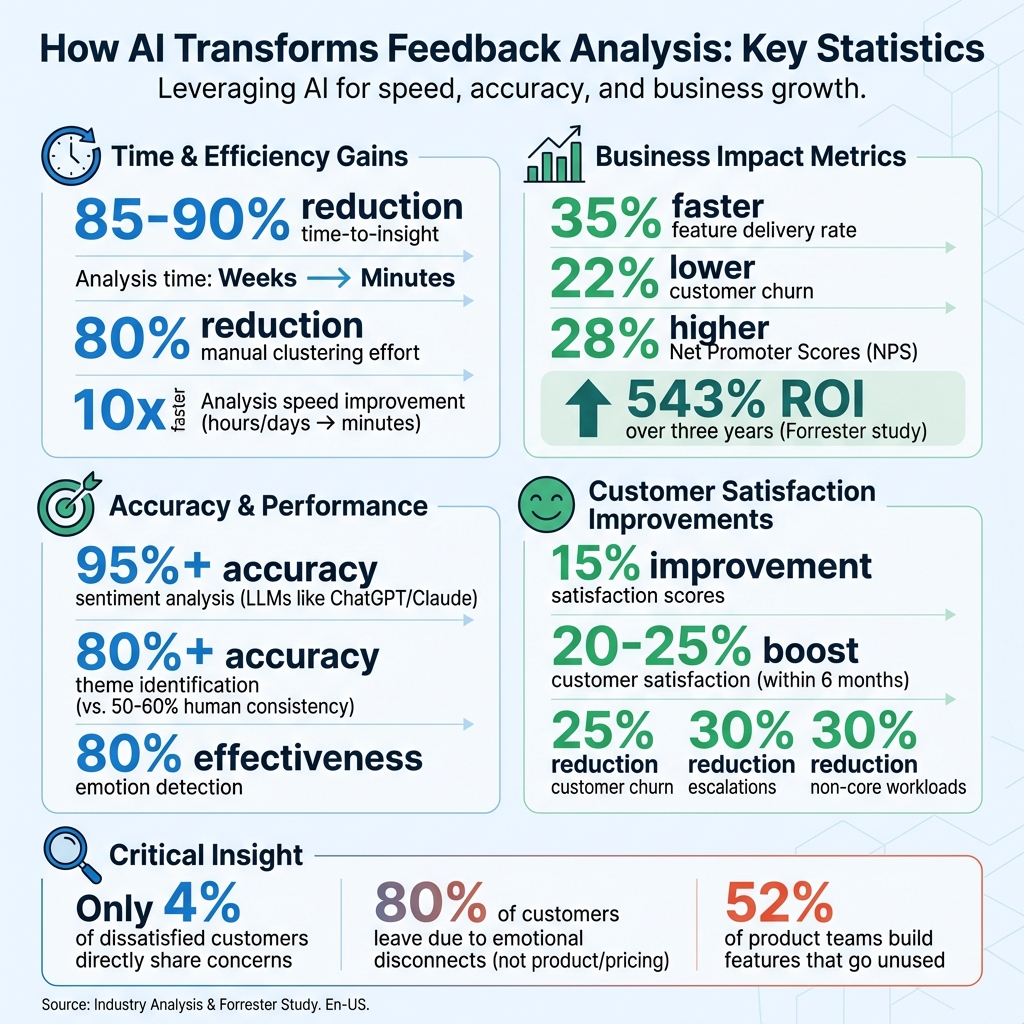
AI is transforming how businesses analyze customer feedback, cutting analysis time from weeks to minutes and improving decision-making accuracy. By automating sentiment analysis, clustering themes, and enabling real-time insights, AI eliminates human bias and uncovers trends that drive better outcomes. Key benefits include:
- Faster insights: 85–90% reduction in time-to-insight.
- Improved decisions: AI objectively identifies patterns and trends missed by manual analysis.
- Business impact: Companies report a 35% faster feature delivery rate, 22% lower churn, and 28% higher Net Promoter Scores.
AI tools like sentiment analysis, topic modeling, and real-time analytics streamline feedback processing, enabling businesses to act on customer needs quickly and effectively. For example, companies like Fivetran and Greyhound have used AI to prioritize feature requests and unify feedback from multiple channels, achieving measurable improvements in customer satisfaction and operational efficiency.
With tools like Modu, businesses can centralize feedback collection, automate clustering, and gain actionable insights for as little as $59/month. The key takeaway? AI doesn't just speed up feedback analysis - it makes it smarter.
Build This Product Feedback AI Analyst In Just 10 Minutes | FULL TUTORIAL
AI Methods Used in Feedback Analysis
AI takes customer feedback and turns it into practical insights by using techniques that assess sentiment and identify patterns, helping businesses address concerns and improve experiences.
Sentiment Analysis and Emotion Detection
Sentiment analysis relies on natural language processing (NLP) to classify feedback as positive, neutral, or negative. Modern systems go further by recognizing context, sarcasm, and intent. The process involves text preprocessing (like tokenization), applying deep learning models such as BERT or Transformers, and categorizing sentiment. Some systems also map emotions to specific feelings like joy, anger, or trust [8][9][10].
This capability is critical - studies show that 80% of customers leave a brand because of emotional disconnects rather than product issues or pricing [8]. For example, in a study analyzing 10,000 support tickets, AI found that 30% of tickets marked as "neutral" actually showed signs of frustration [8].
Large language models like ChatGPT and Claude achieve over 95% accuracy in sentiment analysis, while typical systems range from the high-80s to low-90s in accuracy. Emotion detection, while slightly less precise, still performs at around 80% effectiveness [10][11]. Many tools combine rule-based lexicons with machine learning for deeper insights, enabling aspect-based sentiment analysis to evaluate specific parts of a message [9][12].
"AI sentiment analysis helps you read between the lines of customer feedback. It doesn't just count complaints; it uncovers how your customers feel."
- FeedbackRobot [8]
After sentiment analysis, topic modeling organizes feedback into meaningful themes.
Theme Clustering and Topic Modeling
Topic modeling uses unsupervised machine learning to group similar feedback into themes without manual tagging [10][13][15]. This approach works with unstructured text - like survey responses or support tickets - to identify clusters of related words, revealing what customers are discussing.
Popular methods include:
- Latent Dirichlet Allocation (LDA): Treats each feedback item as a mix of topics.
- Non-negative Matrix Factorization (NMF): Simplifies data into clear themes.
- Latent Semantic Analysis (LSA): Uncovers word relationships based on co-occurrence [13].
Advanced tools often create hierarchies, breaking broad themes like "Customer Support" into subtopics such as "Long Wait Times" or "Unhelpful Responses" [14]. AI can identify themes with over 80% accuracy, far surpassing the 50–60% consistency achieved by human coders [16]. In fact, a Forrester study found that businesses using AI-powered theme discovery saw a 543% ROI over three years [16].
"Topic modeling automatically finds groups of similar words and clusters them into topics... This saves businesses time, making it easy to understand what people are talking about, without having to read each review individually."
- Oluwatosin Obalana, Medium [13]
Real-Time Analytics and Anomaly Detection
Building on sentiment analysis and topic modeling, real-time analytics monitors live data to identify and address issues as they arise. This approach shifts businesses from looking back at past problems to predicting and preventing future ones [17]. Unlike manual reviews that rely on sampling, AI examines all customer interactions across channels like surveys, chats, and social media [3][4]. It can spot sudden spikes, outliers, or shifts in sentiment that might otherwise go unnoticed [17][2].
Modern systems flag high-priority issues - like technical glitches or billing errors - and send alerts to the appropriate teams instantly [10][4]. They can also link customer sentiment to operational data, such as connecting a drop in satisfaction to increased noise levels or equipment downtime, helping businesses address root causes quickly [17].
For example, Motel Rocks implemented Zendesk Copilot in January 2026 for real-time sentiment analysis, achieving a 9.44% increase in CSAT and cutting support tickets by 50% [3]. Similarly, Cynet boosted CSAT by 14 points and reduced ticket volumes by 47% through centralized knowledge and workflow automation [6]. Liberty maintained an 88% CSAT score by evaluating all interactions in real time [3].
AI-driven feedback systems can improve satisfaction scores by 15% and reduce non-core workloads by 30% [17]. Real-time insights can also lower customer churn by 25% and cut escalations by 30% [6].
"Legacy feedback tells you where you've been. AI-infused predictive feedback tells you where you're going."
- Steve Peltzman, FeedbackNow [17]
How Organizations Use AI-Driven Feedback Analysis
Organizations are leveraging advanced AI tools to turn raw customer feedback into actionable insights. This shift allows companies to refine product strategies and enhance customer experiences by replacing guesswork with data-backed decisions.
Prioritizing Feature Requests
One of the biggest challenges for product teams is distinguishing which feature requests truly matter. According to research, 52% of product teams admit to building features that go unused, often because they prioritize feedback volume over what’s actually impactful [18]. AI addresses this by ranking feedback based on factors like customer revenue, retention risk, and technical feasibility. This ensures that high-value accounts with quieter feedback aren’t overlooked in favor of less impactful but more vocal users. Beyond identifying themes, AI now takes a prescriptive approach by proposing solutions or even drafting Product Requirement Documents based on feedback patterns.
A great example comes from Fivetran, which in January 2026 adopted an AI-powered feedback system to manage requests for its 700+ connectors. Spearheaded by Shiva Mogili, Director of Product Management, the platform integrates data from Zendesk, Jira, and Salesforce into BigQuery. Within an hour of a new feature request being submitted, the system generates automated "T-shirt sizing" estimates, helping product managers quickly evaluate feasibility [23].
"The output is a complete report that includes a feasibility assessment, 'T-shirt sizing' effort estimates, API research findings with evidence, and a pre-formatted command that triggers an implementation agent."
- Shiva Mogili, Director of Product Management, Fivetran [23]
AI can reduce manual clustering of feedback by 80%, but decision-making can still stall if roadmaps aren’t aligned with broader strategies [18]. To avoid wasting resources, companies must weight feedback by account value and involve engineering teams early to assess technical feasibility. Additionally, unifying feedback from multiple sources gives teams a more complete view of customer needs.
Combining Feedback from Multiple Channels
Customer feedback often comes from a variety of channels, which can lead to fragmented insights. AI solves this by consolidating data from different sources, helping companies distinguish between recurring complaints and issues that drive meaningful change [19]. Interestingly, only 4% of dissatisfied customers directly share their concerns, leaving the majority of dissatisfaction unvoiced unless AI proactively analyzes data across all channels [22]. Unlike human moderators, AI applies consistent criteria to feedback analysis, free from emotional or cognitive biases [20].
In 2026, Greyhound used AI-powered tools to unify feedback from post-ride surveys, station reports, and driver evaluations. This reduced analysis time by a factor of ten - from several hours or even days to just minutes. Station managers were able to address location-specific problems on the same day they were reported [19]. Similarly, a European telecom provider serving 35 million customers used AI to analyze millions of feedback points. They discovered that 30% of negative feedback stemmed from unmet expectations around real-time data tracking. By updating their mobile app accordingly, they achieved a 25% boost in positive feedback and a 10-point increase in NPS within six months [21].
"Unified data doesn't automatically mean unified insights... Customer feedback analytics was what turned that data into decisions."
- Kyo Zapanta, Thematic [19]
Organizations that integrate AI-driven sentiment analysis across all feedback channels have reported customer satisfaction improvements of 20–25% within six months [22]. To maximize results, it’s crucial to centralize all feedback into a single platform before applying AI analysis, avoiding the pitfalls of data silos that limit visibility.
How Modu Uses AI for Feedback Analysis

Modu has developed tools that take established AI methods and customize them to turn varied user feedback into clear, actionable insights. By automating the grouping of feedback and identifying patterns, it saves product teams from the time-consuming task of manual categorization, allowing them to focus on making important decisions.
AI Clustering for Trend Identification
Modu's AI clustering uses proprietary algorithms that combine text analysis with numerical ratings to identify trends more precisely. For instance, feedback like "where is the download feature?" and "I can't find the export button" would be grouped into a single insight about missing export functionality. This approach helps manage large volumes of feedback efficiently [18]. The platform analyzes both qualitative data (like user comments) and quantitative data (such as rating scores), treating numerical ratings as contextual metadata [24]. For example, a 3-star rating paired with the comment "slow loading times" is weighted more heavily than a standalone rating. This method highlights how Modu turns raw feedback into insights that teams can act on.
Feedback Collection Tools
Modu offers six different modules for collecting user input. These include:
- Suggestions modules: Public idea boards for gathering user ideas.
- Text modules: Private channels for bug reporting.
- Rating modules: Tools for satisfaction scores (1–5 scale) and NPS tracking.
- Polls: Single and multiple-choice surveys for structured feedback.
- Roadmap modules: Visual displays of product plans organized by status, such as Backlog or Shipped.
- Changelog modules: Platforms for release notes, which can include cover images and YouTube embeds.
These tools can be embedded directly on a website, shared via links, or deployed as popup widgets. This flexibility allows teams to choose the setup that best suits their feedback collection and analysis needs.
Pricing Plans and AI Features
Modu's pricing structure is designed to cater to different needs:
- Growth Plan ($59/month): Includes AI clustering, unlimited boards, Google Sheets exports, SSO, password-protected boards, custom domains, and support for up to 10 team members (additional seats cost $5/month).
- Start Plan ($24/month): Offers 3 boards, 15 modules, and integrations with tools like Slack, Jira, Trello, and Linear. However, it does not include AI clustering.
- Free Plan: Limited to 1 board and 3 modules, with basic theme customization but no AI features or third-party integrations.
To access AI-powered clustering and advanced analytics, organizations must opt for the Growth plan, which unlocks these automation capabilities alongside other premium features.
Best Practices for Using AI Feedback Tools
Setting Up Feedback Collection
Gathering effective feedback is the backbone of generating actionable AI-driven insights. Instead of relying on generic emails, use short, context-specific surveys (1–3 questions) triggered by user actions to encourage higher response rates [25]. For instance, you could send an NPS survey right after onboarding or a feature-specific survey after repeated usage. Including optional open-text fields allows users with strong opinions to share more details while letting others complete the survey quickly.
To avoid overwhelming users, limit surveys to one per user per week [25]. This strategy helps prevent survey fatigue and keeps users engaged without feeling bombarded.
It's also essential to pull feedback from multiple sources - support platforms, app reviews, social media, and CRM systems [1][27]. Before feeding this data into AI tools, ensure you deduplicate and filter responses to maintain clean and reliable datasets [26][15]. Clean data leads to better insights. Finally, integrate this refined feedback directly into your operational tools to enable quick, meaningful action.
Integrating AI Insights into Your Workflow
Feedback collection is only useful if it’s seamlessly integrated into your team’s processes. Once you’ve set up a solid feedback system, connect the platform to tools like Slack to receive real-time alerts when negative sentiment spikes or critical issues surface [1][25]. Routing urgent concerns to the appropriate team channels ensures they’re addressed promptly.
For product and engineering teams, syncing AI-clustered feedback with tools like Jira, Asana, or Linear can streamline workflows. For example, if users frequently report slow loading times, the AI can automatically generate a task with all related feedback attached. This automation eliminates the need for manual data transfer between tools [1][25][27].
Additionally, use email mapping to link anonymous feedback to user profiles in your analytics platform [27]. For example, connecting a bug report to a customer’s account data can reveal whether the issue affects a long-time power user or a new customer, helping teams prioritize fixes more effectively. However, always involve humans in decision-making. As Unmesh Sheth, CEO of Sopact, wisely notes:
"AI handles patterns. Humans handle meaning." - Unmesh Sheth, CEO, Sopact [2]
Regularly review AI-generated feedback clusters to ensure their accuracy and provide the business context that algorithms might miss.
The Future of AI in Feedback Analysis
Analyzing Multiple Feedback Formats
AI is stepping into new territory, going beyond text to process voice recordings, video content, images, and even long-form documents like PDFs [2][5]. This multi-modal approach offers teams a broader understanding of user sentiment across various channels. For example, rather than manually sifting through transcripts, AI can convert voice to text and extract meaningful insights in just minutes [30]. Similarly, with video feedback, AI can detect patterns in user demonstrations or screen recordings - tasks that would otherwise take hours for a human to analyze.
Modern systems are also combining image and text data using advanced fusion techniques, making it easier to gather actionable insights compared to older methods [29]. Imagine a user submitting a screenshot of a confusing interface alongside a comment. AI can analyze both the image and the text together, providing a richer context than either source could on its own. By synthesizing diverse data sources, AI also generates concise summaries, allowing teams to make faster, more informed decisions.
AI-Generated Feedback Summaries
Generative AI is transforming how feedback is summarized, creating structured reports tailored to specific audiences. For example, leadership might receive executive summaries, product teams could get root cause analyses, and engineers might see detailed technical reports [28][1]. These summaries are linked to the original feedback, making it easy to verify insights or dive deeper into specific issues. This approach slashes the time it takes to uncover insights - reducing the process from weeks to just hours, an 85% improvement [1].
Instead of wading through thousands of comments, product managers can now ask direct questions like, "How has participant confidence changed since last quarter?" and receive immediate, data-driven answers [2].
A real-world example of this comes from SAP SE, which conducted a UX measurement project between January 2022 and November 2023. Using a multi-label classification model (SBERT), they analyzed 8,757 manually labeled user comments across 40 software products. The AI achieved an F1 score of 0.82 for complex categories like "Licensing", enabling the team to quickly determine whether specific investments were reducing complaints [28].
This ability to generate tailored summaries is paving the way for even deeper AI integration, including direct links between feedback and user profiles.
Linking Feedback to User Profiles
The next wave of AI innovation involves connecting individual feedback to unique user profiles, creating a comprehensive view of each customer’s journey [2]. This means organizations will be able to track a user’s sentiment over time - from their first onboarding survey to their latest support ticket. By integrating feedback with user profiles, businesses can take more proactive and informed actions.
This capability also introduces predictive analysis. AI could identify customer segments at risk of churn or predict which features might spark complaints - before problems escalate [7]. For instance, if a typically satisfied power user suddenly leaves a frustrated comment, the system could flag it as a priority issue.
The move toward agentic AI will take things even further. These systems won’t just analyze feedback - they’ll act on it. Future tools could autonomously update FAQs, route complex issues to the right experts, or tweak website navigation based on patterns of confusion [4]. While AI will handle many routine tasks, human oversight will remain crucial for understanding the deeper "why" behind trends and for making strategic, context-driven decisions [28][2].
Conclusion
AI has reshaped feedback analysis in ways that are hard to ignore. Tasks that used to drag on for weeks can now be completed in just hours. The results? A 35% boost in feature delivery speed, a 28% improvement in Net Promoter Scores (NPS), and a 22% drop in churn rates [1].
This evolution pushes businesses beyond simply reacting to problems. With AI, you can spot trends before they become issues, eliminate human bias, and free up product managers to focus on making strategic decisions. As Unmesh Sheth, Founder & CEO of Sopact, explains:
"The promise isn't about replacing human intuition; it's about finally giving humans time to think, decide, and improve." - Unmesh Sheth, Founder & CEO, Sopact [2]
And here's a blunt reality check from LoopJar:
"If you're still manually analyzing feedback in 2026, you're competing against teams that aren't." - LoopJar [1]
For companies ready to take the leap, Modu's Growth plan offers an easy way to get started. At $59/month, this plan uses AI clustering to uncover trends across unlimited feedback sources - whether it’s community suggestions, ratings, or open-ended responses. Modu also centralizes feedback collection with tools like website embeds, popups, and direct links, making it easier than ever to surface actionable insights.
The real question isn’t whether to adopt AI - it’s how quickly you can do it. Start small by focusing on one key feedback channel, measure the ROI, and then scale up. By weaving AI-powered tools into your feedback processes, you’ll stay ahead in the race toward smarter, data-driven product development.
FAQs
What data do I need to get accurate AI feedback insights?
To get precise insights from AI feedback, you need to start with well-structured, high-quality data. This data should come from a variety of sources, such as customer feedback, surveys, support tickets, social media interactions, and product usage data. It’s also crucial to ensure that the data is collected and prepared correctly - clean, organized, and ready for analysis. This preparation step is key to making sure your AI delivers meaningful and actionable insights.
How do I validate AI sentiment and topic clusters?
To check the accuracy of AI sentiment and topic clusters, compare the AI's output with manual evaluations or established benchmarks. Start by reviewing a sample of feedback to see if sentiment labels - like positive, negative, or neutral - align with human assessments. For topic clusters, take a closer look at a subset of grouped feedback to verify that related comments are organized logically. These steps are key to ensuring that the AI analysis is accurate and dependable.
How can Modu fit into my existing product workflow?
Modu fits smoothly into your product workflow, using AI to simplify how you collect, analyze, and prioritize feedback. You can add features like community suggestions, polls, and ratings directly to your website or share them through links or widgets to gather input from multiple channels. Its AI-powered analytics identify trends and sentiment, enabling your team to focus on the most important feedback. This approach boosts collaboration and helps streamline decision-making.