
How Negative Feedback Improves Customer Satisfaction
How Negative Feedback Improves Customer Satisfaction
Negative feedback isn’t a setback - it’s an opportunity. When customers point out flaws, they’re giving you direct instructions on how to improve. Businesses that respond thoughtfully and take action on complaints can build trust, retain more customers, and even boost revenue. Here’s why handling criticism matters and how to do it right:
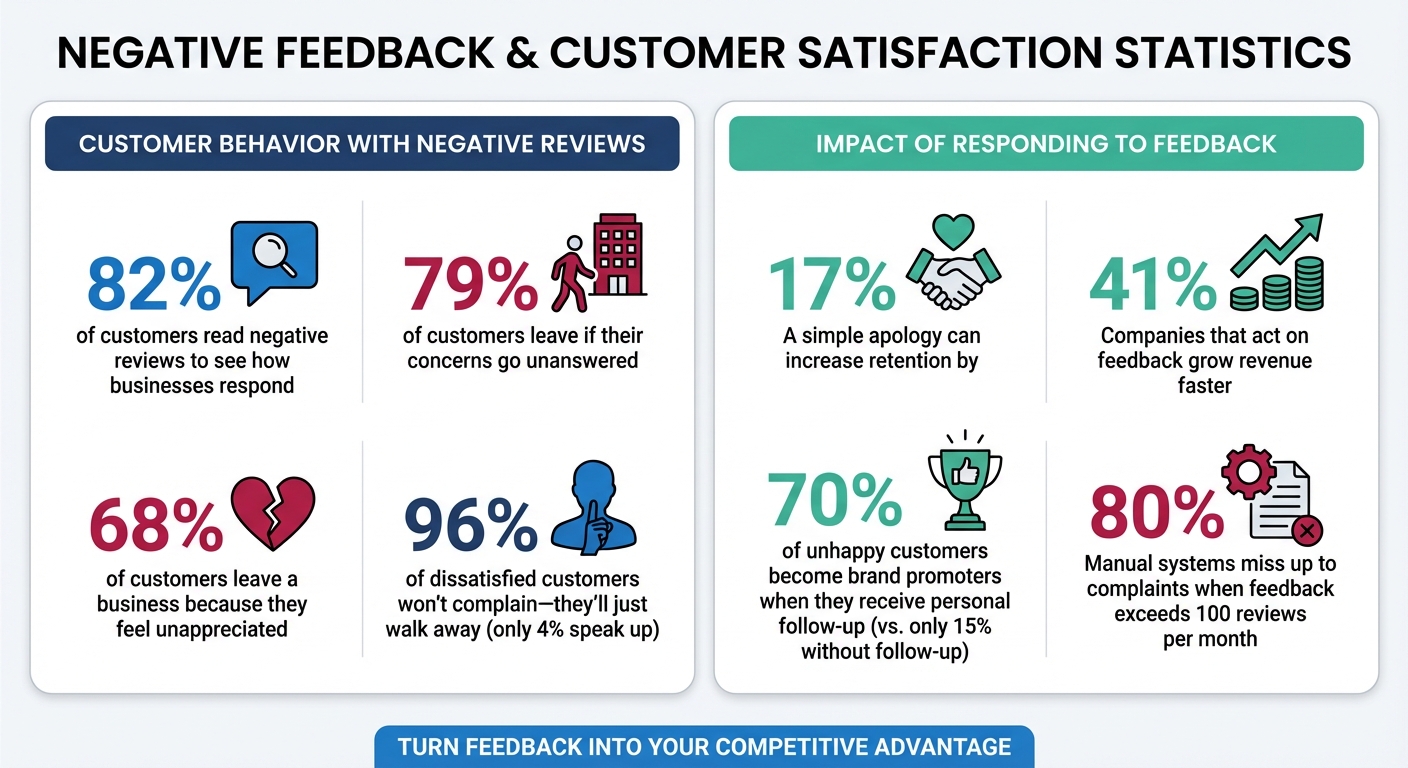
- 82% of customers read negative reviews to see how businesses respond.
- 79% of customers leave if their concerns go unanswered.
- A simple apology can increase retention by 17%.
- Companies that act on feedback grow revenue 41% faster.
The key? Centralize feedback, identify patterns, and respond with empathy. Tools like Modu can help streamline this process, ensuring no complaint is overlooked. When customers see their concerns addressed, they’re more likely to stay loyal and recommend your business. Ignoring feedback isn’t just a missed chance - it’s a risk to your reputation and bottom line.
How to Handle Negative Feedback From Customers
Common Problems with Managing Negative Feedback
Even when businesses recognize the importance of negative feedback, handling it effectively remains a challenge. The problem often isn’t the feedback itself - it’s what happens afterward. Teams may react defensively, feedback gets lost across multiple channels, and critical issues end up being ignored. This not only wastes valuable insights but also risks alienating customers. Consider this: 68% of customers leave a business because they feel unappreciated [8], and 96% of dissatisfied customers won’t even bother to complain - they’ll just walk away [9]. Two core barriers contribute to this struggle: emotional resistance from teams and system breakdowns in feedback management.
Why Teams Push Back Against Negative Feedback
The toughest hurdle isn’t about tools or processes - it’s emotional. Negative feedback often feels like a personal critique. When customers criticize a product or service, employees may interpret it as an attack on their work, triggering defensive reactions that shut down meaningful conversations [2]. This defensiveness is often rooted in a fear of blame, with employees worrying that acknowledging issues will reflect poorly on their performance.
This mindset not only demoralizes teams but also stifles productivity. Instead of viewing feedback as a chance to improve, they see it as a threat. The result? Slow or non-existent responses, which customers interpret as indifference. This further erodes trust and loyalty, creating a vicious cycle.
System Breakdowns in Feedback Management
Even when teams are open to feedback, operational shortcomings can derail the process. Feedback often comes from multiple sources - app reviews, social media, support tickets, emails - leaving it scattered and difficult to act on [5] [3]. For example, product teams may never see the recurring complaints that support teams deal with daily, allowing the same problems to persist for months.
Industry experts have pointed out these systemic issues:
"Mistake #1: Treating Negative Reviews as Support Tickets. Support teams are trained to resolve individual issues. Product teams need patterns across dozens of complaints. When negative reviews go to support and stop there, the product insight dies." - Alterna CX [9]
Manual processes, like using spreadsheets or tagging feedback by hand, simply can’t keep up with high volumes. When feedback exceeds 100 reviews per month, manual systems miss up to 80% of complaints [9]. Without a clear prioritization framework, businesses end up reacting to the loudest voices rather than addressing the root causes of customer dissatisfaction. And when customers don’t see any changes based on their input, they assume their feedback was ignored, discouraging them from sharing insights in the future.
How to Turn Negative Feedback into Better Results
Handling negative feedback effectively can be the difference between a business that thrives and one that struggles. The key? A clear, structured system. Without one, even well-meaning teams can find themselves overwhelmed, unable to turn criticism into meaningful change. Here's a simple three-step approach to transform feedback into a competitive edge.
Step 1: Organize and Centralize Feedback
Scattered feedback doesn’t help anyone. When complaints come through a mix of emails, social media, app reviews, and support tickets, they can easily slip through the cracks. The first step is to bring all feedback into one centralized system where patterns can be identified [3][5].
Platforms like Modu make this easier by offering tools like feedback boards. You can use Rating modules to measure satisfaction and Net Promoter Scores (NPS) on a 1–5 scale. Suggestions modules allow customers to propose ideas and vote on them, while Text modules handle private complaints like bug reports or sensitive issues - visible only to your team.
Once feedback is centralized, categorize it by type (e.g., product quality, service, delivery) and assign severity levels (mild, moderate, or severe) [3][4]. This structure helps teams focus on the most pressing problems. For urgent issues, set up automated alerts to ensure critical complaints are addressed before they escalate [3]. Even a simple, timely apology can improve retention rates by up to 17% [7].
Step 2: Identify Patterns and Address Root Causes
Collecting feedback is just the beginning. The next step is analyzing it to uncover recurring issues. For small volumes, manual review might suffice, but larger datasets call for automation. AI tools can group similar complaints, making trends easier to spot and enabling root cause analysis (RCA) to tackle problems at their source [7][1].
For example, if customers frequently report a slow checkout process, the issue might stem from a confusing payment interface rather than server performance. By addressing the underlying cause, you not only resolve the immediate complaints but also prevent future ones.
It’s equally important to close the loop with your customers. Let them know when their feedback has led to changes. This transparency builds trust, and considering that 85% of consumers trust online reviews as much as personal recommendations, it can also enhance your brand’s reputation [3][5][2].
Step 3: Respond Quickly and With Empathy
Speed is crucial, but empathy is what truly makes a difference. Aim to send a personalized initial response within 4–5 hours of receiving a complaint [7]. Automated acknowledgment emails can confirm receipt instantly, providing a ticket number and an estimated resolution time [7]. This reassures customers that their concerns are being taken seriously.
When responding, avoid generic templates. Address the customer by name and reference specific details from their complaint. This shows you’re genuinely listening [7][2]. A heartfelt apology can go a long way - customers who receive one rate their satisfaction twice as high as those who don’t [7].
Offer practical solutions, like discounts, free shipping, or reward points, to demonstrate your commitment to resolving the issue [7][1]. Finally, follow up 24–48 hours after resolution to ensure the problem hasn’t resurfaced. This extra step can strengthen customer relationships and reduce churn [7].
Taking Action and Keeping Customers Informed
Feedback is only useful if you act on it. The businesses that stand out are those that turn customer insights into concrete improvements. Taking action not only solves problems but also shows your customers that their voices matter. This is how you build trust and loyalty.
Turning Feedback Into Actionable Changes
Once you've identified common themes in customer feedback, it's time to prioritize solutions. A centralized system helps ensure that no issue falls through the cracks. Tools like an impact-effort matrix can help you decide what to tackle first - start with fixes that require minimal effort but deliver maximum impact [5].
Streamlining the process is key. Integrating your feedback platform with tools like Jira, Slack, or Modu's Roadmap module ensures that customer complaints become actionable tasks. These integrations can automatically convert feedback into tickets, send alerts, and keep everyone - from product teams to sales - aligned on priorities.
Modu's Roadmap module takes this a step further by adding transparency. When a customer-requested feature moves from "Backlog" to "Planned" or "In Progress", it’s clear that their input is shaping your product. Businesses that build this kind of feedback loop experience 41% faster revenue growth and better customer retention [5]. And once the changes are live, communicating those updates strengthens the bond with your customers even more.
Building Trust Through Communication
When you make changes based on feedback, let your customers know. Transparency builds trust and shows that their input has real value. For example, in January 2026, Motel Rocks - a popular online fashion retailer - used Zendesk Copilot to analyze customer sentiment and address recurring issues. The result? A 9.44% increase in their Customer Satisfaction Score (CSAT) and a 50% drop in support ticket volume [5].
Tools like Modu's Changelog module make sharing these updates simple. Every time you release a fix or a new feature, you can publish a detailed update, complete with visuals or even YouTube walkthroughs. Personalized follow-ups are especially impactful - 70% of unhappy customers turn into loyal advocates when they receive follow-ups, compared to just 15% without them [9].
Keep in mind that 68% of customers leave a company because they feel unappreciated [8]. A quick message like "We heard you, and here’s what we did" can turn a frustrated customer into a lifelong supporter. And when customers see that their concerns are addressed, they’re more likely to provide meaningful feedback and stick with your brand in the future.
Tracking Results from Feedback Improvements
Measuring the outcomes of changes is essential to confirm their effectiveness. After making adjustments based on customer feedback, the next step is to evaluate their impact on customer satisfaction.
Monitoring Satisfaction Scores Over Time
Begin by tracking key satisfaction metrics before and after implementing changes. Metrics like Net Promoter Score (NPS), Customer Satisfaction Score (CSAT), and Customer Effort Score (CES) provide valuable insights into customer sentiment. For instance, segmenting NPS results by product area can help identify which changes are working well [6].
Tools like Modu's Rating module simplify this process by centralizing 1–5 rating scales and offering analytics to track trends. For businesses on the Growth plan, AI clustering can group similar feedback themes, making it easier to see which improvements resonate most with customers.
In addition to satisfaction scores, keep an eye on product and support metrics. For example, one SaaS analytics platform noticed their 12-step onboarding process was linked to a low 3.4-star rating on G2. By reducing the process to just 3 steps, they cut "difficult to learn" complaints by 82% and boosted their G2 rating to 4.2 within 90 days [9]. Similarly, a mobile banking app addressed 85 complaints about mobile check deposits by introducing real-time photo capture feedback. This change increased the first-attempt deposit success rate from 67% to 91% and reduced related support tickets by 78% [9].
To quantify the value of these improvements, you can calculate ROI using this formula:
ROI = (Prevented Churn Value + Increased Conversion Value) / Development Cost [9].
This calculation not only highlights the business impact of customer feedback but also demonstrates to stakeholders how customer-driven changes deliver measurable returns. Consistent tracking ensures the feedback loop remains active and effective.
Getting Customers to Keep Sharing Feedback
Once you’ve established satisfaction trends, the focus shifts to encouraging ongoing feedback. It’s worth noting that 96% of unhappy customers leave silently [9]. That vocal 4%? They’re a goldmine for turning detractors into promoters.
A simple, personalized thank-you message that outlines the changes made can go a long way in driving repeat feedback. In fact, 70% of customers who receive a personal follow-up after their issue is resolved become brand promoters, compared to just 15% who don’t receive any follow-up [9]. This approach not only fosters continuous improvement but also aligns with proactive problem-solving.
Modu's Suggestions module makes it easy to maintain a feedback loop. Customers can submit ideas and vote on others’ suggestions. When approved ideas are synced to your Roadmap and updates are shared via the Changelog module, customers see the direct impact of their input. This transparency builds trust and motivates continued participation. While incentives like discounts can help, showing genuine appreciation is the most effective way to keep customers engaged [8] [1].
Conclusion
Negative feedback can be a game-changer. The businesses that thrive the most are the ones that treat criticism as a guide for improvement, not as something to shy away from. As Alterna CX wisely points out:
"The complaints already exist. Your competitors are reading them too. The question is: who acts on them faster?" [9]
To turn feedback into an advantage, it’s essential to follow a clear process: centralize how you collect feedback, use AI to spot patterns, respond promptly (ideally within 48 hours), and close the loop by showing customers how their input leads to action. Companies that embrace this approach can see up to 41% faster revenue growth and as much as a 95% boost in profits through better retention [5].
Tools like Modu simplify this process by consolidating feedback from multiple channels. Features such as the Suggestions module allow customers to share ideas and vote on priorities, while AI clustering identifies recurring issues to uncover root causes. When approved ideas are added to your Roadmap and updates are published in your Changelog, customers see their input in action. Combine this with a personal follow-up, and you could turn 70% of dissatisfied customers into loyal advocates [9].
It’s worth noting that only 4% of unhappy customers speak up - the rest leave without a word [9]. Those who do share their concerns are giving you a rare opportunity to make things right. By addressing their feedback, you not only solve immediate problems but also build trust, loyalty, and a reputation for listening. This approach doesn’t just improve customer satisfaction - it drives meaningful growth and strengthens your business for the long haul.
FAQs
What’s the best way to prioritize negative feedback?
To make the most of negative feedback, approach it with a clear and organized strategy. Start by systematically reviewing the feedback to uncover recurring themes or patterns. These patterns often point to the most pressing and actionable issues. Engage with customers to clarify their concerns when needed, ensuring you fully understand their perspectives. Then, focus on implementing specific changes that address these key areas.
Tools like Modu can simplify this process. With features like suggestion boards and open-ended response collection, Modu helps teams gather, organize, and prioritize feedback. By crowdsourcing priorities, businesses can zero in on critical issues and tackle them effectively. This approach ensures that feedback isn't just collected - it’s used to create meaningful improvements that boost customer satisfaction.
How do you respond to a complaint without sounding generic?
When responding to a customer, it's crucial to address their specific issue head-on and make the interaction feel personal. Start by acknowledging their concern directly - mentioning the details they shared can go a long way in showing you truly listened. Use empathetic language to validate their feelings, whether it's frustration, confusion, or disappointment.
Then, explain the steps you're taking to resolve the issue. Be clear and transparent about what actions are underway or what they can expect next. Avoid generic, scripted replies that feel impersonal. Instead, tailor your response to their feedback, showing that their input matters to you. This approach not only builds trust but also reassures the customer that their voice is heard and valued.
Which metrics prove feedback changes are working?
Metrics such as Customer Satisfaction Score (CSAT), Net Promoter Score (NPS), and retention rates are great tools to show how effective feedback-driven changes are. They provide a clear way to measure progress in boosting customer satisfaction and loyalty over time.