
Integrating AI into Product Strategy
Integrating AI into Product Strategy
AI is transforming product strategy by enabling teams to predict trends, analyze data, and make informed decisions faster. Unlike older methods that rely heavily on intuition, AI uses real-time data to improve decision-making, shorten planning cycles, and optimize workflows. Key benefits include faster product improvements, better customer segmentation, and higher returns on investment.
Key Takeaways:
- AI improves decision-making: Predicts feature adoption, effort, and risk using historical data.
- Real-time insights: Tracks competitor actions, customer behavior, and market shifts.
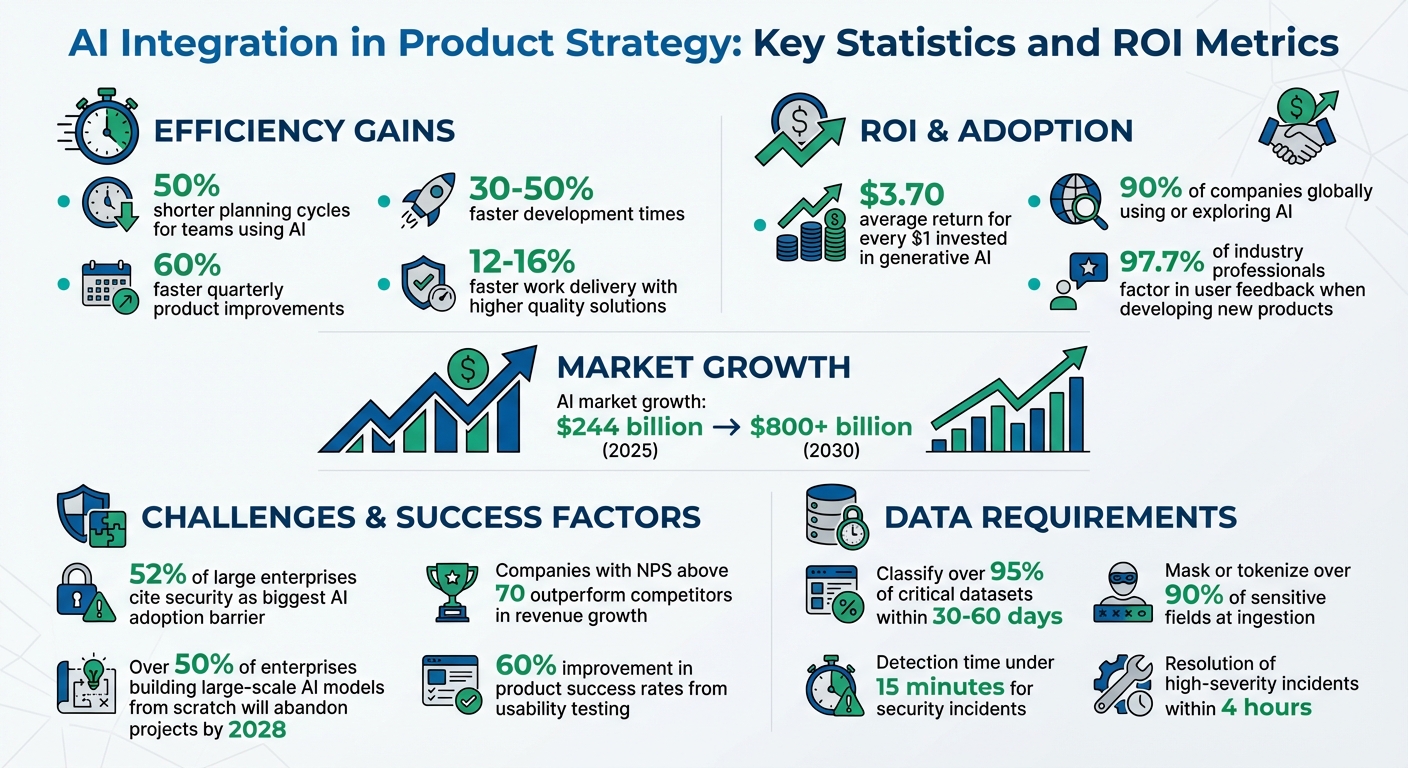
- Efficiency gains: Teams using AI report up to 50% shorter planning cycles and 30–50% faster development times.
- High ROI: For every $1 invested in generative AI, teams see an average return of $3.70.
- Customer-focused segmentation: Groups users by behavior rather than static demographics for better churn prediction and growth opportunities.
- Data readiness is critical: Clean, secure, and well-organized data ensures reliable AI outputs.
To succeed, align AI efforts with clear business goals, focus on solving specific problems, and involve human oversight to validate AI-driven insights. Start with small pilot projects, ensure data quality, and prioritize privacy and compliance to build trust and scale effectively.
Twilio CPO on Integrating AI into Product Strategy to Grow Revenue
Aligning AI with Business Goals
When AI efforts don’t align with business goals, resources get wasted. By 2028, over 50% of enterprises building large-scale AI models from scratch will abandon their projects due to high costs and poor alignment with actual needs [5]. The focus should be on using AI to create real customer value - not treating AI as an end in itself [4].
Start by clearly defining the business challenge AI will address, whether it’s boosting revenue, improving customer retention, or standing out in the market. AI’s role is to enhance human decision-making, not replace it [1][2]. Your team sets the strategy; AI identifies patterns and insights that guide those decisions.
Transparency is key to building trust. When AI recommends a change - like adjusting a roadmap or prioritizing a feature - teams need to understand how data inputs led to those insights. This clarity transforms AI from a mysterious "black box" into a trusted tool for smarter decision-making [2].
Finding the Right Problems for AI
To get the most out of AI, focus on pain points where its capabilities - like classification, forecasting, or summarization - can make a measurable difference. Look for manual, repetitive processes that slow down your team or frustrate customers [8]. Common areas to target include lengthy onboarding times, confusing product navigation, and repetitive customer support tasks [10].
In 2025, Causal introduced an "AI Wizard" to tackle onboarding delays. By addressing initial product friction, the feature smoothed the adoption process and improved user experience [10].
Peoplelogic developed "Noah", an AI agent that generates interview candidate summaries. By normalizing data before feeding it into a language model, they ensured accurate outputs, boosting customer trust and adoption [10].
AI-powered tools like Natural Language Processing (NLP) can analyze support tickets, customer reviews, and call transcripts at scale. This helps uncover recurring issues and unmet needs much faster than manual methods [7][1]. Additionally, monitoring competitors - such as their hiring trends, pricing changes, or messaging shifts - can reveal opportunities for differentiation [1].
AI can also improve prioritization. Frameworks like RICE (Reach, Impact, Confidence, Effort) or WSJF (Weighted Shortest Job First) can use historical data to evaluate roadmap ideas more objectively than relying on gut instinct [3][2]. Considering 66% of project success depends on early ideation and planning [4], identifying the right problems to solve is a critical first step.
Once you’ve pinpointed the right challenges, evaluate your organization’s readiness to implement AI solutions effectively.
Assessing Your Organization's Readiness for AI
Before diving into AI projects, assess your organization across four main areas: strategic readiness, resource availability, data maturity, and team capability. Strategic readiness means having a clear product roadmap and well-defined business goals (OKRs) that AI will support [8][10][3]. Without a solid strategy, AI can end up amplifying confusion instead of solving problems.
Resource readiness involves budgeting for AI expertise, cloud infrastructure, and storage [8]. Data maturity, however, is often the biggest challenge. AI models need data that is accurate, representative, historical, and secure [8]. Poorly managed data can lead to errors or biased outputs, which erode trust [8][12]. Conduct a thorough audit of your data pipelines to ensure they provide the consistent, high-quality inputs your AI models require [10].
Team readiness is another critical factor. Your product and engineering teams need enough understanding of how Large Language Models work to identify effective use cases [10]. Implement human-in-the-loop processes, where team members review and validate AI outputs, to ensure AI serves as an assistant rather than an unchecked authority [1][2].
Begin with a high-impact pilot project that has minimal dependencies and clearly defined outcomes. Even a modest improvement - like a 10–15% boost in efficiency or customer satisfaction - can deliver noticeable results [8]. Set SMART goals for the pilot, such as "Reduce customer response time by 20% within six months" [8]. Engage legal teams early to address compliance with regulations like GDPR and CCPA [8].
Here’s a quick breakdown of readiness factors to consider:
| Assessment Factor | Key Considerations |
|---|---|
| Strategic Readiness | Clear roadmap, defined goals, and a focus on solving user problems over chasing trends [8] |
| Resource Readiness | Budget for AI talent, cloud infrastructure, and storage [8] |
| Data Readiness | High-quality, representative, and secure data [8] |
| Team Readiness | Data literacy, understanding of AI models, and human-in-the-loop processes [2][1] |
| Security Readiness | Compliance with GDPR/CCPA, encryption (AES-256), and strong access controls (RBAC) [8][10] |
Building a Data Foundation for AI
AI models are only as reliable as the data they consume. To ensure dependable outputs, classify over 95% of critical datasets - like PII, PHI, and biometrics - within 30 to 60 days [13]. Without clean, well-organized data, even advanced AI systems can produce flawed results, eroding trust and wasting resources.
A solid data foundation should draw from diverse sources. Qualitative data - such as customer feedback from support tickets, call transcripts, user reviews, and NPS surveys - helps uncover the "why" behind user behavior. Meanwhile, quantitative data - including product usage metrics, feature adoption rates, churn indicators, and behavioral cohorts - provides insights into the "what" and "how." Combining these datasets gives AI a well-rounded view for analysis and decision-making.
Don’t overlook competitive insights. Tracking competitor pricing, product updates, hiring trends (e.g., machine learning roles), and patent filings can help identify market shifts or opportunities. Internal systems like CRM platforms, ERP data, help desk logs, and file storage systems are equally important. Centralizing this feedback and data in a single workspace enables AI to spot recurring patterns across channels.
Standardize your data. As Matt Schmidt, CEO and co-founder of Peoplelogic, puts it:
"By accessing normalized customer data through Merge, our agents always provide accurate and helpful information and won't share sensitive information when it's unnecessary" [10].
Data standardization involves deduplication, harmonizing terminology, and cleaning inconsistencies. Documenting sources, refresh rates, and definitions, alongside setting appropriate sync schedules, ensures your data stays accurate and aligned with strategic goals. A strong foundation simplifies data collection and management, making AI-driven insights more reliable.
Data Collection and Management
Start by mapping all sources of customer feedback and product data. Support tickets, chat logs, email threads, app reviews, community forums, and survey responses can reveal valuable signals. Tools like Amplitude, Mixpanel, or Heap help track feature adoption, user engagement, and drop-off points. CRM systems provide firmographic data and sales interactions, while platforms like GitHub and sprint logs highlight project velocity and potential delays.
To make this data actionable, consolidate siloed information from marketing, support, and product teams using APIs. AI thrives on a unified data layer, so normalization is key - standardize formats, eliminate duplicates, and resolve conflicts.
| Data Category | Key Sources | Strategic Use Case |
|---|---|---|
| User Feedback | Support tickets, reviews, call notes | Identifying recurring complaints and sentiment shifts |
| Product Analytics | Amplitude, Mixpanel, Heap | Detecting anomalies in feature adoption and engagement |
| Competitive Intel | Competitor websites, pricing data, patents | Mapping market opportunities and competitor moves |
| Operational Data | CRM, ERP, ATS | Powering AI agents for specific workflows |
| Development Data | GitHub, sprint logs, velocity metrics | Predicting delays and optimizing resource allocation |
Mask or tokenize over 90% of sensitive fields at the point of ingestion [13]. Regular audits can help catch errors, outdated records, or biased samples that might skew AI recommendations. Assigning ownership to each data pipeline ensures accountability and smooth operations.
Platforms like Modu streamline feedback collection by offering tools for suggestions, ratings, polls, and open-ended responses. Consolidating this input into a single workspace provides AI with cleaner, more representative data for analysis.
Protecting Data Privacy and Security
After collecting and normalizing data, safeguarding its privacy and security becomes essential. Encryption is a must - using AES-256 to secure data both at rest and in transit minimizes the risk of breaches. Role-based access control ensures only authorized users can view or modify sensitive information, and permissions should be reviewed regularly.
Adopt a "Privacy by Design" approach, embedding privacy into your data processes from the start. This means collecting only the data necessary for specific purposes and avoiding reuse without a clear legal basis. Deterministic tokenization can replace sensitive identifiers, like emails and phone numbers, with repeatable tokens as data is ingested [13].
Larry Fitzpatrick, CTO at OneMain Financial, emphasizes:
"Ethical considerations are very high on the radar because generative AI is fundamentally different in that we can't explain how it's working and it's non-reproducible in many cases" [5].
To further protect privacy, use contextual redaction to automatically remove sensitive entities from unstructured data - like notes, PDFs, or transcripts - before they are sent to your AI model.
Layered security is critical. Combine multiple safeguards, such as discovery tools, tokenization, prompt filters, and anomaly detection, to ensure a single failure doesn’t expose sensitive data. Observability tools can monitor API activity, aiming for a detection time of under 15 minutes and resolution of high-severity incidents within 4 hours [13].
For customer-facing integrations, use scopes to restrict data categories that don’t need to be synced. Swati Trehan, Head of Operations and Strategy at Ema, explains:
"Our AI agents only show information to a user based on the documents that user has access to. This helps us keep our customers' sensitive information secure over time" [10].
This "least privilege" principle ensures every data request is tied to a specific purpose and role.
Finally, comply with regulations like GDPR and CCPA by documenting how data is collected, stored, and used. Ignoring privacy considerations can lead to "privacy debt", where honoring rights like data erasure becomes impossible once data has influenced a trained model [14].
Using User Feedback in AI Product Strategy
With reliable data management as a foundation, user feedback becomes the bridge that turns raw information into actionable product decisions. Ignoring this feedback can lead to misguided efforts and wasted resources. It's no surprise that 97.7% of industry professionals factor in user feedback when developing new products [16]. Moreover, companies with a Net Promoter Score (NPS) above 70 often outperform their competitors in revenue growth [16].
The real challenge isn’t deciding whether to gather feedback - it’s figuring out how to do it effectively without getting overwhelmed by unstructured comments and survey responses. AI steps in here, turning fragmented feedback into clear insights that directly shape your product roadmap. As Stackby puts it:
"AI does not replace product managers. It supports clearer thinking by connecting data, feedback, and trends in one place." [7]
Collecting Feedback at Scale
Gathering feedback effectively means using multiple channels that complement each other. Start by identifying where your users naturally share their thoughts: NPS surveys and satisfaction ratings provide measurable benchmarks, while open-ended questions help uncover the reasons behind user behavior.
Platforms like Modu simplify this process by consolidating feedback into a single workspace. They offer tools like:
- Suggestion modules: Allow users to submit and vote on feature ideas.
- Rating modules: Perfect for NPS-style feedback using 1-5 scales.
- Text modules: Collect open-ended responses, such as bug reports.
- Polls: Use single or multiple-choice questions for quick preference checks.
These tools can be embedded on your website, shared via direct links, or triggered as pop-ups during user interactions, ensuring feedback is captured right when it matters most.
To ensure the data reflects genuine trends rather than outliers, aim for feedback from 5-10% of your user base [16]. Usability testing alone has been shown to improve product success rates by up to 60% [16], making systematic feedback collection a necessity. Once gathered, this data is ready for AI-powered analysis to uncover trends and sentiment changes.
Analyzing Feedback with AI
Once feedback is collected across various channels, AI can transform it into prioritized insights. Techniques like natural language processing (NLP) organize scattered data - from emails to support tickets - into recurring themes [7][1]. Automated synthesis can process multiple interviews and surveys in just hours, speeding up the discovery phase significantly [15].
AI-powered teams often work 12-16% faster and deliver higher-quality solutions than traditional teams [4]. This is largely because AI handles the time-intensive tasks like clustering feedback into themes. This allows product managers to focus on addressing emerging issues and rolling out fixes in days instead of weeks [1].
Sentiment and urgency detection further refines the process. NLP tools can analyze user emotions and urgency levels, flagging sudden spikes in complaints or changes in sentiment before they surface in manual reviews [15][7]. Tools like Modu even offer AI clustering features, grouping feedback by themes to highlight which issues impact the most users or provoke the strongest reactions.
"AI should support, not override, human judgment. Establish checkpoints where product managers can review, adjust, or override AI-generated insights." [2]
AI-generated summaries should be treated as a starting point. Always validate them against domain knowledge to ensure critical nuances aren’t overlooked - for instance, distinguishing between confusion among power users and struggles faced by new users [15]. AI can also help identify feedback trends specific to different segments, such as high-value enterprise accounts versus small businesses, so you can align your strategy with broader business objectives [1].
Organizations leveraging AI for strategic decisions see 60% faster quarterly product improvements [4]. The goal isn’t automation for its own sake - it’s about creating better products with greater clarity and speed [7]. By connecting user feedback directly to roadmap priorities and generating automated prioritization scores, AI ensures that user voices are at the heart of your product strategy in real time [2][15].
Deploying and Scaling AI Features
With a solid data foundation and an effective feedback loop in place, the next step is deploying and scaling your AI features. Early strategic planning plays a crucial role, accounting for 66% of project success[4]. This highlights the importance of thorough preparation during pilot testing before moving to full-scale deployment.
Starting with Pilot Projects
Begin with tasks that are high-impact but low in complexity and dependencies[8]. For instance, automating customer response categorization is a relatively low-risk initiative that can deliver noticeable results.
Set clear goals using SMART criteria[8]. For example, aim to "reduce customer response time by 20% within six months." This gives your team a clear and measurable target.
Roll out your Minimum Viable Product (MVP) to a small group of design partner users. These are customers who agree to provide early feedback in exchange for early access. This approach helps you quickly identify and address any friction points[10]. As product management expert Alex Rastatuev explains:
"The real value of AI comes from solving meaningful customer problems, improving critical workflows, and identifying clear business opportunities."[8]
Scaling from Beta to Full Deployment
After a successful pilot, move to the beta phase by expanding to a larger and more diverse group of users. Once the pilot results confirm the AI feature's effectiveness, scale further to validate its impact on a broader audience. This stage is ideal for A/B testing, allowing you to compare AI-driven features with traditional workflows to measure their effect on metrics like retention and conversion rates. It also serves as a stress test for your infrastructure, ensuring your cloud compute and storage systems can handle increased data volumes without performance issues.
Keep an eye on data drift during scaling. As user behavior changes, models trained on historical data can lose relevance. Regular audits and monitoring of both operational metrics (such as speed and cost savings) and technical indicators (like model accuracy and compute cost per task) are critical to maintaining the feature's efficiency and cost-effectiveness at scale[6].
Security should be a top priority. Among large enterprises, 52% identify security as the biggest hurdle to AI adoption[5]. Implement robust measures like AES-256 encryption for data at rest and in transit, and use Role-Based Access Controls (RBAC) to restrict who can modify AI features. Involve legal and compliance teams early to ensure adherence to GDPR and CCPA regulations.
Finally, keep AI in an assistant role. Maintain a human-in-the-loop for critical decisions and monitor how often users override AI recommendations. High override rates could indicate the need for refinements or signal that users don’t fully trust the AI yet. Companies that successfully scale AI features report achieving product improvements 60% faster each quarter[4]. However, speed is only valuable if the features provide real benefits and maintain user trust.
Conclusion
Key Takeaways for AI Integration
Bringing AI into your product strategy isn't just about adopting trendy technology - it's about solving real user problems and creating measurable business value. With the AI market expected to surge from $244 billion in 2025 to over $800 billion by 2030 [17], the potential is massive. But success lies in how you implement it.
Start with alignment. Your AI initiatives should directly support your business goals and address specific user pain points. As Julie Price, Senior Director of PM/UX at Aha!, explains:
"AI cannot set strategy for you. You still decide what to build, why to build it, and when. Its role is to save you time and hassle in the process." [11]
A good rule of thumb? Apply the 3x Value Rule: any AI feature should deliver value - whether through time saved or risk reduced - at least three times higher than its compute and retrieval costs [9].
Data quality is non-negotiable. Even the most advanced AI models depend on clean, well-organized data. If your data is messy or outdated, the results will reflect that, no matter how powerful the model is [9]. To avoid this, invest in normalized, well-governed data. Set up clear input definitions, human review processes, and audit logs to minimize bias and drift [2][3]. It’s worth noting that 52% of large enterprises cite security as the top barrier to AI adoption [6], so establishing strong safeguards from the start is critical. Solid data practices are the backbone of successful human-AI collaboration.
Keep humans in the loop. AI works best when it enhances human judgment rather than attempting to replace it [1]. While 90% of companies globally are already using or exploring AI [17], the most effective implementations include human oversight for key decisions, ethical considerations, and trade-offs. Tim Adair, Strategic Executive Leader at IdeaPlan, offers a cautionary perspective:
"The risk is not that AI replaces you. The risk is that you either ignore these tools entirely or trust them too much." [15]
From aligning objectives to building strong data foundations, continuous iteration is key. Markets change quickly, and your AI strategy needs to keep pace. Start small with low-risk, high-impact features to build confidence across your organization. Then, scale gradually through pilot programs, beta testing, and full deployment [19]. With 79% of corporate strategists agreeing that AI and analytics will be critical to their organization’s success through 2026 and 2027 [18], the real question isn’t whether to integrate AI - it’s how thoughtfully you approach it. These principles provide a roadmap for integrating AI strategically, helping teams drive meaningful product innovation.
FAQs
What’s the best first AI use case to pilot in product strategy?
One of the smartest ways to start incorporating AI into your product strategy is by using it to analyze and prioritize customer feedback. AI can group similar feedback into clusters and assign scores, making it much simpler to spot trends. This process can guide important roadmap decisions, like which features to focus on or what improvements to tackle first.
How can I tell if my data is good enough for reliable AI insights?
To make sure your data leads to dependable AI insights, it needs to be precise, complete, consistent, and current. Quality data should accurately reflect the problem you're addressing and be large enough to provide meaningful patterns. Incorporating continuous, real-time data streams can further improve AI's ability to deliver actionable results. Adhering to these principles helps ensure reliable and impactful AI outcomes.
How can I measure ROI from AI features without risking user trust?
To evaluate ROI from AI features while keeping user trust intact, rely on clear and measurable indicators like engagement rates, satisfaction scores (such as Net Promoter Score or NPS), and task completion rates. Incorporate tools for collecting open-ended feedback to better understand user experiences and encourage openness. Make sure to communicate the benefits of AI and how data is used responsibly. Regularly review feedback and engagement patterns to ensure your ROI assessment aligns with user-focused goals, balancing trust with showcasing the value of your AI initiatives.