
How to Measure Community Success with KPIs
How to Measure Community Success with KPIs
Want to know if your community is thriving? Start by tracking the right KPIs. Success isn’t about how many people join your community - it’s about how engaged they are and the value they create. Key Performance Indicators (KPIs) help you measure real engagement, member contributions, and how your community supports broader goals like customer retention or sales growth.
Here’s what you’ll learn:
- Define your goals: Align KPIs with your community’s purpose (e.g., support, learning, or advocacy).
- Track engagement: Measure participation rates, contribution levels, and interaction quality.
- Monitor growth and retention: Understand how many members stay active and why others leave.
- Focus on outcomes: Assess how member activity drives results like problem resolution or customer loyalty.
- Leverage tools: Use dashboards and feedback platforms to simplify tracking and analysis.
How to Develop Key Performance Indicators - 6 Steps for Great KPIs
Step 1: Define Your Community's Purpose and Goals
To measure success effectively, start by clarifying your community's purpose. Tracking numbers without context won’t help - "Data without context is noise. Insights tied to outcomes are strategy," as ASAE puts it [5]. When you know your purpose, you can focus on metrics that truly reflect your community’s impact.
Identify Your Community's Main Purpose
What is your community's primary role? Is it about support, engagement, learning, advocacy, or sparking innovation? For instance, a community built around support should focus on metrics like the rate of resolved issues. On the other hand, a learning-centered community might track knowledge-sharing activities or skill-building progress [2].
It's crucial to align with stakeholders on what the community is expected to achieve. Ask questions like: What business problem does this community address? Does it aim to lower support costs, encourage product adoption, or strengthen brand loyalty? [5]
Here’s an example: A support community might aim for 30–50% of discussion threads to end with a marked solution [7]. Meanwhile, an advocacy community could track the number of member-generated testimonials or mentions on social media [1].
Define SMART Goals
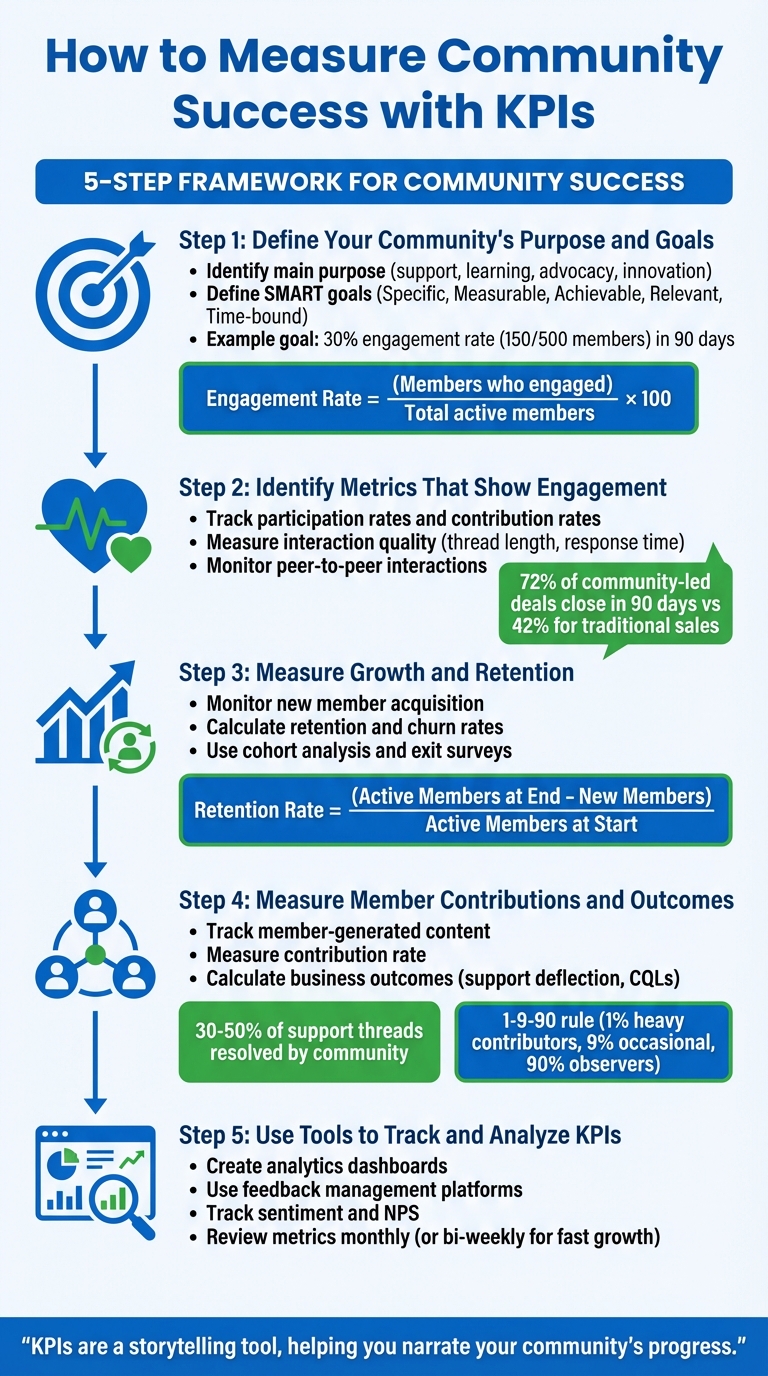
Once you’ve nailed down the purpose, connect it to measurable outcomes using SMART goals - Specific, Measurable, Achievable, Relevant, and Time-bound [4]. This approach replaces vague aspirations with clear targets. For example, instead of saying "increase engagement", aim for a 30% engagement rate (150 out of 500 active members) within 90 days [1].
Tailor these goals to your community’s stage of development. A newer community might focus on acquiring members, while an established one could prioritize retention and contributions [1]. To ensure your goals are measurable, use formulas like:
- Engagement Rate = (Members who engaged / Total active members) × 100
- Retention Rate = (Current active members / Active members at start of the period) × 100 [1].
Retention often provides a clearer picture of long-term success than raw growth numbers, so don’t overlook it [1].
Step 2: Identify Metrics That Show Engagement
When it comes to understanding your community's health, engagement metrics go beyond simple activity - they reveal the depth of participation. With your goals clearly defined, it's time to measure how members are truly interacting. Engagement is often described as the "heartbeat" of community success because without meaningful interaction, activity can feel shallow and unproductive [1].
Track Participation Rates
Start by focusing on your Engagement Rate. This is calculated by dividing the number of members who actively engage - whether through comments, reactions, or event attendance - by the total number of active members [1]. For example, if 150 out of 500 members participate, your engagement rate is 30%. This figure serves as a baseline to monitor progress over time.
Another key metric is member-initiated conversations. A high number of discussions started by members signals a self-sustaining, thriving community [2][3]. Additionally, track your Contribution Rate, which measures how many members are making valuable contributions, such as hosting events or answering questions. Divide the number of contributors by the total membership. For instance, if 100 members out of 500 contribute, your contribution rate is 20% [1].
It’s also important to track where these interactions are happening. Use Activity by Source to identify which platforms - like Slack, Discord, or your website - are driving the most engagement [3]. This insight allows you to focus your resources on the channels delivering the best results.
Once you’ve examined participation, it’s essential to evaluate the quality of these interactions.
Measure Interaction Quality
Raw numbers can sometimes be misleading. For instance, a high volume of posts might mask low-quality interactions. To dig deeper, look at metrics like average thread length and the number of unique respondents per thread. These indicators offer a clearer picture of how meaningful discussions really are [2].
"Vanity metrics, such as a high number of likes, can be misleading - just because someone clicks 'like' doesn't necessarily mean they're deeply engaged or find your content valuable." - Kajabi [8]
Another critical metric is Time to Response. Quick responses ensure members feel heard and valued, which directly impacts their satisfaction and loyalty [3]. To further refine your analysis, consider using sentiment analysis. This can help differentiate between high activity levels and genuinely positive member experiences. For example, a community might be buzzing with posts, but sentiment analysis could reveal underlying frustrations among members [3].
Lastly, assess the peer-to-peer interaction ratio. Communities that thrive often feature members helping each other, rather than relying solely on admin responses. This type of interaction fosters trust and collaboration. In fact, research shows that 72% of community-led deals close within 90 days, compared to just 42% for deals driven by traditional marketing and sales teams [3]. This highlights how authentic engagement can translate into tangible business outcomes.
Step 3: Measure Growth and Retention
To understand the health of your community, you need to track both growth and retention. Growth shows how much interest your community generates, while retention demonstrates its lasting value. As Kannect wisely puts it, "Growth is flashy... but community success isn't just about growth. It's about longevity" [1]. By focusing on longevity, you’ll gain a clearer picture of how your community is thriving and where it needs attention.
Monitor New Member Acquisition
Keep a close eye on how many new members are joining, either monthly or bi-weekly. If your community spans multiple platforms - like Slack, Discord, Reddit, or LinkedIn - gather data from all channels to see the bigger picture. Tools like Google Analytics and UTM links can help you identify which channels are driving the most sign-ups.
"When you keep an eye on how many new members are joining each month, you'll be able to see when there's a rise and, in turn, reflect on what you've been doing right." - Jade Warne, Copywriter, Community-Led Alliance [4]
Understanding who is joining is just as important as tracking the numbers. Use identity resolution tools to analyze member demographics, such as their workplace or location. This ensures your growth aligns with your Ideal Customer Profile (ICP) rather than just inflating membership stats. Pay special attention to "pioneers" - those first few members from target organizations - and encourage them to bring in colleagues.
Calculate Retention and Churn Rates
Acquiring members is just the first step; keeping them engaged is what truly matters. Retention rates show how many members stay active over time. You can calculate it using this formula:
Retention Rate = (Active Members at End – New Members) / Active Members at Start [3]
For instance, if you started with 500 members, gained 100 new ones, and ended with 550 active members, your retention rate would be 90%: (550-100)/500.
On the other hand, churn rates measure how many members leave or go inactive. To calculate churn, divide the number of members who churned by the total membership during that period [3]. First, you’ll need to define what "active" means for your community - whether it’s posting once a month, attending events, or participating in discussions. Without a clear definition, your calculations won’t hold much weight.
To improve retention, use tools like cohort analysis to identify trends and exit surveys to understand why members leave. Automated re-engagement workflows can also help you reconnect with members who’ve been inactive for a set period, giving you a chance to win them back before they churn entirely [3].
Retention is more than just a metric - it’s the backbone of a healthy community. A revolving door of members joining and leaving not only drains resources but also weakens trust among your audience. Communities with strong retention rates naturally generate referrals, reducing the need for costly acquisition efforts like paid advertising [9].
Step 4: Measure Member Contributions and Outcomes
Once you've set up metrics for growth, retention, and engagement, it's time to assess the real impact of your community. This step goes beyond just counting heads - it’s about understanding what members do and how their actions benefit your organization.
"Member count is merely a vanity metric when isolated. A community with 10,000 passive members often delivers less value than one with 500 active participants who genuinely connect with each other" [2].
Track Member-Generated Content
Start by evaluating your contribution rate - the percentage of members actively giving back instead of just consuming. You can calculate this as:
(Contributing Members ÷ Total Members) × 100.
Keep in mind the common 1-9-90 rule: 1% of members are heavy contributors, 9% participate occasionally, and 90% are observers [1][2].
Focus on contributions that drive engagement and value. Track things like member-initiated discussions, peer-to-peer answers, and shared resources such as guides or templates [1]. For instance, in a product-focused community, measure feature requests, bug reports, and product improvement ideas. Some communities report that members identify up to 70% of bugs and submit all feature requests [10].
To gauge the quality of interactions, monitor conversation depth. Look at thread length, response times, and how many unique members participate [2]. A thread with 20 meaningful replies from different members shows more engagement than 100 one-word comments from the same few people. Additionally, track your problem resolution rate - the percentage of member questions answered by other members. A good benchmark for brands is resolving 30–50% of support-related threads through community input [7].
These metrics not only highlight active participation but also reveal how member contributions align with your business goals.
Measure Business Outcomes
Member contributions often lead to tangible business benefits. Start by calculating support deflection - the savings generated when members solve each other's problems instead of contacting your support team [2].
Identify Community-Qualified Leads (CQLs) by spotting high-intent members who match your Ideal Customer Profile based on their activity. Push this data to your CRM for follow-up by your sales team [3]. Use UTM links on content shared within your community to track referral traffic and conversions through Google Analytics [4].
"If you can prove a correlation between your content and an increase in site traffic, then you'll be able to show the efficacy of your community" [4].
Finally, compare the purchasing behavior of active community members to non-members. Review metrics like average contract value, purchase frequency, and customer satisfaction (CSAT) scores. Members who share testimonials, success stories, and referrals often become advocates for your brand. This advocacy matters - 88% of shoppers trust online reviews as much as personal recommendations [9].
Step 5: Use Tools to Track and Analyze KPIs
Once you've identified your KPIs, the next move is to make tracking and analysis as efficient as possible. Relying on outdated manual methods can slow things down, so it's a good idea to use automated tools that simplify data collection and provide visualized insights.
Create Analytics Dashboards
Dashboards bring together data from owned channels (like Slack or Discord) and unowned channels (such as Reddit or LinkedIn) into one organized view [3]. This eliminates the need for time-consuming manual data gathering.
Your dashboard should focus on metrics tied to your goals, not on superficial numbers. For example, if you manage a knowledge-sharing community, track metrics like webinar participation and completed training tasks. If you're running a brand advocacy community, keep an eye on user-generated testimonials and social media mentions [1]. Use filters to highlight meaningful engagement rather than just inflating raw totals.
Real-time tracking of engagement and sentiment is crucial. Automated alerts for things like unanswered posts can help you stay responsive [3]. This kind of proactive monitoring ensures small issues don’t grow into larger problems.
Rather than fixating on raw numbers, look at trends over time. Establishing a baseline allows you to spot genuine growth patterns versus normal fluctuations [2]. For example, you can measure retention rates with this formula:
(Current Active Members ÷ Active Members at Start of Period) × 100 over a set period, like three months [1].
To add depth to your analysis, integrate qualitative feedback tools alongside your quantitative dashboards.
Use Feedback Management Platforms
Platforms like Modu make it easier to collect and analyze member feedback. Use Rating modules to track satisfaction scores and Net Promoter Score (NPS), giving you measurable insights into member sentiment. Suggestions modules can surface your community's top priorities through public idea boards.
For more detailed feedback, Text modules allow members to share private, open-ended responses. This is great for uncovering honest opinions about what’s working and where improvements are needed. Pair this qualitative input with quantitative data from polls and ratings to get a complete picture of both the "what" and the "why" behind member behavior [2].
Sentiment analysis features can also help by automatically categorizing discussions as positive or negative [3]. This gives you a quick "temperature check" of your community without having to manually review every conversation. And by integrating your feedback platform with tools like Slack, Jira, or Linear, you can streamline processes - such as automatically creating tasks for high-priority suggestions.
"KPIs are a storytelling tool, helping you narrate your community's progress. They are therefore a powerful tool to secure the resources and support your community needs." - Carrie Melissa Jones, Founder, CarrieMelissaJones.com [6]
Conclusion
Key Takeaways
Measuring the success of a community begins with selecting KPIs that directly align with your goals. It's about prioritizing active engagement over just growing member numbers. While large membership stats might feel rewarding, they often fail to reflect meaningful impact.
For example, if you manage a support community, focus on metrics like problem resolution rates. On the other hand, if you're fostering brand advocacy, keep an eye on testimonials and Net Promoter Score (NPS). Review your metrics regularly - monthly at a minimum, or every two weeks if your community is expanding rapidly - to ensure they stay relevant to your evolving initiatives [1].
"Statistics are essential to have, but knowing your members are happy and engaged is just as valuable." - Jade Warne, Copywriter, Community-Led Alliance [4]
Every metric should connect to your community's core objectives, helping you consistently measure and refine its success.
Keep Using Data to Guide Decisions
To build on these insights, make data-driven experimentation a cornerstone of your strategy. Analyzing data shouldn’t be a one-off task - it should be a regular part of how you manage your community. By consistently evaluating and testing, you can shift from simply observing trends to taking strategic action [11].
As your community grows, so will its goals. Regularly reviewing your metrics and sharing updates with members strengthens transparency and fosters strategic growth. Plus, it shows members how their involvement directly contributes to the community's success [2][4].
FAQs
Which KPIs matter most for my community’s goal?
The key performance indicators (KPIs) you prioritize will depend on the unique goals of your community. However, common ones often include engagement, activity levels, growth rate, and satisfaction. For instance, keeping an eye on metrics like follower growth, the number of active members, and engagement rates can provide a clear picture of progress. By aligning these KPIs with larger objectives - whether that's boosting participation, improving retention, or increasing overall satisfaction - you can ensure they truly represent what success looks like for your community.
How do I define “active” for retention and churn?
Defining what it means to be "active" on your platform boils down to pinpointing user behaviors within a specific time frame. This might involve activities like logging in, posting content, leaving comments, or making contributions. When it comes to retention, "active" users are those who regularly interact with your platform over an extended period. On the flip side, for churn analysis, it refers to users who cease engaging during the designated timeframe. The key is to align these criteria with your specific goals and the period you're analyzing.
How can I tie community KPIs to revenue or support savings?
To connect community KPIs with revenue or support savings, zero in on metrics that demonstrate a clear impact. Metrics like customer acquisition, retention, and engagement are key players here. For instance, insights from the community can trim down marketing expenses, while engaged members often become advocates, fueling organic growth. On the support side, improved satisfaction and retention scores can highlight savings achieved through self-service options and community-driven problem-solving. By tracking these KPIs, you can tie community achievements directly to business goals.