
Balancing Short- and Long-Term Product Goals
Balancing Short- and Long-Term Product Goals
Balancing short-term wins and long-term goals is key to building successful products. Focus too much on quick fixes, and you risk creating a product without purpose. Overemphasize the future, and you might lose current users or stakeholder trust. The solution? A clear vision that aligns immediate tasks with bigger objectives.
Here’s the core idea:
- Short-term wins: Build momentum and show progress.
- Long-term vision: Keep the team focused and guide decisions.
To achieve this balance:
- Define a product vision based on user needs and market trends.
- Use frameworks like OKRs to connect daily work to long-term outcomes.
- Allocate resources for both incremental improvements and ambitious projects.
- Leverage customer feedback and growth insights to prioritize effectively.
The goal: Deliver immediate value while staying on track for sustained growth.
How to Build a Product Roadmap by Walmart Senior Product Manager
Building a Clear Vision and Strategy
A clear product vision serves as a powerful decision-making tool. When everyone understands the destination, it becomes easier to assess every feature request, bug fix, or sprint by asking one key question: Does this move us closer to our future goals? Without that clarity, teams may find themselves swayed by the loudest voices or sidetracked by individual agendas.
The best visions are directional and aspirational, rather than tied solely to metrics. For example, instead of setting a goal like "increase revenue by 30%", aim for something broader, like "Become the most trusted platform for freelancers." This kind of vision inspires action while leaving room for adaptability. Pair it with the OKR framework to separate the aspirational "what" from the measurable "how." Your objective stays steady, while the key results evolve as you gain insights.
"Be stubborn on vision, but flexible on details." - Jeff Bezos, Founder, Amazon [2]
This approach lays the groundwork for a vision that consistently guides product decisions.
Defining Your Long-Term Product Vision
To create a meaningful vision, start by focusing on genuine customer needs and market realities. Engage with users, study industry trends, and pinpoint the problem your product is uniquely positioned to address over the next three to five years. A strong vision should both inspire your team and remain actionable.
It’s also important to balance your resources wisely. Dedicate at least 20% of your development budget to bold, high-risk projects that align with your long-term goals. These initiatives can drive significant progress while complementing more incremental improvements. [4]
Evaluating Short-Term Goals Against Long-Term Objectives
Not every short-term task contributes to the bigger picture. When deciding what to prioritize, consider these three questions: "Does this help us move closer to our vision?", "Can this work be reused or scaled in the future?", and "Does this compromise our ability to achieve our long-term goals?" [2] These questions encourage teams to think strategically and avoid falling into the trap of urgency bias.
To maintain focus, appoint a "Vision Keeper" during prioritization meetings. This person ensures that long-term objectives remain central to decision-making. Additionally, categorize backlog items into short-term ("one-off"), medium-term (next release), or long-term (foundational/architectural) to keep priorities clear. [2]
When stakeholders push for quick fixes, rely on data rather than emotion to guide decisions. As former Netscape CEO Jim Barksdale famously said: "If we have data, let's look at data. If all we have are opinions, let's go with mine." [2] Use objective criteria like customer impact, ROI, and alignment with strategic goals to ensure short-term efforts support the broader vision instead of diverting from it.
These practices keep short-term actions aligned with long-term aspirations, ensuring that every step contributes to the overall roadmap.
Setting Priorities and Measurable Goals
Once your vision is clear, the next step is turning it into actionable priorities and measurable goals. This ensures you address both current demands and long-term objectives. The key? Focus on outcomes over outputs. For instance, instead of saying, "We'll launch three new features this quarter", aim for something like, "We'll boost user retention by 15%" [1][3].
For ambitious projects - those high-risk, high-reward "Big Bets" - it's crucial to evaluate them separately from smaller, incremental improvements. Dedicate at least 20% of your development budget to these groundbreaking initiatives. This ensures you're not sacrificing long-term innovation for short-term tasks [4].
Using KPIs to Connect Short- and Long-Term Success
Metrics act as the bridge between your day-to-day work and your broader strategy. A balanced set of metrics is essential:
- Short-term metrics: These track immediate progress, such as feature completion rates or increases in sign-ups.
- Long-term metrics: These measure lasting impact, like Annual Recurring Revenue (ARR) growth, Net Promoter Score (NPS), or enterprise customer retention [1][3].
The OKR framework (Objectives and Key Results) is a practical way to link short- and long-term goals. Start with an inspirational Objective - such as "Become the most trusted platform for freelancers" - and pair it with three to five measurable Key Results, like "Increase NPS from 42 to 55" or "Reduce onboarding time by 30%" [3].
Don't forget health metrics, which act as guardrails to maintain stability while you grow. For instance, platform teams might monitor Service Level Objectives (SLOs) like error rates and system availability. Keeping churn below a certain threshold is another way to ensure operational stability [3].
To prioritize effectively, consider frameworks like RICE (Reach, Impact, Confidence, Effort) or ICE (Impact, Confidence, Ease). These tools help you objectively evaluate tasks by weighing their potential value against the effort required [3].
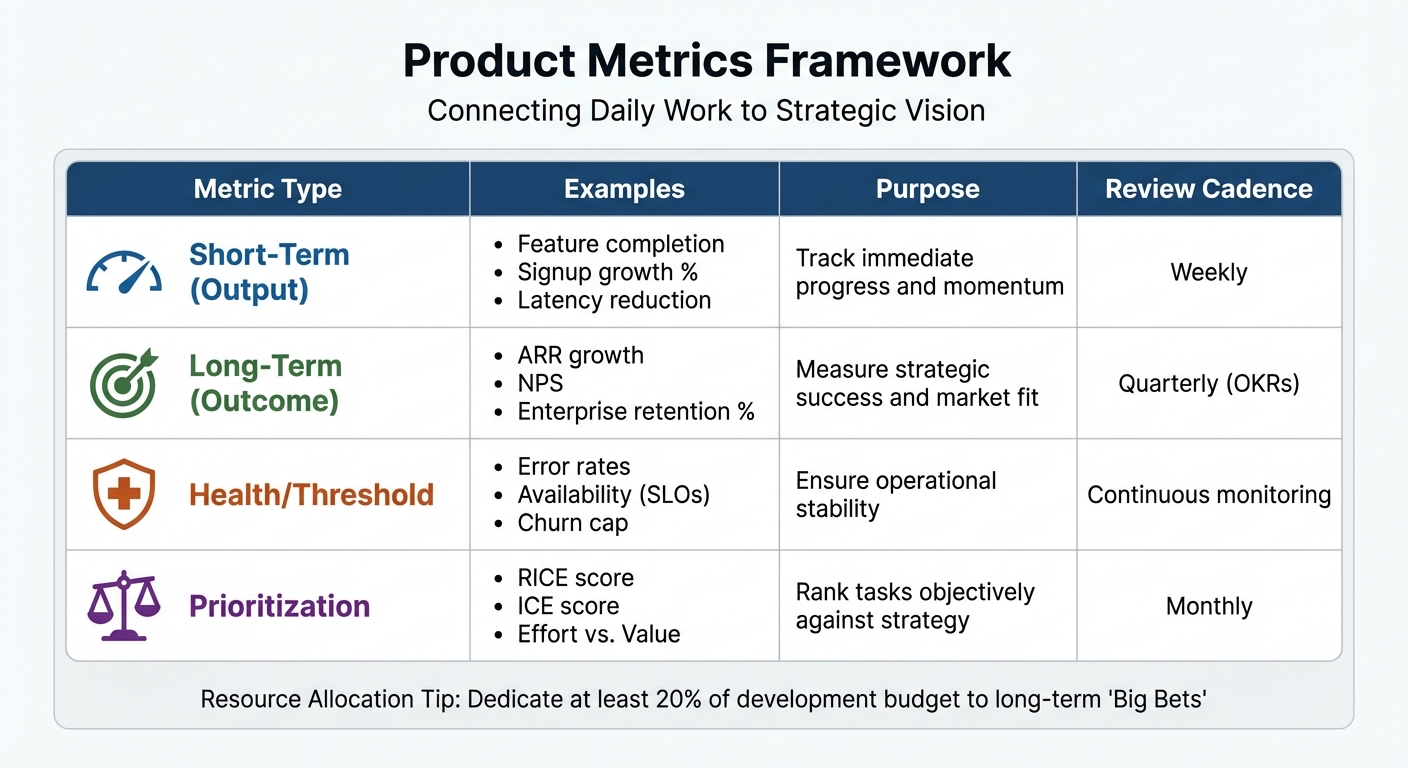
| Metric Type | Examples | Purpose |
|---|---|---|
| Short-Term (Output) | Feature completion, signup growth %, latency reduction | Track immediate progress and momentum |
| Long-Term (Outcome) | ARR growth, NPS, enterprise retention % | Measure strategic success and market fit |
| Health/Threshold | Error rates, availability (SLOs), churn cap | Ensure operational stability |
| Prioritization | RICE score, ICE score, Effort vs. Value | Rank tasks objectively against strategy |
To stay on track, review short-term metrics weekly, plan upcoming tasks monthly, and revisit OKRs quarterly. This approach keeps you flexible and ensures you're measuring what truly matters without clinging to outdated assumptions [3].
Communicating Priorities Across Teams and Stakeholders
Once your priorities and goals are set, clear communication becomes critical for maintaining alignment across teams and stakeholders. Misalignment often happens when stakeholders don’t understand why certain tasks are prioritized or what trade-offs were made. Transparency is non-negotiable. When adding a new priority, explicitly document what’s being postponed or set aside. This builds trust and shows that decisions are intentional - not arbitrary [3].
Use data to guide conversations about trade-offs. Dashboards can help visualize how resources are divided between short-term fixes and long-term projects. This gives stakeholders a clearer picture of constraints and priorities. As Jim Barksdale, former CEO of Netscape, famously said: "If we have data, let's look at data. If all we have are opinions, let's go with mine." [2]
Avoid simply listing features. Instead, tell the story behind each priority. Explain the opportunity, the hypothesis, how success will be measured, and the specific trade-offs involved [3].
Consider hosting vision workshops that bring together product, UX, engineering, and leadership teams. These sessions help develop a shared, user-focused vision that acts as a guide for prioritization. When everyone feels invested in the process, they’re better equipped to support both immediate tasks and long-term objectives [5].
Implementing Agile Processes for Flexible Goal Alignment
Agile methods are all about moving quickly and staying adaptable, but the trick is keeping your long-term vision in sight while executing short-term tasks. As Jeff Bezos wisely said: "Be stubborn on vision, but flexible on details." [2]
To achieve this, structure your backlog to reflect different time horizons. Tag items as short-term (quick fixes), medium-term (upcoming releases), and long-term (foundational work). This approach ensures every sprint includes a mix of tasks - or at least alternates between addressing immediate needs and investing in the future [2].
Think of planning as having two layers. Your short-term roadmap (3–6 months) offers clear, actionable steps for teams like engineering and UX, while your long-term roadmap serves as a vision-focused tool for executives and stakeholders. This dual approach keeps sprints from feeling like isolated tasks and helps break down big-picture goals into actionable steps.
Breaking Down Long-Term Goals Into Sprints
One way to bridge the gap between vision and execution is through theme-based roadmapping. Instead of locking in specific features, group work under strategic themes like "Enterprise Expansion" or "User Activation." Themes provide flexibility, allowing teams to adjust tactics without straying from the overall strategy [3].
Pair these themes with outcome-focused OKRs (Objectives and Key Results). For example, instead of saying, "Launch mobile app", reframe the goal as, "Increase daily active users by 25% through mobile accessibility." This shifts the focus to measurable impact rather than just delivering features, giving teams the freedom to experiment and find the best solutions [3].
Align each sprint goal with your long-term vision. For instance, a sprint task like "reduce latency by 200ms" could tie directly to a broader objective, such as becoming the fastest platform in your category. Assign a "vision keeper" to ensure that sprint tasks consistently contribute to overarching goals. This prevents work from becoming isolated or disconnected from the bigger picture [1][2].
Next, let’s look at how to balance short-term deadlines with ongoing long-term initiatives.
Balancing Short-Term Deadlines With Long-Term Initiatives
One of the biggest challenges to long-term planning is the constant pressure of day-to-day operations. To avoid this, set aside a fixed portion of sprint capacity for strategic projects. These are the high-risk, high-reward efforts that can drive major growth or innovation [4].
Run short-term and long-term tracks simultaneously. This means addressing immediate issues while still focusing on future goals. Evaluate "big bets" separately from smaller, incremental improvements to ensure that ambitious projects don’t get overshadowed by quick wins [4].
To maintain this balance, establish calibration rituals. For example:
- Review "Now" items weekly.
- Reassess "Next" items monthly to ensure they align with your goals.
- Revisit OKRs and strategic themes quarterly to adjust as needed [3].
For platform teams, health metrics like Service Level Objectives (SLOs) help maintain the balance. Monitoring things like error rates and system availability ensures you're not sacrificing reliability for speed. Similarly, setting thresholds for churn can help you avoid trading stability for short-term gains [3].
As Nabeel Hyatt from Spark Capital put it: "An excellent product manager is keeping in mind the long-term vision while driving short-term results... very much a mini CEO when it's done right." [2] With thoughtful implementation, Agile processes provide the framework to achieve just that.
Using Customer Feedback to Guide Prioritization
Customer feedback is like a compass - it shows you exactly what users need, steering teams away from creating features that miss the mark. Without this guidance, it’s easy to waste time on quick fixes that don’t align with your long-term goals or on projects that fail to resonate with users. By focusing on what customers actually want, you can strike a balance between solving immediate issues and building toward future innovations.
The tricky part? Feedback often comes from scattered sources - support tickets, sales calls, social media, emails - and it’s easy for valuable insights to slip through the cracks. That’s why centralizing this information is so important. Tools like Modu help by gathering all feedback into a single hub, making it easier to evaluate user requests and prioritize them effectively based on both short-term needs and broader strategic goals.
While vote counts on feature requests can be helpful, they shouldn’t be the sole factor in decision-making. Frameworks like RICE or the Kano Model help ensure that decisions align with long-term objectives. These methods provide a structured way to assess feedback, ensuring every request is weighed against your strategic priorities.
Crowdsourcing Priorities With Feedback Tools
Feature request boards simplify the chaos of scattered feedback by creating a transparent system where users can share their ideas and vote on what matters most. For example, Modu’s Suggestions module offers a public idea board where users can see and upvote requests. This crowdsourced approach highlights patterns - if a feature like dark mode gets significantly more votes than others, it’s a clear signal of high demand.
But it’s not just about the numbers. Combining vote counts with AI clustering and objective scoring ensures a balanced approach. Sometimes, a highly requested feature might not align with your strategic goals, while a less popular idea could be a quick win that supports a larger initiative. Separating "Big Bets" (long-term projects) from "Short-term Wins" (smaller, immediate improvements) ensures you’re prioritizing effectively without comparing apples to oranges. This method naturally feeds into a more transparent and focused product roadmap.
Using Roadmaps to Communicate Progress and Vision
Transparency is key to building trust with your users. When they see their feedback shaping your product, they feel more invested in its success. Modu’s Roadmap module uses a "Now, Next, Later" framework to clearly communicate progress. Status labels like Backlog, Planned, In Progress, and Shipped show users exactly where their suggestions stand - without the pressure of rigid deadlines.
By syncing roadmap items directly with approved suggestions, you create a closed feedback loop. Users can see their ideas move from submission to implementation, reinforcing their sense of involvement. Automatic updates keep everyone - from customers to executives - informed about both short-term progress and long-term plans.
Tracking Satisfaction With Rating Metrics
While feature requests show what users want, satisfaction ratings reveal how they feel about what you’ve already delivered. Modu’s Rating module uses a simple 1–5 scale to measure user satisfaction, helping you spot usability issues that need immediate attention. Low ratings highlight areas that risk user churn, while high ratings confirm what’s working well. Monitoring these metrics ensures that your improvements are making a real difference.
When a feature is marked as "Shipped", automatic notifications close the loop by informing users that their input has been acted on. This process not only keeps users engaged but also strengthens their loyalty, ensuring that their feedback continuously shapes both your short-term actions and your long-term vision.
Conclusion
Balancing short-term wins with long-term strategy isn't just about checking off tasks - it’s about creating lasting momentum while staying focused on the bigger picture. The best product teams know that quick wins can energize the team and provide immediate proof of progress, but only if they’re tied to a larger vision. Otherwise, you risk chasing metrics that look good but don’t really matter.
Start with a clear, long-term vision to guide your efforts, and translate that vision into measurable goals using OKRs. As Jeff Bezos once said:
"Be stubborn on vision, but flexible on details" [2].
This approach encourages staying focused on your ultimate destination while adapting your methods along the way. Agile frameworks can help by breaking down ambitious goals into manageable steps, but the real impact comes from deliberate resource allocation. Remember, investing in bold, forward-thinking initiatives is what drives future progress [4]. This alignment also creates space to integrate customer insights effectively.
Customer feedback plays a critical role in this process, ensuring that priorities are shaped by real user needs rather than internal assumptions. Tools like Modu streamline this by organizing feedback through suggestion boards, transparent roadmaps, and satisfaction tracking. This creates a feedback loop where user input directly influences both quick fixes and strategic decisions.
To maintain balance, focus on delivering immediate value through short-term projects while also committing to long-term goals. Tagging backlog items clearly can help keep this balance intact [2]. Regular check-ins - weekly for immediate tasks, monthly for upcoming priorities, and quarterly for big-picture themes - ensure everything stays aligned [3].
FAQs
How do I decide what to ship now vs. later?
To figure out what to ship now and what can wait, you need to find the right balance between addressing immediate needs and staying aligned with long-term objectives. Start by prioritizing what matters most: urgent customer demands, strategic importance, and the effort required to build it.
Roadmaps are your best friend here. They help you clearly separate what needs attention now from what can be tackled later. This way, you can allocate resources effectively between major projects and smaller, incremental updates.
Keep in mind, priorities aren’t set in stone. Regularly reassess them based on customer feedback, shifts in the market, and your team’s capacity. This ensures you’re delivering work that’s both timely and impactful.
Which metrics best balance short-term wins and long-term growth?
Metrics that focus on both immediate results and future growth offer valuable insights for achieving current goals while planning ahead. Short-term indicators like customer satisfaction, churn rates, and feature adoption help assess the effectiveness of current strategies. On the other hand, long-term metrics, such as market share growth and alignment with product vision, provide a clearer picture of sustained progress. By consistently monitoring both, teams can ensure that short-term achievements contribute to broader strategic goals, creating a balance between quick wins and lasting success.
How can Modu help turn customer feedback into a clear roadmap?
Modu makes it easy to transform customer feedback into an actionable roadmap. It gathers input like suggestions, ratings, and open-ended responses through its feedback modules. Then, with the help of AI, it identifies trends and organizes prioritized features into stages such as "Planned" or "In Progress." These stages can seamlessly sync with development tools, ensuring updates stay current and keeping everything transparent.