
Product Roadmap vs Feature Request Board: Key Differences
Product Roadmap vs Feature Request Board: Key Differences
Product roadmaps and feature request boards serve distinct but complementary roles in product management.
- A product roadmap is a high-level plan that outlines your product's vision, goals, and timeline, aligning teams with long-term business objectives.
- A feature request board is a platform for gathering user feedback, where customers can submit and vote on ideas, helping teams identify user priorities.
Key differences:
- Purpose: Roadmaps focus on strategy; request boards collect user input.
- Audience: Roadmaps are for internal teams and executives; request boards are for customers and product teams.
- Scope: Roadmaps cover long-term goals; request boards focus on immediate user needs.
Quick Comparison:
| Feature | Product Roadmap | Feature Request Board |
|---|---|---|
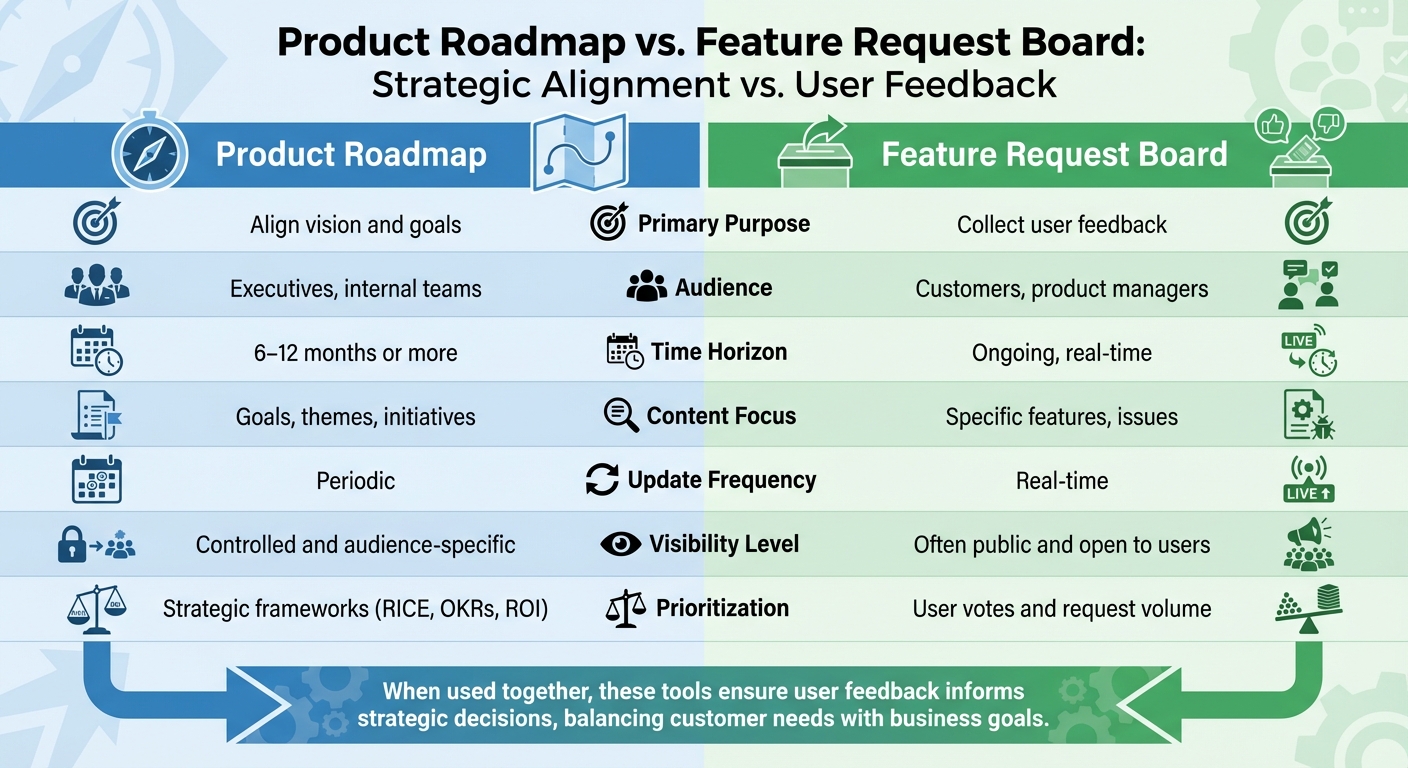
| Primary Purpose | Align vision and goals | Collect user feedback |
| Audience | Executives, internal teams | Customers, product managers |
| Time Horizon | 6–12 months or more | Ongoing, real-time |
| Content Focus | Goals, themes, initiatives | Specific features, issues |
| Update Frequency | Periodic | Real-time |
When used together, these tools ensure user feedback informs strategic decisions, balancing customer needs with business goals.
What is a Product Roadmap?
A product roadmap is a strategic guide that lays out the vision, direction, and progress of a product over time. Think of it as a visual plan that not only charts the product’s future but also explains the reasoning behind its development. Unlike a simple features list, a roadmap connects your work to larger business goals, making it a powerful communication tool.
It serves as a shared reference point for teams across engineering, marketing, sales, and leadership, ensuring everyone is aligned on priorities and long-term plans. Brian de Haaff, Co-founder and CEO of Aha!, captures this idea well: “When there are many paths you can take, you need guardrails to keep you focused on the destination” [1].
What sets a roadmap apart is its focus on the "why" behind your work, not just the "what." Every feature or initiative should tie back to a strategic goal or business objective. This focus helps teams avoid unnecessary features and ensures time and resources are spent on what truly matters.
A roadmap isn’t static - it’s a living document that evolves as market conditions shift, customer feedback rolls in, or competitors change the landscape. Product consultant Rich Mironov explains, “I think of roadmaps as communication vehicles rather than decision vehicles... The roadmap is simply a reflection of [product strategy]” [3].
Main Elements of a Product Roadmap
A roadmap typically includes these key components:
- Goals: Specific, measurable objectives with clear success metrics.
- Initiatives: Broad focus areas that outline how your work supports those goals.
- Timeline: A visual layout of when key milestones or releases are expected. Teams often use flexible timeframes - like quarters or a "Now, Next, Later" framework - rather than rigid dates.
- Features and Releases: The functionality being built and the planned launches that deliver value to users.
- Epics: Larger projects that span multiple releases, broken down into smaller, actionable features.
- Dependencies and Risks: A clear understanding of how various tasks are interconnected and potential challenges that could delay progress.
Together, these elements provide a complete picture of what’s being developed, when it will be delivered, and why it aligns with overarching goals.
When to Use a Product Roadmap
A roadmap becomes essential when teams need to coordinate across different functions. Whether it’s engineering, marketing, sales, or support, everyone benefits from understanding how their work fits into the bigger picture.
Roadmaps are especially useful for products with long development cycles, as they help teams stay focused and track progress over months or even years. They’re also a critical tool when business priorities shift, ensuring everyone knows what’s changing and why. For executives, a roadmap offers a high-level overview that connects product efforts to company goals and performance metrics.
Tailor your roadmap to its audience. Executives might need a summary focused on goals and initiatives, while development teams often require more detailed information about features and dependencies. Build your roadmap after strategic product planning is complete - once you’ve defined what to deliver and when. For external or sales-facing roadmaps, consider using broader timelines to avoid overcommitting to specific deadlines. Regular updates keep the roadmap accurate and ensure it remains a reliable source of truth.
Next, we’ll dive into the unique purpose of a feature request board.
What is a Feature Request Board?
A feature request board is a platform where users can submit, view, and vote on ideas for new features or product improvements. Think of it as a modern suggestion box that bridges the gap between users and product teams. Instead of feedback being scattered across emails, support tickets, or social media, it brings everything together in one organized place.
One of its standout benefits is the transparency it offers. With status updates and community voting, users can see how their suggestions are being considered. Product teams can use labels like "Under Consideration", "Planned", or "Done" to show progress, closing the loop and proving that user input directly shapes the product.
"The most substantial benefit of the feature request process is that it creates an open connection to your customers. Through this connection, your team can encourage users to make their voice heard and deepen their relationship with - and investment in - your product" [5].
Despite 80% of product managers valuing customer feedback, only 14% have systems in place to effectively gather it [6]. A feature request board solves this problem by giving teams a structured way to collect and organize feedback at scale.
Main Elements of a Feature Request Board
A feature request board is built around several essential components, each designed to streamline feedback collection and prioritization.
Idea Submission: This is where it all starts. A simple form lets users describe their problem or propose a solution. It captures both the "what" and the "why" behind their needs.
Voting System: Users can upvote or "like" ideas, providing a clear signal of demand. This helps teams identify the most popular requests quickly.
Comments and Discussion Threads: Each idea comes with a space for discussion, allowing users to share specific use cases while teams can ask follow-up questions to dig deeper.
"This is something that's not just the support agent experiencing this, but we've seen it across 20 or 30 people. So the voting has been super helpful too" [2].
Status Labels: Transparency is key. Tags like "Under Consideration", "Planned", or "Done" keep users informed about the progress of their requests. Even a clear "no" can build trust by showing decisions are being made.
Categories and Tags: These labels (e.g., "UI", "Integration", "Mobile") help group feedback by theme, making it easier to sort and filter. Some boards even allow segmentation by customer type (e.g., free vs. paying users) or revenue impact to align feedback with business priorities.
| Element | Description | Purpose |
|---|---|---|
| Idea Submission | A form for users to describe a problem or suggest a solution | Captures the "what" and "why" of user needs |
| Voting System | Upvoting or "liking" functionality for existing ideas | Measures demand and highlights key trends |
| Comments | A discussion thread attached to specific requests | Adds context and specific use cases |
| Status Labels | Tags like "Under Consideration", "Planned", or "Done" | Communicates progress and closes the feedback loop |
| Categories/Tags | Organizational labels (e.g., "UI", "Integration", "Bug") | Helps sort and filter feedback by theme |
Understanding these elements makes it easier to see how and when to use a feature request board effectively.
When to Use a Feature Request Board
Feature request boards shine when you need to gather input from a large user base and identify what matters most to them. They’re particularly useful when feedback is scattered across multiple channels, like support tickets, social media, or sales calls, and you need a centralized system to organize it all.
These boards also foster a sense of community. When users see their ideas being considered - or even implemented - it shows that their opinions carry weight. For example, GiveButter used its feature request board to prioritize an "Auctions" feature, which attracted over 600 votes.
"We assigned the effort score and strategic importance to achieve a more balanced ranking for our roadmap" [2].
Feature request boards are also a practical solution to common challenges. Nearly half (49%) of product managers struggle with validating whether the market truly needs what they’re building [7]. For enterprise software managers, this figure jumps to 62% [7]. These boards can help address this gap by offering clear insights into user needs. Plus, they can reduce support volume - when users can track the status of their requests, they’re less likely to reach out for updates. Features like Single Sign-On (SSO) make submitting ideas even easier, while merging duplicate requests keeps feedback organized and actionable.
Main Differences Between Product Roadmaps and Feature Request Boards
Each tool plays a unique role: the roadmap focuses on strategy, while the request board gathers user feedback. A product roadmap serves as a strategic document, outlining the "why" and "what" behind your product's direction. It helps align the organization around long-term goals. On the other hand, a feature request board functions as an intake system, collecting user insights and specific functionality requests from customers and internal teams.
Roadmaps focus on high-level themes and business objectives, while feature request boards zero in on individual pain points and feature ideas. Think of the roadmap as your strategic guide and the request board as your listening hub. This distinction highlights how these tools complement each other.
"I think of roadmaps as communication vehicles rather than decision vehicles... The roadmap is simply a reflection of [product strategy]." - Rich Mironov, Product Consultant [3]
Their audiences are also different. Roadmaps are geared toward executives, cross-functional teams, and investors who need a clear view of the strategic direction. In contrast, feature request boards cater to customers, support teams, and product managers responsible for gathering and managing feedback.
Comparison Table: Product Roadmap vs Feature Request Board
Here’s a quick breakdown of their differences:
| Feature | Product Roadmap | Feature Request Board |
|---|---|---|
| Primary Purpose | Aligning strategy and communicating vision | Collecting user needs and feedback |
| Audience | Executives, cross-functional teams, and investors | Customers, support teams, and product managers |
| Time Horizon | Long-term (6–12 months or Now-Next-Later) | Ongoing and immediate |
| Content Focus | High-level themes, objectives, and outcomes | Specific features, bug reports, and pain points |
| Update Frequency | Periodic (weekly, monthly, or quarterly) | Real-time as feedback comes in |
| Visibility Level | Controlled and audience-specific | Often public and open to users |
| Prioritization | Strategic frameworks (e.g., RICE, OKRs, ROI) | Based on user votes and request volume |
How These Tools Work Together
The real magic happens when these tools are used together. Feature request boards capture raw, bottom-up insights from users, which product managers can analyze and prioritize for the roadmap. Once a feature progresses from the request board to the roadmap - or is shipped - updating its status closes the loop, showing users how their feedback shaped the product.
This closed-loop approach tackles a common challenge: 49% of product managers struggle to confirm whether their work aligns with market needs [7]. For enterprise software managers, that number rises to 62% [7]. By using the request board as a research tool, product managers can make evidence-based decisions for the roadmap. The request board signals demand, while the roadmap filters these signals through a strategic lens - ensuring you're not just building what's popular but what's aligned with your product's vision. Together, these tools help connect user insights with long-term business goals.
Using Product Roadmaps and Feature Request Boards Together
Improving Decision-Making and Prioritization
When used together, product roadmaps and feature request boards create a powerful combination that ensures user feedback informs strategic decisions. Effective product teams don’t pick one tool over the other - they leverage both to balance user needs with business goals. The feature request board captures the "what" (specific user needs and pain points), while the roadmap focuses on the "why" (strategic goals and desired outcomes). This approach avoids the pitfall of becoming a "feature factory", where popularity alone drives decisions.
To make this process even more effective, segment feedback based on customer value. For example, feedback from high-value enterprise customers should be weighted differently than input from free-trial users. By linking your feature requests to metrics like Monthly Recurring Revenue (MRR) or opportunity value through your CRM, you can anchor roadmap decisions in concrete data rather than intuition.
Organize similar feature requests under broader strategic outcomes, such as "Increase Power User Retention by 20%." This ensures that even highly requested features align with your business direction.
"Feature roadmapping adopts a predefined prioritization method, not responsive to the goals and needs of the company or market. Outcome-based OKR roadmapping adjusts priority and focus based on the business and market needs." – Becky Flint, CEO of Dragonboat [8].
Frameworks like RICE (Reach, Impact, Confidence, Effort) provide an objective way to score and prioritize features. This removes subjectivity from the decision-making process and helps you clearly explain why certain popular requests might not fit the current strategy. The feature request board highlights demand, but the roadmap ensures those demands are filtered through a strategic lens, so you’re building what truly matters.
Next, let’s explore how Modu’s tools simplify this process.
Using Modu's Tools for Better Integration
Modu offers a seamless way to connect feedback with execution through its Suggestions and Roadmap modules. With the Suggestions board, users can submit ideas and vote on existing ones. As patterns emerge, approved ideas can be promoted directly to the Roadmap module, linking user feedback to your strategic goals.
The roadmap itself is organized into four clear status tabs - Backlog, Planned, In Progress, and Shipped - giving everyone visibility into the progress of each feature. When a feature is marked as "Shipped", stakeholders who interacted with the original suggestion receive updates, showing how their input influenced the product. This transparency builds trust and keeps users engaged.
A practical example of this approach comes from Mercury, a financial technology company. In 2022, they replaced scattered feedback across Notion and Linear with a unified voting board. According to Senior Product Designer Ida Ström, the voting system uncovered patterns where a single support ticket represented an issue affecting 20 to 30 users. This level of visibility made it easier to justify roadmap decisions [2].
Modu’s Growth plan adds even more efficiency with AI-powered clustering, which automatically groups similar suggestions to help you identify trends faster. Feedback data can also be exported to integrate with prioritization frameworks like RICE or value–effort matrices. Additionally, integrations with tools like Jira, Linear, Trello, and ClickUp allow approved roadmap items to automatically generate tasks in your development workflow, eliminating the need for manual data entry.
To avoid overwhelming stakeholders, Modu’s board-level access controls provide tailored views for different audiences. For example, you can share a public roadmap with customers to foster transparency while keeping internal boards detailed with effort estimates and revenue projections for executive review.
Conclusion: Selecting the Right Tool for Your Needs
Understanding the distinct roles of these tools is crucial for aligning user feedback with your broader goals. Product roadmaps and feature request boards each serve unique but complementary purposes. Roadmaps outline your strategic vision and the reasoning behind product decisions, often covering months or even years [4][9]. On the other hand, feature request boards focus on capturing user needs and specific challenges, providing actionable insights into what matters most to your customers [2].
A product roadmap is ideal when you need to align your team around long-term objectives, gain executive support, or share release plans with departments like sales and marketing [4][10]. It acts as a guiding framework, helping everyone focus on achieving larger outcomes rather than getting lost in individual features. Meanwhile, a feature request board is best for validating fresh ideas, spotting recurring customer pain points, and improving transparency by making user feedback visible [2]. Together, these tools create a balance of customer-driven insights and strategic foresight.
It's important to treat the feature request board as a source of inspiration, not a rulebook. As Brian de Haaff, CEO of Aha!, puts it:
"Vision, strategy, and roadmaps build upon one another - you need all three to create winning plans and realize your goals" [4].
FAQs
How do I turn votes into roadmap priorities?
To transform votes into actionable roadmap priorities, start by diving into user and stakeholder feedback to pinpoint the features with the most demand. But don’t just focus on the number of votes - factor in things like how well a feature aligns with your strategy, the effort it will take to develop, and the potential impact it could have. Prioritization frameworks can be super helpful here, giving you a structured way to make decisions.
Make sure to keep users in the loop by sharing updates on how their input is influencing the roadmap. This not only builds trust but also ensures your priorities stay in sync with both user expectations and your broader goals.
What should never go on a public roadmap?
Sensitive, confidential, or private customer information has no place on a public roadmap. Including such details could jeopardize privacy and security, creating risks for both your organization and your customers.
How often should I update each tool?
The frequency of updates varies depending on the tool's purpose. For instance, a product roadmap should be updated whenever necessary to reflect shifts in strategy, emerging market trends, or new customer feedback. This ensures it remains aligned with overarching goals.
On the other hand, a feature request board typically requires more frequent updates - weekly or bi-weekly works well. Regular updates help capture ongoing user input and voting, enabling teams to prioritize features based on the most current feedback.