
Public Roadmaps: Setting Clear Expectations
Public Roadmaps: Setting Clear Expectations
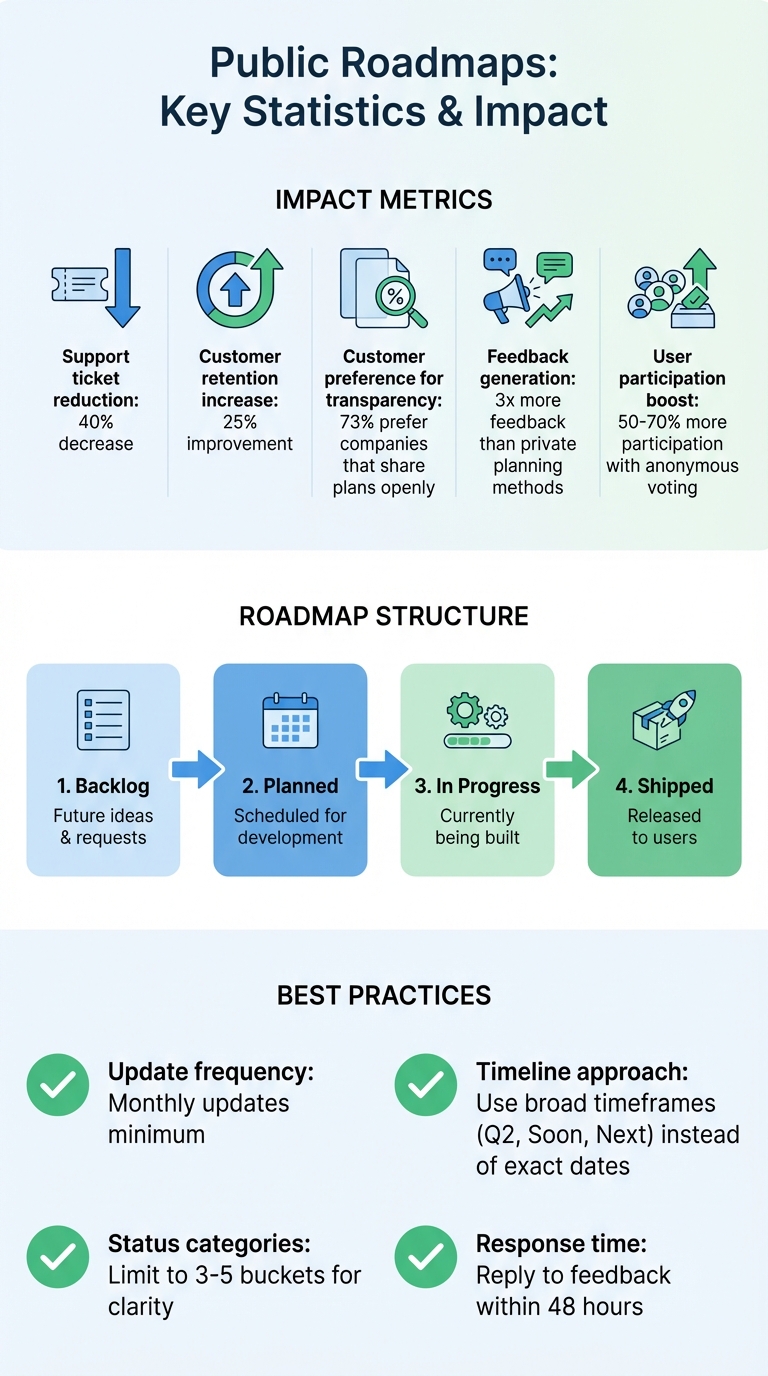
Public roadmaps help businesses communicate product plans transparently while managing customer expectations. They focus on high-level goals and outcomes rather than technical details, offering clarity through categories like "Planned", "In Progress", and "Shipped." This approach builds trust, reduces support tickets by up to 40%, and increases customer retention by 25%.
Key takeaways:
- Transparency builds trust: 73% of customers prefer companies that share plans openly.
- Clear structure matters: Use categories like "In Progress" and "Planned" to simplify updates.
- Regular updates are essential: Monthly updates keep users informed and engaged.
- User feedback drives improvement: Tools like voting systems ensure customer needs shape the roadmap.
Best Practices for Building Effective Product Roadmaps
Core Components of a Clear Public Roadmap
When it comes to transparency, a well-structured public roadmap is key. It not only builds trust but also sets clear expectations for users. Without a solid structure, users can easily lose track of progress and feel disconnected.
Clear Status Categories and Priorities
One of the simplest ways to make your roadmap user-friendly is by organizing items into clear status categories. The most effective roadmaps typically include four main stages: In Progress, Planned, Backlog, and Shipped. These categories answer the essential questions: What's happening now? What's coming next? What's already done?
Using flexible labels can help manage user expectations while giving your team the freedom to adjust as needed [6]. This level of clarity not only improves communication but also encourages user engagement. In fact, public roadmaps often generate three times more feedback than private planning methods [1].
But categorization alone isn’t enough. Adding precise details and realistic timelines ensures users understand what’s happening and when.
Detailed Descriptions and Timelines
Every roadmap item should be clear and to the point. Start with a concise title (about 50–60 characters) and follow it with a short description (150–160 characters) that explains the problem being addressed. Focusing on the problem rather than technical specifics makes the roadmap accessible to all users, not just those with technical expertise.
Timelines can be tricky. Instead of committing to exact dates, use broader timeframes like "Q2" or "Soon" to avoid disappointing users if delays occur. Regular updates - whether monthly or bi-weekly - show users that progress is being made and help maintain their trust. Consistency here can be the difference between a roadmap that reassures users and one that leaves them frustrated.
The presentation of these details is just as important as the content itself.
Easy Navigation and Design
A roadmap should be easy to navigate and understand. Features like filtering options, search functionality, and mobile-friendly design make it simple for users to find the information they need [2].
Language plays a big role too. Avoid technical jargon and focus on explaining the "why" behind each item and its benefit to the user [2]. This approach keeps things clear and relatable. Additionally, consider how users interact with your roadmap. For example, tools that allow anonymous voting tend to see 50–70% more participation compared to those requiring account creation [1]. Reducing barriers to engagement can significantly increase user involvement.
Using Modu's Roadmap Module
Modu's Roadmap Module simplifies the way teams communicate product plans, making it easier to align with both team goals and user expectations.
How Modu's Roadmap Module Works
Modu categorizes roadmap items into four distinct status groups: Backlog, Planned, In Progress, and Shipped. Each item can include optional ETA tags like "Soon", "Q3 2026", or "Next", which help set expectations without committing to overly rigid timelines.
One standout feature is how Modu incorporates user feedback directly into the roadmap. For instance, when TinyMCE's Product Manager Fredrik Danielsson and Head of Product Roman Khudonogov were developing the Merge Tags plugin, they shared mockups in the "In Progress" section. This led to over 300 user insights that directly influenced the final design. This closed-loop process shows how user feedback can translate into meaningful product updates, fostering transparency and collaboration.
Modu also integrates seamlessly with tools like Jira, Linear, Trello, and ClickUp. For example, when a Jira issue is marked as "Done", Modu automatically updates the corresponding roadmap item to "Shipped" and notifies users who voted on it. This automation ensures your roadmap stays accurate and keeps stakeholders informed, building trust through consistent and timely updates.
Customizing Your Roadmap
Modu allows you to fully tailor your roadmap to suit your brand and access needs. You can tweak themes for brand consistency, embed the roadmap directly on your website, and set access permissions such as public visibility, password protection, or Single Sign-On (SSO) for internal use. These options offer flexibility while safeguarding sensitive plans.
GiveButter's Director of Product, Jesse Sandala, used these customization tools to highlight a feature request that received over 600 votes. After weighing the vote count against internal effort scores and strategic goals, the team added the feature to their public roadmap with a "Planned" status and a "Q2 2026" ETA label. This example illustrates how Modu helps teams balance data-driven prioritization with clear communication, ensuring user input shapes the roadmap in a meaningful way.
Adding User Feedback to Your Roadmap
Incorporating user feedback into your roadmap transforms planning into a more informed and collaborative process. Modu's Suggestions module allows users to submit ideas and vote on each other's requests. The most popular suggestions can then be promoted to the roadmap, making prioritization more measurable and transparent.
For instance, Mercury's Senior Product Designer Ida Ström found that a single support request often represented the needs of 20 to 30 other users. By leveraging Modu's voting system instead of relying on scattered feedback from multiple tools, the team gained actionable, quantifiable data to justify roadmap decisions. This approach not only ensures user feedback is heard but also shows users how their input directly shapes the product, fostering trust and strengthening community engagement.
How to Maintain Your Public Roadmap
Update Regularly and Communicate Changes
An outdated roadmap can quickly erode user trust. To keep users engaged and show consistent progress, aim to update your roadmap at least once a month [1]. Regular updates signal that your team is actively working on delivering value, not just making empty promises.
When timelines shift, it’s crucial to communicate those changes immediately - don’t wait until the next scheduled update [7]. Be transparent about why the change is happening. Tom Redman, Head of Product at Buffer, explains their approach:
"At Buffer, we're 'transparent by default.' That is, if we don't have a compelling reason for something to be private, it'll be shared transparently" [8].
Even when the news isn’t what users want to hear, this level of openness builds trust.
Using tools like Modu, which integrates with platforms such as Jira, Linear, and Trello, can simplify this process. These integrations allow roadmap updates to sync automatically when tasks are marked complete, and they even notify users who voted on specific features. Automation like this ensures your roadmap stays accurate and up-to-date without requiring extra manual effort.
Balance Openness with Flexibility
Transparency doesn’t mean locking yourself into rigid deadlines. Instead of committing to specific dates, use broader timeframes like "Q2 2026" or "Next" [1][7]. This approach communicates priorities while leaving room for adjustments if technical hurdles or market shifts occur.
As moo-tetsuo, a product management expert, puts it:
"Roadmaps are never commitments, they are indicators of strategic themes of what you plan to invest in and most importantly, why" [10].
Focus on overarching themes and user outcomes rather than getting bogged down in technical details. This keeps users informed about your direction without revealing sensitive information or creating unrealistic expectations.
If priorities change, make sure to follow up with users who have shown interest in specific features through votes or comments. Explain why the shift happened - whether it’s due to a technical challenge, a more pressing customer need, or a strategic pivot. Eric Hoppe from Canny highlights the importance of this:
"Hearing a clear 'no, we aren't working on that right now' is better than not knowing" [8].
By being upfront about changes, you can strengthen user relationships and maintain trust. This approach allows your roadmap to adapt naturally while staying aligned with your goals.
Set Realistic Expectations
Transparency and flexibility mean little without realistic expectations. Overpromising and underdelivering is one of the fastest ways to lose user trust. Before adding anything to your roadmap, verify timelines with your development team and factor in testing, setbacks, and other ongoing projects [9].
Using status-based categories like "Backlog", "Planned", "In Progress", and "Shipped" can help manage expectations better than date-based commitments. This Kanban-style method lets users see progress as features move through your development cycle without tying you to specific delivery dates [1]. For example, when a feature transitions from "Planned" to "In Progress", users can see tangible progress without feeling misled if the timeline shifts.
Setting achievable goals shows respect for your users’ time and investment in your product. As Tim Soulo, CMO of Ahrefs, explains:
"If our competitors want to focus on what customers request from us instead of what their customers request from them - it's their choice" [8].
Confidence in your roadmap comes from knowing it reflects both your strategy and your team’s capabilities.
Common Problems and Solutions
Building a transparent roadmap can be tricky, but addressing common challenges head-on makes a big difference.
Handling Conflicting User Requests
When users have conflicting opinions about what features should come next, votes alone don't tell the whole story. For example, a feature with 200 votes might seem like the obvious choice, but those numbers don’t explain why users want it or how it aligns with your product's overall strategy.
The key is to combine vote counts with qualitative insights. User interviews, usability testing, and diary studies can reveal the real needs behind the requests [3]. A prioritization framework can help you cut through the noise and make better decisions:
| Prioritization Factor | Description | Purpose |
|---|---|---|
| Effort Score | Estimated developer hours or complexity | Highlights resource-heavy requests |
| Strategic Importance | Alignment with the product's core vision | Keeps the product focused |
| Financial Impact | Potential to reduce churn or grow revenue | Targets high-value business opportunities |
| User Sentiment | Vote counts and user ratings | Measures overall demand |
Using this framework ensures your decisions balance user needs with business priorities. When you pick one direction over another, explain your reasoning directly on the roadmap. Even if users don’t get their preferred feature, they’ll often appreciate the transparency.
Once you’ve clarified conflicting requests, the next step is creating a roadmap that’s clear and user-focused.
Keeping Your Roadmap Focused
A transparent roadmap only works if it’s easy to understand. Overloading it with unnecessary details confuses users and weakens your message. Start by removing internal noise - items like backend tasks, technical debt, security updates, and minor bug fixes don’t belong on a public roadmap [3][11][4]. While these are critical for your team, they don’t help users see where the product is headed.
Keep your roadmap simple by limiting status categories to 3–5 buckets, such as "Under Review", "Planned", "In Progress", and "Shipped" [1][11]. If your product covers multiple areas, use swimlanes to group features by themes or customer segments. Adding filters also allows users to focus on what matters most to them [1].
This streamlined approach doesn’t just look better - it also reduces repetitive support tickets by up to 40% [1]. When users can easily find answers to questions like "When will you add X?" they’re less likely to contact support, freeing your team to focus on development instead.
Keeping Users Engaged
A roadmap that isn’t regularly updated risks becoming irrelevant. To keep users interested, respond to feedback within 48 hours [2]. Quick replies show that you’re listening and value their input.
Transparency in status updates encourages users to check back often. For example, when features move from "Planned" to "In Progress" to "Shipped", users can see real progress [1][5][11]. Pairing your roadmap with a changelog is another great way to celebrate completed work. This approach closes the feedback loop and reminds users that their contributions lead to actual results.
Consistent communication builds trust and reinforces the transparency you promised. Over time, this drives higher user engagement. When people feel heard and see steady progress, they’re more likely to become active supporters of your product’s growth.
Conclusion
Throughout this guide, we've highlighted the importance of creating clear, transparent roadmaps to align product strategy with customer expectations. Public roadmaps, in particular, open the door for meaningful collaboration between companies and their customers. By sharing what you're working on and explaining the reasoning behind those decisions, you establish a central source of truth. This approach reduces confusion and fosters genuine trust. Plus, public roadmaps can boost customer retention, lower support ticket volumes, and even improve conversions [1].
"The public roadmap is a place for conversation, both internally and externally with prospects, customers, and users. It's a place where we can collect and structure feedback, but also publish new ideas and have a conversation with our community about them." - Roman Khudonogov, Head of Product and Design, Tiugo [12]
Incorporating user feedback into your roadmap transforms customers from passive users into active participants in your product's journey. This sense of involvement often turns them into enthusiastic advocates for your brand. To achieve this, keeping your roadmap up-to-date is non-negotiable.
Regular updates are key. Make it a priority to refresh your roadmap consistently, communicate changes openly, and focus on what truly matters to your users. A well-maintained roadmap not only steers development but also paves the way for long-term, collaborative success.
FAQs
What should be included (and excluded) on a public roadmap?
A public roadmap serves as a great way to keep users informed about key features and initiatives - whether they’re in progress, planned, or recently launched. It helps set clear expectations while offering a glimpse into what’s being prioritized. Including sections for feature requests under review and current development efforts can also show users that their feedback matters and give them insight into what’s actively being worked on.
That said, it’s important to steer clear of sharing sensitive details. Avoid specifics like exact launch dates, untested experiments, internal metrics, or anything related to security. Instead, stick to broad timeframes like "Q1" or "Coming Soon" to keep things flexible while still providing a clear overview.
How often should we update a public roadmap?
Regular updates to your public roadmap are essential for maintaining trust and transparency with your audience. The timing of these updates often depends on your product development cycle. A good rule of thumb is to revise the roadmap after major milestones - like finishing a significant feature or adjusting priorities.
Many teams choose to update their roadmaps on a monthly or quarterly basis. This frequency helps ensure users remain informed without overwhelming them with constant changes. The most important thing? Syncing updates with your development pace so the roadmap stays accurate and truly reflects your plans.
How do we share timelines without making promises?
When sharing timelines without committing to specific promises, aim for transparency and flexibility. Instead of fixed dates, use broader timeframes like "Now," "Next," or "Later" to manage expectations effectively. Make it clear that plans are subject to change and include disclaimers stating the roadmap reflects current priorities rather than firm guarantees. This strategy helps build trust, keeps accountability intact, and ensures stakeholders recognize that the roadmap can adjust as circumstances evolve.