
Ultimate Guide to Real-Time Satisfaction Tracking
Ultimate Guide to Real-Time Satisfaction Tracking
Real-time satisfaction tracking collects customer feedback immediately during or after an interaction. Unlike delayed surveys, it captures accurate, detailed responses before memories fade. This approach helps businesses quickly address issues, improve customer experiences, and boost retention.
Key Takeaways:
- Why it matters: Real-time feedback leads to better insights, faster problem resolution, and stronger customer loyalty.
- Benefits: Companies using real-time tracking report 62% higher revenue growth and up to 95% profit increases with small retention gains.
- How it works: Tools like microsurveys, live chat ratings, and AI analysis identify and resolve pain points in the moment.
- Metrics to track: CSAT (short-term satisfaction), NPS (long-term loyalty), CES (task ease), and sentiment analysis.
Real-time tracking is a proactive feedback system that helps businesses stay ahead by acting on customer input as it happens.
Customer Satisfaction Isn’t a Guess - Here’s How to Track It Right - The Daily Dose | Ep627
Benefits of Real-Time Satisfaction Tracking
Real-time satisfaction tracking is changing the way businesses connect with their customers. Instead of waiting weeks for survey results, you gain instant feedback on what’s working and what needs improvement. This shift from reacting to problems after the fact to addressing them in real time helps businesses deliver better service and achieve measurable results. Here’s how real-time tracking improves customer insights and overall satisfaction.
Better Customer Insights
When feedback is captured immediately, it’s more accurate and detailed because it reflects customers' fresh experiences. Waiting too long can lead to distorted insights as memories fade [5].
Real-time tracking also uncovers issues that traditional surveys might miss. Take silent problems like confusing website navigation or slow-loading pages - these can frustrate users without ever generating a complaint ticket [3]. By monitoring user behavior and capturing reactions in the moment, businesses can identify these hidden pain points early and address them before they escalate. This kind of immediate feedback leads to a deeper understanding of customer needs and expectations.
Faster Problem Resolution
Speed matters when resolving customer complaints. Addressing an issue within five minutes can significantly boost customer loyalty [5]. Real-time tracking allows businesses to spot and fix issues quickly, often before they impact a large number of users [1].
A great example is Wahi, a real estate platform. By integrating their surveys with HubSpot, they updated customer profiles in real time, saving over 10 hours of work each week. This automation also enabled them to send more personalized and relevant messages (Survicate, 2024) [3]. The result? Faster responses, stronger customer relationships, and a more efficient workflow. These kinds of improvements naturally lead to better engagement with customers.
Stronger User Engagement
When customers see businesses acting on their feedback quickly, it builds trust. Real-time tracking creates a responsive feedback loop, making customers feel valued and heard. This, in turn, strengthens engagement and loyalty. In fact, real-time programs can increase retention by 10%, which often translates to profit growth of 25% to 95% [1][2].
The numbers back this up: companies that use real-time tracking report 62% higher revenue growth compared to those that don’t [2]. Additionally, businesses that focus on customer satisfaction are 60% more profitable than those that don’t [4]. Real-time satisfaction tracking isn’t just about collecting feedback - it’s about using that feedback to create products and experiences that keep customers coming back.
Key Metrics for Real-Time Satisfaction Tracking
Tracking the right metrics helps capture customer sentiment as it happens. Here are some key measures that provide insights into different facets of the customer experience:
Customer Satisfaction Score (CSAT) measures how happy customers are with a specific interaction. It’s typically gathered right after an event, such as completing a purchase, finishing a support chat, or trying out a new feature. The question is straightforward: "How satisfied were you with this experience?" Responses are often on a 1-to-5 scale, making it perfect for evaluating individual touchpoints [1][4].
Net Promoter Score (NPS) focuses on long-term loyalty by asking customers how likely they are to recommend your product or service. Unlike CSAT, which looks at immediate experiences, NPS measures brand loyalty over time. It’s often collected 30 days after signup or on a quarterly basis [1][3].
Customer Effort Score (CES) gauges how easy it is for customers to complete specific tasks. This is particularly useful during onboarding or when introducing new features. Low effort signals a smooth experience, while high effort highlights areas causing friction [3].
Sentiment Analysis Scores dive into the emotions behind customer feedback. While metrics like CSAT and NPS provide numerical data, sentiment analysis interprets the tone and language in open-ended comments, support tickets, and even social media posts. Many organizations use AI-driven sentiment analysis to gain deeper insights. As FeedbackRobot explains:
"AI sentiment analysis helps you read between the lines of customer feedback. It doesn't just count complaints; it uncovers how your customers feel" [4].
How Modu Powers Real-Time Satisfaction Tracking

Modu takes real-time tracking to the next level by integrating tools that capture feedback instantly. By combining quantitative scores and qualitative insights, the platform ensures you get a complete picture of customer satisfaction right when it matters most.
Using Rating Modules for CSAT and NPS
With Modu's Rating Modules, you can track satisfaction and loyalty metrics using a simple 1–5 scale. These modules can be embedded on websites, triggered as popups, or shared via direct links immediately after a key event. Whether it’s following a purchase, completing onboarding, or trying out a new feature, the timing ensures feedback is fresh and relevant.
The analytics dashboard organizes these ratings, making it easy to spot trends and identify areas needing attention. For example, if a particular feature consistently gets low scores, it will be flagged for review. Labels like "Very Unsatisfied" to "Very Satisfied" help maintain consistency in the data, which is crucial when paired with AI analysis. A low score combined with a specific comment is weighted more heavily, ensuring critical issues get addressed quickly.
Gathering Open-Ended Feedback with Text Modules
While Rating Modules provide an instant snapshot of satisfaction, Text Modules dive deeper into the "why" behind the numbers. These modules collect detailed feedback, such as bug reports or suggestions, which are visible only to administrators.
Combining Text Modules with Rating Modules offers a well-rounded approach. For instance, if a user leaves a low satisfaction score, you can follow up with an open-ended question like, "What could we have done better?" This pairing ensures your AI tools have the context needed to identify specific problems, not just general sentiment.
AI-Powered Trend Analysis
Modu's AI takes feedback analysis to the next level by clustering similar responses and prioritizing issues based on their impact. Available in the Growth Plan for $59/month, this feature doesn’t just count complaints - it identifies recurring themes. For example, if twenty customers mention "slow loading times" in different ways, the AI groups these comments together, helping you focus on what matters most.
This kind of analysis allows your team to act quickly and efficiently, addressing problems before they escalate into larger issues.
Integrations for Real-Time Notifications
To ensure your team stays on top of feedback, Modu integrates with tools like Slack, Jira, Linear, Trello, and Google Sheets. These integrations keep everyone informed and enable seamless action on customer feedback.
| Integration | Function | Benefit |
|---|---|---|
| Slack | Real-time notifications | Immediate updates on critical feedback |
| Jira / Linear | Automated task creation | Smooth transition from feedback to action |
| Trello | Visual task management | Easy tracking of improvement initiatives |
| Google Sheets | Data export | Advanced analysis and long-term reporting |
For example, a critical bug report or low satisfaction score can trigger a Slack notification, ensuring your team is alerted instantly. Feature requests gaining momentum can automatically generate Jira tickets or Linear issues, eliminating the need for manual data entry.
As Tim Jordan, Senior Manager of Customer Support at Cars.com, says:
"Numbers tell you what's happening. Comments tell you why."
These integrations help close the feedback loop quickly, enabling your team to address issues proactively and keep customers happy.
Best Practices for Real-Time Satisfaction Tracking
To truly make the most of real-time satisfaction tracking, you need more than just tools - you need a well-thought-out strategy. Timing, channel selection, and a mix of feedback types all play a role in capturing insights that are both actionable and meaningful.
Combine Multiple Feedback Types
Relying on just one feedback method gives you an incomplete picture. For example, quantitative metrics like CSAT scores can show what's happening, but you need qualitative insights from open-ended responses to understand why. Combining these approaches is key. Tools like Modu’s Rating Modules paired with Text Modules allow you to gather both the numbers and the narrative.
Take Greyhound in 2026 as an example. They used AI-powered tools to consolidate feedback from post-ride surveys, station reports, and driver evaluations. This streamlined their feedback analysis, cutting the process from several days to just minutes. With this system, station managers could address location-specific issues the same day they were flagged [3]. By merging different feedback types, they turned scattered data into actionable insights almost instantly.
Time Surveys Strategically
Timing matters when it comes to feedback. Immediate surveys capture the raw and authentic details of a user’s experience - details that might fade if you wait too long. For example, you can deploy surveys at friction points, like when a user abandons a page or struggles with a feature (e.g., repeatedly clicking the same button). Similarly, targeting users after they interact with a new feature or stop using one entirely can provide valuable insights [3]. The key is to gather feedback while the experience is still fresh in the user’s mind.
To make this even more effective, it helps to use a variety of channels for feedback collection.
Use Multiple Feedback Channels
Customers interact with your business across multiple platforms, so your feedback collection efforts should match that diversity. For instance, 41% of customers now favor live chat as their go-to communication channel [1]. This makes live chat an ideal spot to request satisfaction ratings immediately after resolving a support issue [3].
Think about key customer touchpoints - like onboarding, post-purchase moments, or feature interactions - and align your feedback collection efforts there [3][4]. You can embed Modu’s feedback modules directly on your website, trigger popups within your app, or send survey links via email. By meeting customers where they already are, you make it easier for them to share their thoughts without adding extra steps. This multi-channel approach ensures your feedback collection feels seamless and natural.
Real-Time Tracking vs Traditional Surveys
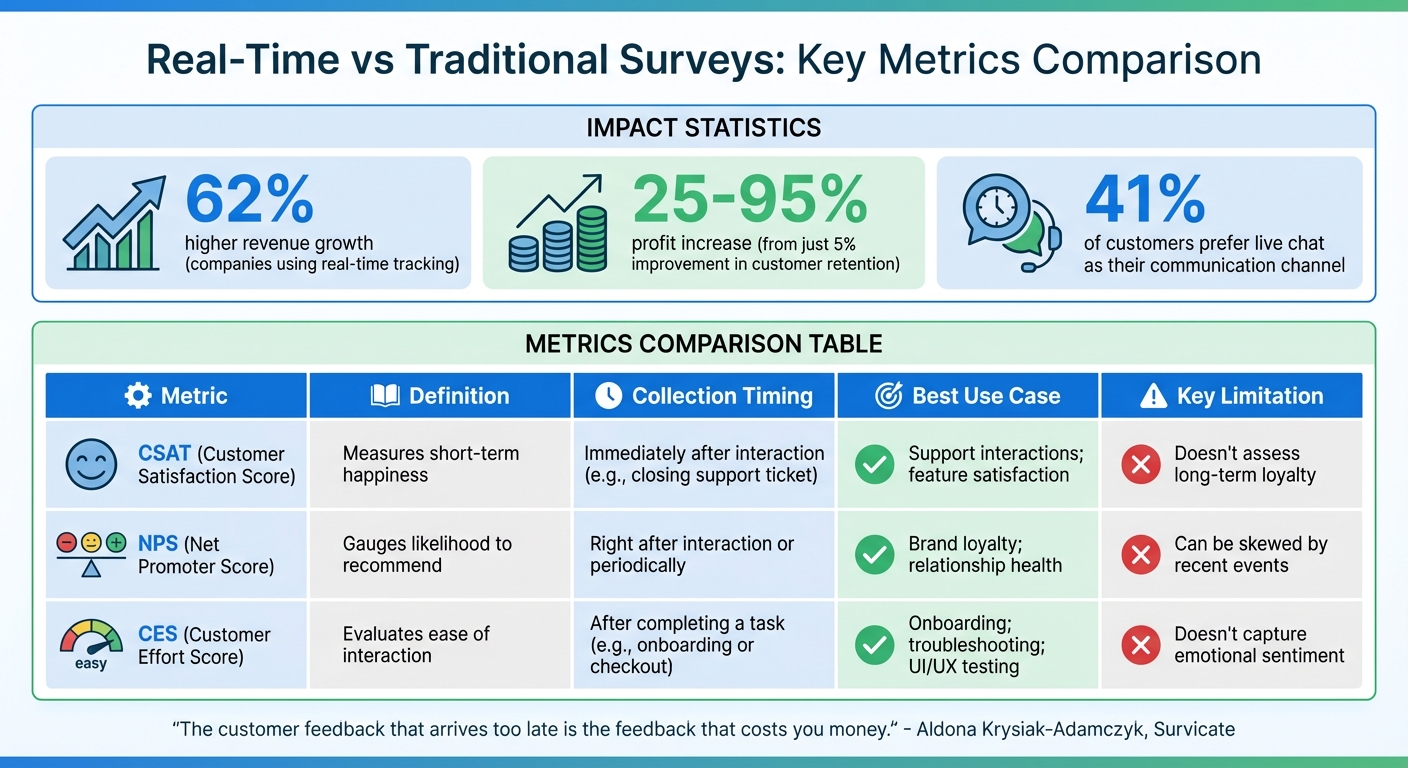
Real-time tracking gathers feedback immediately after an interaction - like a purchase or a support chat - while traditional surveys typically reach out days or even weeks later, when the experience is no longer fresh in the customer's mind [2]. This immediate approach captures detailed and accurate impressions, unlike feedback collected long after the event.
The timing difference is crucial. Companies using real-time tracking see 62% higher revenue growth compared to those relying only on delayed feedback [2]. It also acts as an early warning system, helping businesses address issues - like checkout errors - before they affect a larger group of customers [2]. Even a small improvement in customer retention, such as 5%, can lead to a massive profit boost of 25% to 95% [2], often thanks to immediate feedback loops.
Comparison of Metrics and Methods
Here's a breakdown of key metrics used in customer feedback and how they differ in timing, strengths, and best applications:
| Metric | Definition | Collection Timing | Pros | Cons | Best Use Case |
|---|---|---|---|---|---|
| CSAT | Customer Satisfaction Score; measures short-term happiness [1] | Immediately after interaction (e.g., closing a support ticket) [3] | Easy to answer; high response rates [3] | Doesn’t assess long-term loyalty [1] | Support interactions; feature satisfaction [1] |
| NPS | Net Promoter Score; gauges likelihood to recommend [3] | Right after interaction or periodically [1] | Provides a standardized benchmark for growth [3] | Can be skewed by recent events [6] | Brand loyalty; relationship health [3] |
| CES | Customer Effort Score; evaluates ease of interaction [3] | After completing a task (e.g., onboarding or checkout) [3] | Predicts future purchase behavior well [3] | Doesn’t capture emotional sentiment [6] | Onboarding; troubleshooting; UI/UX testing [3] |
Real-time tracking offers a constant flow of data, which can quickly overwhelm teams if not managed effectively [6]. Tools like AI sentiment analysis can help sort through the noise, prioritizing urgent issues - like billing errors - over general feedback. It’s essential to close the loop by informing customers when their input leads to improvements. This not only builds trust but also keeps them engaged [3]. Ultimately, timely insights are key to driving improvements and staying ahead in competitive markets.
Conclusion
Tracking customer satisfaction in real time isn't just a trend - it's a necessity to stay ahead. When feedback is captured as it happens, it provides insights that delayed surveys simply can't replicate [1][2]. Businesses using real-time feedback systems report 62% higher revenue growth, and even a modest 5% increase in customer retention can lead to profit gains ranging from 25% to 95% [2].
"The customer feedback that arrives too late is the feedback that costs you money." - Aldona Krysiak-Adamczyk, Senior Content Manager, Survicate [3]
The benefits are clear: acting quickly on real-time feedback allows businesses to turn insights into meaningful changes. Whether it’s fixing a checkout issue or smoothing out onboarding hiccups, real-time tracking works like an early warning system. And when customers see their feedback leading to real improvements, trust and loyalty naturally grow [3].
Modu simplifies this process. With its Rating modules for CSAT and NPS, Text modules for open-ended responses, and AI clustering to identify trends instantly, Modu lets you monitor satisfaction at crucial moments - like after a purchase or a support interaction. The results speak for themselves: Catapult cut its first reply time by 50% using automated triage [modu.io/blog/collect-user-feedback-proven-methods, 2025], and Motel Rocks boosted its CSAT by 9.44% after adopting real-time sentiment analysis [modu.io/blog/how-ai-enhances-feedback-analysis, 2026].
You can start small by focusing on one or two key touchpoints with Modu's Free plan. Or, for $59/month, the Growth plan unlocks unlimited boards and AI clustering. Investing in customer satisfaction can increase profits by 60% [4] - that’s the impact of real-time tracking done right.
FAQs
Where should I collect real-time feedback first?
Start gathering real-time feedback during critical moments in the customer journey - like when customers are using your product, interacting with customer support, or engaging with your website. These touchpoints offer a chance to capture genuine, immediate reactions, allowing you to act quickly, boost satisfaction, and demonstrate that customer opinions are valued. Using tools like in-app popups or feedback widgets can make this process smoother, delivering insights you can use to address problems and improve the overall experience.
How can I prevent my team from being overwhelmed by real-time feedback?
To keep things manageable, focus on feedback that matters most by considering both its urgency and potential impact. Look for actionable insights rather than trying to address everything at once. Tools like AI-driven analytics can help you spot patterns and trends, cutting down on the time spent sifting through data manually.
It’s also smart to set clear boundaries - like limiting how often updates are made or scheduling specific times for reviews. This helps maintain focus and avoids constant interruptions. Make sure your team concentrates on feedback that aligns with your key objectives, so resources are directed toward solving the most pressing issues effectively.
When should I use CSAT vs NPS vs CES?
CSAT (Customer Satisfaction Score) measures how satisfied customers are with a specific interaction, product, or service. It's typically assessed using a simple scale, such as 1-5 or 1-10, making it ideal for gathering immediate feedback.
NPS (Net Promoter Score) focuses on customer loyalty and their likelihood of recommending your brand to others. Customers rate this on a 0-10 scale, helping you gauge long-term brand sentiment.
CES (Customer Effort Score) evaluates how easy it was for customers to resolve an issue or complete a task with your company. This metric highlights potential friction points in the customer journey.
Each metric serves a unique purpose: use CSAT for short-term feedback, NPS for understanding loyalty, and CES to pinpoint and address areas where customers face challenges.