
Survey Incentives: Data-Backed Strategies for 2026
Survey Incentives: Data-Backed Strategies for 2026
Want higher survey response rates? Incentives are the answer.
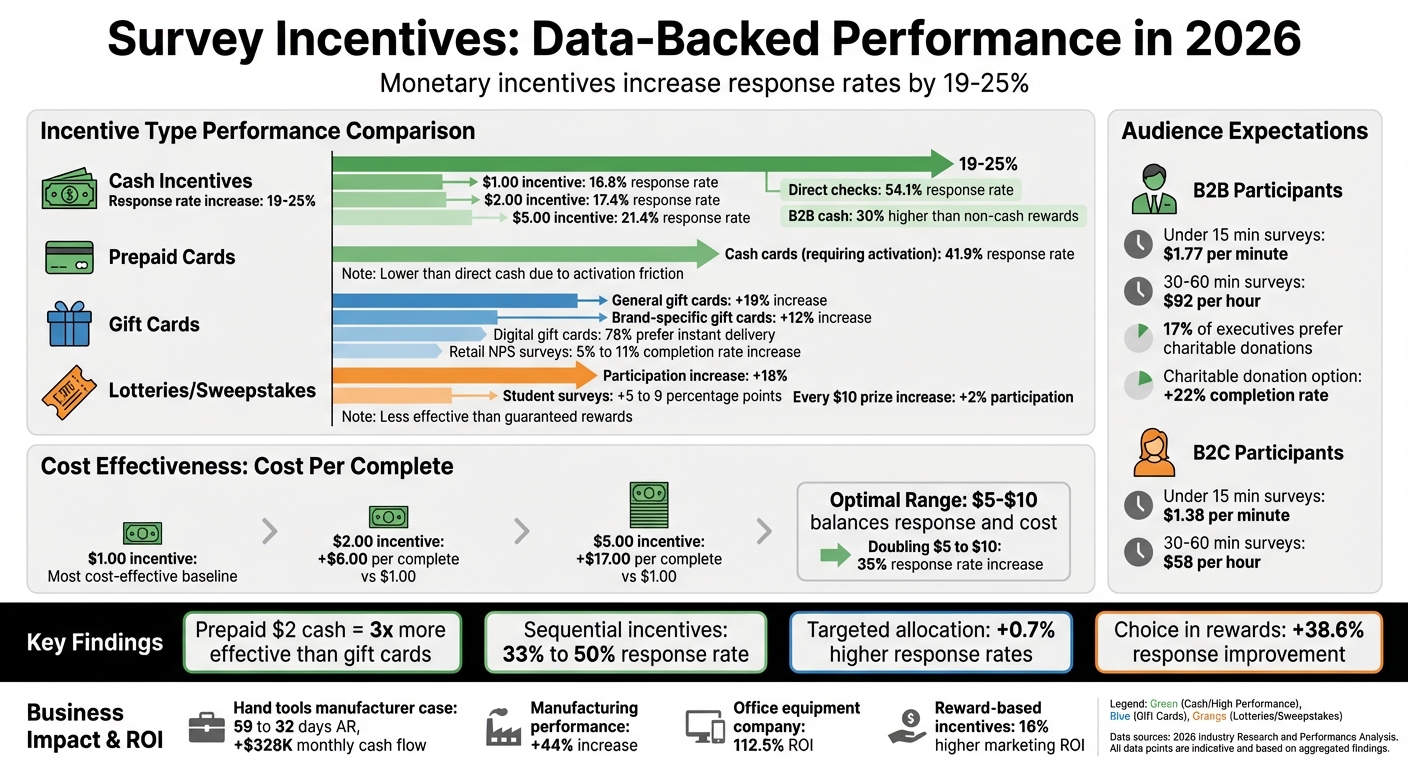
In 2026, survey fatigue is a real challenge, but offering rewards can increase participation by 19% to 25%. Cash works best, especially prepaid amounts like $2.00 or $5.00, which can double or even triple response rates compared to gift cards or lotteries. Tailoring incentives to your audience - like digital gift cards for younger participants or charitable donations for professionals - further boosts engagement.
Key findings:
- Monetary incentives outperform others: Cash increases response rates by up to 25%.
- Prepaid rewards work better: $2.00 upfront cash triples response rates over gift cards.
- Audience preferences matter: B2B participants expect ~$1.77 per survey minute; B2C expect ~$1.38.
- Lotteries are cost-effective: A $500 prize boosts participation by 18%.
The right incentive strategy can improve data quality, reduce costs, and even drive business outcomes like better cash flow or operational efficiency. Use automation to manage rewards, offer choices, and ensure transparency to keep participants engaged while meeting your research goals.
How Incentives Affect Survey Response Rates
Why Incentives Work
Offering an upfront reward taps into Social Exchange Theory, signaling trust and value while encouraging respondents to reciprocate [1][5]. Research shows that prepaid incentives outperform promised rewards because they remove any uncertainty about receiving the benefit [5][10]. For tech companies and SaaS platforms, incorporating gamification adds another psychological layer. Using progress bars and checklists, based on the Ovsiankina Effect, creates a strong urge to complete tasks once started. This approach has been shown to boost survey response rates by 22% when gamified elements are included [2].
"Providing meaningful incentives demonstrates to respondents that researchers understand the competing demands on their time and value their input." - Jared Coopersmith et al., Survey Practice [9]
These psychological principles are repeatedly reflected in response rate data, as shown below.
Response Rate Data by Incentive Type
The numbers back up how incentives drive higher participation. Monetary incentives consistently lead the pack, increasing response rates by 19% to 25% compared to surveys without any rewards [5][6]. Even small increases in incentive amounts can make a difference. For instance, raising rewards from $1.00 to $5.00 improves response rates from 16.8% to 21.4% [2]. However, this comes at a cost - offering $5.00 per respondent adds $17.00 more per completed survey compared to $1.00 incentives [2].
Cash incentives outperform gift cards significantly. In healthcare surveys, direct checks achieved a 54.1% response rate, while cash cards requiring activation lagged behind at 41.9% [2]. The reason? Direct cash avoids the friction of activation, making it simpler and more appealing. In B2B contexts, cash incentives drive 30% higher response rates than equivalent non-cash rewards [2]. On the other hand, lotteries offer a cost-effective option for large-scale surveys, boosting student response rates by 5 to 9 percentage points [2]. However, lotteries are less effective than guaranteed rewards when motivating individuals [6].
At the University of Virginia, targeted micro-incentives like $20–$100 gift certificates increased response rates to 51% for the National Survey of Student Engagement in 2016 [2]. The conclusion? Both the type of incentive and how it’s delivered can make a big difference - sometimes more than the dollar amount itself.
Cash and Prepaid Card Incentives
How Much Cash Works Best
When it comes to cash incentives, the data shows that increasing the amount does improve response rates, but not in a straight line. For instance, offering $1.00 results in a 16.8% response rate, bumping it to $2.00 nudges the rate to 17.4%, and $5.00 pushes it further to 21.4% [2]. However, these gains come with higher costs. Moving from $1.00 to $5.00 adds $17.00 per completed survey, whereas going from $1.00 to $2.00 only adds $6.00 [2].
For most surveys, offering between $5.00 and $10.00 strikes a balance between encouraging responses and managing costs [6][11]. Doubling the incentive from $5.00 to $10.00 can increase response rates by 35%, all while reducing the cost per completed survey [6]. On a tighter budget, a $1.00 incentive is still the most cost-effective choice [2]. Additionally, expectations vary depending on the audience: for B2B surveys under 15 minutes, participants tend to expect about $1.77 per minute, while B2C respondents expect around $1.38 per minute [7].
"Small incentives are most effective as monetary payments (e.g., cash) provided with the survey request (prepaid)." - Don Dillman, Professor and Leading Expert in Survey Methodology [5]
These findings highlight the importance of balancing incentive amounts with costs. While cash amounts directly impact response rates, understanding how cash compares to other options, like prepaid cards, is equally important.
Prepaid Cards vs. Cash
When it comes to prepaid cards versus cash, physical cash has the upper hand. Cash eliminates the activation steps required for prepaid cards, which can deter participants and lower response rates [2]. Including cash with survey requests also triggers a stronger sense of reciprocity compared to equivalent gift cards [2].
Electronic gift card codes often create confusion, as respondents may mistakenly believe they need to complete the survey before accessing the reward [9]. By contrast, cash or checks avoid this issue entirely. While prepaid Visa or Mastercard cards offer flexibility similar to cash [7], they lack the immediate, tangible impact that physical currency provides in encouraging participation [5][9].
Maximize Your Survey Response Rates: Expert Insights from Sheila B. Robinson
Gift Cards and Lottery Incentives
When it comes to encouraging participation, gift cards and lotteries are excellent alternatives to cash or prepaid incentives. The key is understanding your audience and aligning rewards with their preferences. Gift cards and lotteries offer flexibility and can effectively boost engagement.
General vs. Brand-Specific Gift Cards
Gift cards are a proven way to increase participation, but not all types perform equally. General-purpose gift cards, such as those for Amazon or Visa, often outperform brand-specific options because they give recipients the freedom to shop wherever they prefer. For example, in educational surveys, general gift cards increased response rates by 19%, while brand-specific cards saw only a 12% improvement [2].
The issue with brand-specific gift cards is that they may not appeal to everyone. A $10.00 gift card to a niche coffee shop, for instance, holds little value for someone who doesn’t drink coffee. On the other hand, digital gift cards offer an added advantage - they’re delivered instantly, eliminating any waiting period. In fact, 78% of focus group participants said they preferred instant digital delivery over receiving physical cards [12].
"A gift card to a niche retailer may have no value to participants who never shop there, effectively providing zero compensation despite the monetary amount."
– CleverX [12]
Digital gift cards have proven particularly effective in boosting survey engagement. For example, some retail brands have doubled their NPS survey completion rates, increasing from 5% to 11%, by offering digital gift cards [2]. The takeaway? Choose incentives that align with participants’ shopping habits rather than defaulting to popular brands.
Using Lotteries to Increase Participation
Lotteries are another effective way to motivate participants, particularly for large-scale surveys. Instead of rewarding every respondent, a lottery offers the chance to win a larger prize, such as a $500.00 Amazon gift card. This approach can increase participation odds by about 18% compared to offering no incentive at all [5].
Prize size plays a more critical role than the odds of winning. People are generally more drawn to a single, substantial prize than to several smaller ones. Research shows that for every $10.00 increase in prize value, participation odds rise by approximately 2% [5]. For instance, a retail survey in 2024 that featured an iPad giveaway saw an 18% jump in participation [1].
"The difference between one-in-three-million odds and one-in-three-hundred-million odds didn't matter, but the difference between a three-million-dollar jackpot and a three-hundred-million-dollar jackpot mattered enormously."
– New Yorker (cited by Tremendous) [5]
To maximize the impact of a lottery incentive, make it highly visible in your outreach efforts. For example, a subject line like "Win a $500.00 Amazon Gift Card" can boost response rates by 5 percentage points [5]. However, it’s essential to ensure compliance with local sweepstakes regulations and include all necessary legal disclaimers [3].
| Incentive Type | Response Rate Impact | Best Use Case |
|---|---|---|
| General Gift Card | +19% | Consumer feedback, retail surveys [2] |
| Brand-Specific Gift Card | +12% | Niche audiences with known preferences [2] |
| Lottery/Sweepstakes | +18% participation odds | Large-scale surveys with tight budgets [5] |
Advanced Incentive Strategies
Advanced methods for survey incentives focus on refining techniques like sequential rewards and tailoring incentives to specific demographics. These strategies aim to boost engagement while keeping costs manageable.
Sequential Incentives: Small First, Larger Later
Sequential incentives involve offering a small upfront reward followed by a larger bonus for completing the survey. This approach taps into the principle of reciprocity, encouraging participants to follow through.
Research highlights its effectiveness: pairing a $5.00 or $10.00 pre-survey payment with a $20.00 post-survey bonus for non-respondents can elevate response rates from about 33% to nearly 50% [5].
"Studies that have paired pre-and post-survey incentives have also shown success: prepayment builds legitimacy with potential survey participants, and then follow-up contact (with additional incentives) signal why the survey is important to the user or organization."
– Luke Strathmann, Tremendous [5]
Another proven method is the non-response conversion strategy. For example, in a study involving public school principals, a $25.00 prepaid incentive was offered to those who hadn't responded after 12 weeks. This follow-up effort raised response rates within this subgroup from 12.9% to 24.1% [9].
However, early bird incentives, while initially effective, can backfire. They tend to boost early responses but often lead to a drop in participation once the early reward period ends, as potential respondents feel they've missed out [9].
Beyond sequential incentives, tailoring rewards to your audience can further improve participation rates and make better use of your budget.
Matching Incentives to Your Audience
While sequential rewards can increase overall engagement, customizing incentives based on audience characteristics takes survey strategies to the next level.
Age plays a major role. Younger participants often prefer digital gift cards or streaming service vouchers, while older individuals are more inclined toward traditional cash rewards or charitable donations [4]. In professional settings, 17% of executives favor charitable donations made in their name over personal rewards, and offering this option can boost completion rates by 22% [6].
Cultural and ethnic factors also matter. For instance, increasing a reward from $2.00 to $5.00 led to an 8-point response rate increase among Black/African American households and a 7.3-point increase for Asian/Pacific Islander households, compared to a smaller 4% increase in the general population [2].
The value of the reward should align with the survey's effort. A quick five-minute survey might only require a $3.00 gift card, while a more in-depth questionnaire could justify a $10.00 reward or even a chance to win a high-value prize [1]. For example, in 2016, the University of Virginia achieved a 51% response rate on the National Survey of Student Engagement by combining targeted marketing with micro-incentives, offering gift certificates ranging from $20.00 to $100.00 [2].
A particularly efficient approach is targeted incentive allocation. Instead of offering the same reward to everyone, allocate higher-value incentives to groups less likely to respond. Government organizations using this method achieved response rates 0.7 percentage points higher than those using random distribution [2]. By focusing on harder-to-reach participants, this strategy ensures your budget is spent effectively, rather than over-rewarding those already inclined to participate.
Costs, Benefits, and ROI of Survey Incentives
Benefits and Drawbacks of Incentives
Survey incentives can have a significant impact on response rates and business outcomes, but they come with both advantages and challenges.
Research shows that incentives can boost survey participation by 19%, with small cash rewards increasing response rates by 10–20% [5][1]. These aren't just numbers on paper - they translate into measurable business improvements. For instance, in February 2026, a hand tools manufacturer used a points-based incentive strategy to drive better distributor behavior. This reduced accounts receivable from 59 days to 32 days, improving their monthly cash flow by approximately $328,000 [2]. Similarly, manufacturing teams offered incentives saw their performance increase by 44% [2].
Interestingly, incentives don't seem to harm data quality. Studies suggest they either have no negative effect or even improve quality by engaging more motivated respondents [2][5]. However, the logistical side can get tricky. Manual reward fulfillment can be a hassle, and over-reliance on incentives might lead respondents to expect compensation for every survey [1][7].
"Bad incentives for surveys = bad data."
– Liz Steelman, Senior Content Marketing Manager, User Interviews [7]
Another challenge is selection bias, where rewards attract specific demographics, potentially skewing your sample. In sensitive fields like finance, anonymity is crucial. The "two-survey method" can help here: one survey collects feedback anonymously, while a separate form gathers reward details, keeping the two unlinked [2].
Here’s a quick breakdown of the benefits, drawbacks, and possible solutions:
| Benefit | Drawback | Mitigation Strategy |
|---|---|---|
| 19% increase in response rates [5] | Attracts "satisfiers" who rush through | Use control questions to weed out low-quality responses [3] |
| Drives business outcomes like improved cash flow [2] | Creates expectation for future surveys | Mix up incentive types and limit frequency [4] |
| Builds trust with prepaid rewards [5] | Manual fulfillment is time-consuming | Automate rewards via digital platforms [7] |
| Reaches hard-to-engage groups [3] | Skews sample demographics | Target underrepresented groups with tailored incentives [2] |
While these qualitative factors are important, a deeper dive into ROI calculations can reveal the true value of survey incentives.
Calculating Incentive ROI
To measure the return on investment (ROI) for survey incentives, start with the basic formula: (Benefit of initiative – Cost of initiative) / Cost of initiative [2]. The challenge lies in quantifying benefits beyond participation rates.
For example, in early 2026, an office equipment company aligned survey responses with dealership data, achieving an impressive 112.5% ROI [2]. This approach focused on real business outcomes rather than just participation metrics.
One key metric to watch is cost per complete. A $1.00 incentive costs $6.00 less per complete than a $2.00 incentive and $17.00 less than a $5.00 reward, even though higher incentives like $5.00 yield better response rates (21.4% vs. 16.8%). However, higher response rates don’t always translate into better ROI, emphasizing the need for a balanced approach [2].
When budgeting, consider your audience and the complexity of your study. For instance, B2B unmoderated surveys cost $1.77–$2.13 per minute for studies under 30 minutes, while B2C rates are lower at $1.08–$1.38 per minute [7]. Proper compensation also reduces no-show rates. Remote interviews offering $160 per hour saw no-shows drop to just 1%, safeguarding the research investment [7].
In cases where traditional experiments aren’t practical, post-hoc ROI analysis can fill the gap. This involves matching survey responses with historical performance data to simulate control groups, helping isolate the impact of your incentive program [2].
How to Implement Survey Incentives
Aligning Incentives with Survey Goals
When designing survey incentives, it’s crucial to align their value with the survey’s length and the expectations of your target audience. For instance, B2B participants generally expect higher compensation per minute compared to B2C audiences. Research highlights that B2B professionals anticipate $1.77 per minute for short surveys (under 15 minutes), while B2C respondents expect $1.38 per minute. For longer surveys (30–60 minutes), the compensation jumps to $92 per hour for B2B participants versus $58 per hour for B2C studies [7].
The timing of incentives also plays a big role. Prepaid rewards often outperform promised ones because they build trust and encourage reciprocity. Studies show that combining an upfront prepaid incentive with a post-survey bonus can significantly improve response rates [5].
Offering choice in rewards can further increase engagement. Data from 2025 shows a 38.6% improvement in response rates when participants can select their reward [8]. In B2B surveys, giving respondents the option between a personal gift card or a charitable donation has been shown to boost completion rates by 22% [6]. These findings emphasize the importance of tailoring incentives to participants’ preferences.
Additionally, there’s a psychological factor when it comes to reward amounts. Incentives under $100 are often viewed as small treats (e.g., Amazon or Starbucks gift cards), while those over $100 lean toward practical options like Visa or Walmart cards. For rewards exceeding $500, luxury items or travel vouchers tend to be more appealing [8].
By aligning rewards with these preferences, you can maximize participation while ensuring your survey feels worthwhile to respondents.
Managing Incentives with Feedback Tools
Once you’ve determined the right incentives, managing them efficiently is the next step. Automation tools can simplify this process, handling everything from tracking to delivery. Modern survey platforms can integrate incentive workflows, ensuring rewards are automatically issued upon survey completion.
For example, you can use Modu’s Text and Rating modules to streamline reward distribution. A Text module can collect delivery information, such as email addresses for e-gift cards, directly within the survey. This keeps everything organized and ensures privacy for sensitive surveys [2].
It’s also important to set clear limits on budgets and respondent quotas to avoid overspending. If response rates are lower than expected, you can adjust incentive amounts mid-project or offer manual bonuses for particularly valuable feedback [7].
Transparency is critical. Clearly communicate the type of incentive, the exact dollar amount, and the delivery timeline (e.g., "delivered within 48 hours of completion") in your survey invitation [7]. Delivering digital rewards promptly not only enhances participant satisfaction but also increases claim rates [8].
Finally, implement quality control measures to weed out participants who rush through surveys just to claim rewards. As Liz Steelman, Senior Content Marketing Manager at User Interviews, aptly states:
"Bad incentives for surveys = bad data" [7].
Conclusion
Survey incentives are more than just a way to increase response rates - they’re a strategic tool for driving meaningful business results. The data from 2026 highlights a clear trend: prepaid cash incentives outperform promised rewards. For example, offering a $2.00 upfront cash incentive makes respondents three times more likely to complete a survey than providing a gift card of the same value [2]. By aligning incentive strategies with audience preferences and survey length, organizations not only see higher participation rates but also benefit from better data quality and stronger returns on investment.
This shift toward focusing on outcome-based ROI marks a major evolution in how companies evaluate success. Instead of simply tallying completed surveys, forward-thinking organizations now measure the broader business impact. Take the case of a hand tools manufacturer: by using targeted incentive programs, they reduced accounts receivable from 59 days to 32 days, improving monthly cash flow by nearly $328,000 [2]. This example underscores how well-crafted incentives can deliver financial results that go far beyond participation metrics.
In 2026, automation and instant delivery have become essential. Manual reward fulfillment not only frustrates participants but also creates unnecessary delays and inefficiencies. Digital rewards delivered within 24–48 hours improve participant satisfaction, increase claim rates, and streamline operations. As Liz Steelman from User Interviews aptly states: "Bad incentives for surveys = bad data" [7].
The most effective strategies combine data-driven insights with a deep understanding of the audience. Whether you’re offering $1.77 per minute to B2B professionals or tailoring other incentive models, success lies in aligning rewards with your goals and participants' expectations. Companies leveraging reward-based incentives report a 16% higher return on marketing investments compared to those relying on discounts or merchandise [2][13].
Ultimately, survey incentives should be treated as a core element of your research strategy, not an afterthought. Experiment with different approaches, track results beyond response rates, and refine your methods using real-world data. Organizations that strike this balance will not only gather better insights but also foster stronger connections with their audiences.
FAQs
How do I choose the right incentive amount for my survey length?
To choose the best incentive amount, think about things like how long the survey takes, who your audience is, and what will motivate them. Studies suggest that small, prepaid cash incentives tend to work well, particularly when they stand out and feel worthwhile to participants. Make sure the reward matches the effort needed to finish the survey.
When should I use cash vs. gift cards vs. a lottery?
When deciding on incentives, it all comes down to what you want to achieve. Cash tends to be the best option if you're aiming to increase response rates and reduce bias since it provides a guaranteed reward that appeals to most people. Gift cards are also effective, especially when offered in smaller guaranteed amounts, such as $5 or $10, making them a practical choice. On the other hand, lotteries can be a budget-friendly way to create excitement, but they usually don't perform as well as guaranteed incentives like cash or gift cards when it comes to boosting participation.
How can I prevent incentives from hurting data quality?
To ensure high-quality data, it's crucial to design incentives that promote honest responses while steering clear of bias. Offer rewards that are appealing but not excessive, as overly generous incentives can sometimes lead to insincere or rushed answers. Additionally, incorporate methods like attention checks or post-survey validation to verify the reliability of the responses. These steps help maintain the integrity of the collected data.